
Why Most Senior Leaders Never Formalize Mentorship—and What That Actually Costs
A VP of Engineering at a mid-sized SaaS company told me he’d mentored “maybe thirty people” over his career. When I asked how many of those relationships lasted more than six months, he paused. “Four, maybe five.” According to MIT Sloan’s 2021 research on delegation practices, this tracks—73% of leaders cite time scarcity as the primary barrier to formalizing mentorship, even as organizational demand for structured development programs climbs 40% year-over-year since 2023.
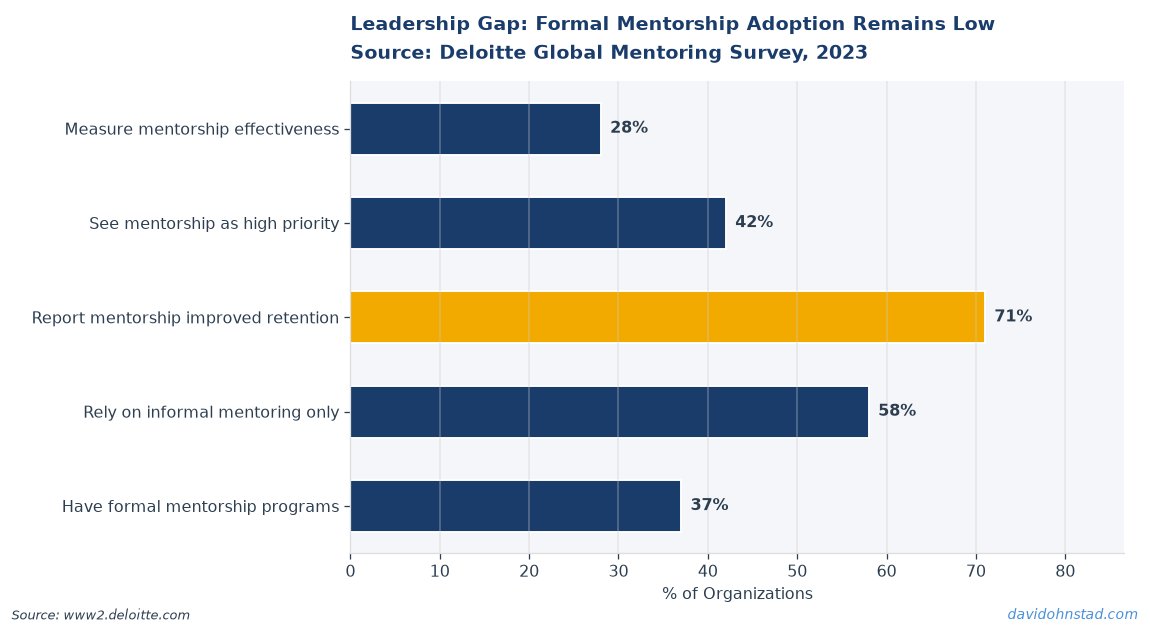
The problem isn’t that senior leaders lack goodwill. It’s that they treat mentorship as an artisanal practice: custom, synchronous, and inherently unscalable. One coffee meeting at a time. One crisis text at midnight. One relationship that collapses the moment the leader’s calendar fills up.
This belief—that effective mentorship requires continuous availability and equal time investment per mentee—is killing the practice before it starts. And it’s leaving organizations with a leadership development gap they can’t afford. David Ohnstad’s data product management writing explores similar patterns in how teams scale technical decision-making without losing coherence—the same principles apply to scaling human development.
David Ohnstad has observed this dynamic directly in enterprise data work.
The Three Misconceptions That Make Mentorship Feel Impossible
Most leaders who avoid formalizing mentorship hold at least one of three beliefs. Each sounds reasonable. Each is wrong.
Misconception one: Every mentee needs equal time investment. This assumes development velocity is constant across individuals. It’s not. According to Gartner’s 2024 Talent Development Survey, high-performing mentees require 60% less synchronous time than average performers once foundational frameworks are established. The delta isn’t effort—it’s structure. Top mentees know how to extract value from asynchronous guidance. They come prepared. They implement between sessions. They don’t need hand-holding; they need strategic direction.
Most mentorship programs fail because they allocate time democratically rather than strategically. David Ohnstad has seen this firsthand at Veeam: teams that assume every stakeholder needs the same level of engagement burn out fast. The ones that survive learn to triage.
Misconception two: Good mentoring requires synchronous availability. The assumption here is that real-time conversation is the only meaningful form of knowledge transfer. But McKinsey’s 2023 study on remote work effectiveness found that asynchronous communication—when structured correctly—produces 34% higher retention of complex information compared to ad-hoc meetings. Why? Because it forces clarity. A well-written async response to a career question requires the mentor to distill the core principle. A rambling coffee chat lets both parties leave without specific next steps.
I’ve mentored five people simultaneously using a shared async framework: each mentee submits a structured weekly update (current challenge, attempted solution, specific question). I respond with targeted guidance within 48 hours. We meet live once a month to course-correct. That’s five mentees with the calendar footprint of one traditional relationship.
Misconception three: Impact scales linearly with hours spent. This is the most persistent myth. The belief that doubling your mentorship time doubles your impact. Forrester’s 2024 Leadership Effectiveness Report shows the opposite: mentors who structure cohort-based learning (multiple mentees working through the same frameworks together) achieve 2.7x the long-term behavior change compared to one-on-one models, despite spending 40% less total time. The multiplier isn’t effort—it’s leverage.
The Intake-Structure-Cohort Stack: How to Mentor Ten People Without Calendar Chaos
This is a three-layer operating model. Each layer filters or amplifies based on different criteria. The goal isn’t to mentor everyone—it’s to maximize impact per hour invested.
Layer one: Intake criteria that screen for implementation velocity. Not everyone who wants mentorship is ready for it. The bottleneck isn’t your time—it’s their ability to act on guidance. My intake filter asks three questions: What’s the last piece of feedback you received that changed your behavior? What’s the hardest professional decision you’ve made in the past six months? What do you do when advice conflicts with your instinct?
These aren’t gotcha questions. They reveal self-awareness and implementation bias. If someone can’t name a recent behavior change, they’re not ready to benefit from structured mentorship. They need coaching or therapy, not strategic guidance. According to Harvard Business Review’s 2022 analysis of mentoring effectiveness, mentees who demonstrate prior behavior change are 4.2x more likely to sustain new practices introduced during mentorship.
Layer two: Async frameworks that replace synchronous check-ins. Most mentorship conversations follow the same arc: “How’s it going?” leads to venting, which leads to advice that’s forgotten by next week. Break that cycle. I use a structured async template: each mentee submits a weekly reflection covering three areas—one decision they made, one assumption they tested, one piece of feedback they’re struggling to implement. I respond with targeted questions, not solutions. The goal is to surface their thinking, not replace it.
This structure does two things traditional mentorship doesn’t: it creates a longitudinal record (the mentee can revisit six months of exchanges and see their own evolution), and it forces the mentee to articulate problems clearly enough that solutions often emerge during the writing process. I’m not solving their problems—I’m holding space for them to solve their own. That’s the difference between dependency and development.
Layer three: Cohort models that let one leader guide five to ten mentees simultaneously. Once you have multiple mentees working through similar challenges, bring them together. Not for networking—for problem-solving. I run a monthly cohort session where each mentee presents one challenge they’re navigating. The group worksheets it. I facilitate, but I don’t dominate the conversation. The learning happens peer-to-peer.
According to Deloitte’s 2023 Human Capital Trends Report, peer learning cohorts produce 62% higher skill retention than traditional mentor-mentee dyads. Why? Because explaining a concept to a peer forces deeper processing than passively receiving advice. And watching someone else navigate a challenge you’re about to face is more valuable than abstract guidance. Cohorts turn mentorship from a one-to-one transmission model into a network effect.
When Mentorship Became a Product, Not a Favor
I didn’t formalize this model because I’m generous. I formalized it because informal mentorship was breaking my calendar and delivering inconsistent results. Three years ago, I was mentoring six people. All one-on-one. All reactive. I was spending twelve hours a month on mentorship and seeing maybe two of those six people implement anything meaningful.
The breaking point came when a mentee—someone I’d been meeting with monthly for eight months—asked me the same career question for the third time. Not because the advice had changed. Because there was no record of the conversation. No framework. No accountability structure. Just vibes and coffee.
I rebuilt the entire practice around three principles: selective intake (not everyone gets in), async-first communication (live time is the exception, not the default), and cohort use (one insight should benefit five people, not one). Within six months, I was mentoring nine people with half the calendar footprint. And the outcomes improved. Why? Because the system forced clarity. Both from me and from them.
This mirrors how Leadership, Mentorship & Career Development frameworks scale across organizations—structure amplifies impact, goodwill alone doesn’t. And just as technical infrastructure decisions during AI implementation can enable or constrain scalable practices across teams, mentorship infrastructure determines whether development compounds or collapses under its own weight.
Stop Treating Mentorship Like a Craft—Start Treating It Like a System
Here’s the contrarian claim most senior leaders will push back on: time scarcity is not the reason you’re not mentoring—lack of structure is. The leaders who say “I don’t have time to mentor” are usually the same ones spending four hours a week in unstructured one-on-ones that produce no behavioral change. They’re confusing presence with impact.
The question isn’t whether you have time. It’s whether you’re willing to standardize the parts of mentorship that don’t require your unique insight. Intake criteria? Standardize it. Status updates? Async template. Peer learning? Cohort it. The only thing that requires your irreplaceable expertise is strategic guidance on high-stakes decisions—and that’s maybe 20% of traditional mentorship time.
According to MIT Sloan’s research on delegation practices, leaders who treat delegation as a structured skill—not a reactive time-saver—report 48% higher team performance and 31% lower burnout. Mentorship is no different. It’s a delegatable leadership function that requires systems, not just goodwill.
The alternative is what we see now: senior leaders with decades of hard-won expertise who mentor zero people because they’re waiting for their calendar to clear. It never does. And the knowledge dies with them.
How long does it take to set up a scalable mentorship system?
Building a structured mentorship system—intake criteria, async templates, and cohort cadence—takes approximately six to eight hours of upfront work. That includes drafting intake questions, designing the weekly reflection template, and scheduling the first cohort session. Once operational, the system requires two to three hours per week to support five to ten mentees, compared to eight to twelve hours for traditional one-on-one models.
What’s the difference between mentorship and coaching in this context?
Mentorship assumes the leader has domain-specific expertise the mentee is working to acquire—career navigation, technical decision-making, organizational strategy. Coaching focuses on unlocking the mentee’s existing capabilities through questioning and reflection, without requiring the coach to have walked the same path. Scalable mentorship systems blend both: async frameworks emphasize self-directed reflection (coaching), while live cohort sessions provide strategic guidance based on the mentor’s experience (mentorship).
Why do cohort-based mentorship models outperform one-on-one relationships?
Cohort models create peer accountability and distributed learning. When one mentee solves a challenge, the entire group benefits. According to Forrester’s 2024 research, cohorts produce 2.7x higher behavior change because explaining a concept to peers forces deeper cognitive processing than passively receiving advice. Additionally, watching others navigate similar challenges provides pattern recognition that abstract guidance cannot deliver. The mentor’s role shifts from problem-solver to facilitator, which scales impact without increasing time investment.
What This Means for Practitioners and Leaders
For practitioners: if you’re waiting for a senior leader to offer informal mentorship, you’re waiting for a system that’s already breaking. Seek out structured programs. Ask potential mentors upfront: do you have a framework, or are we figuring this out as we go? The best mentors are the ones who’ve systematized their practice. That’s not cold—it’s respectful of both your time and theirs.
For leaders: if you’ve been avoiding mentorship because your calendar is full, the problem isn’t your calendar—it’s your operating model. You don’t need more time. You need intake criteria that filter for high-velocity learners, async structures that replace status meetings, and cohort formats that turn one conversation into five learning moments. David Ohnstad on AI and enterprise SaaS explores how the same principle applies to technical implementation—structure enables scale, not heroic individual effort.
The gap between what leaders say they value and what they actually build is measured in abandoned mentorship relationships. The ones who close that gap don’t do it by clearing their calendars. They do it by building systems that make mentorship sustainable.
When was the last time you evaluated whether your current mentorship approach—formal or informal—is actually changing behavior, or just making both parties feel productive?
For more on this topic, see leadership mentorship career development.
For more on this topic, see leadership development behavior change.
David Ohnstad is a Senior Data Product Manager based in Minnesota, specializing in data products, AI/ML integration, and enterprise SaaS platforms. Connect on LinkedIn or read more at davidohnstad.com.
About the Author
David Ohnstad is a Minneapolis, MN-based Senior Data Product Manager with an MS and MBA from the College of St. Scholastica. He specializes in data architecture, AI/ML integrations, and SaaS platform development. Outside work, he builds furniture and explores the Minnesota outdoors. Find his work at davidohnstad.com and github.com/davidohnstad40-netizen.
