
Photo by Beatriz Cattel on Unsplash
The State of Leadership, Mentorship & Career Development in 2026: What the Data Actually Shows
Harvard Business Review just published a piece arguing that “power skills” — their rebranding of soft skills — are the competency set leaders should prioritize in 2026. The argument sounds right until you look at what’s actually breaking in organizations right now. According to Gartner’s 2025 Talent Management Survey, 68% of mid-level managers report that their direct reports lack the technical capabilities required to execute current roadmap priorities, while only 31% cite interpersonal skill gaps as a blocker to delivery. The data tells a different story than the thought leadership: teams aren’t failing because they can’t communicate — they’re failing because they can’t ship.
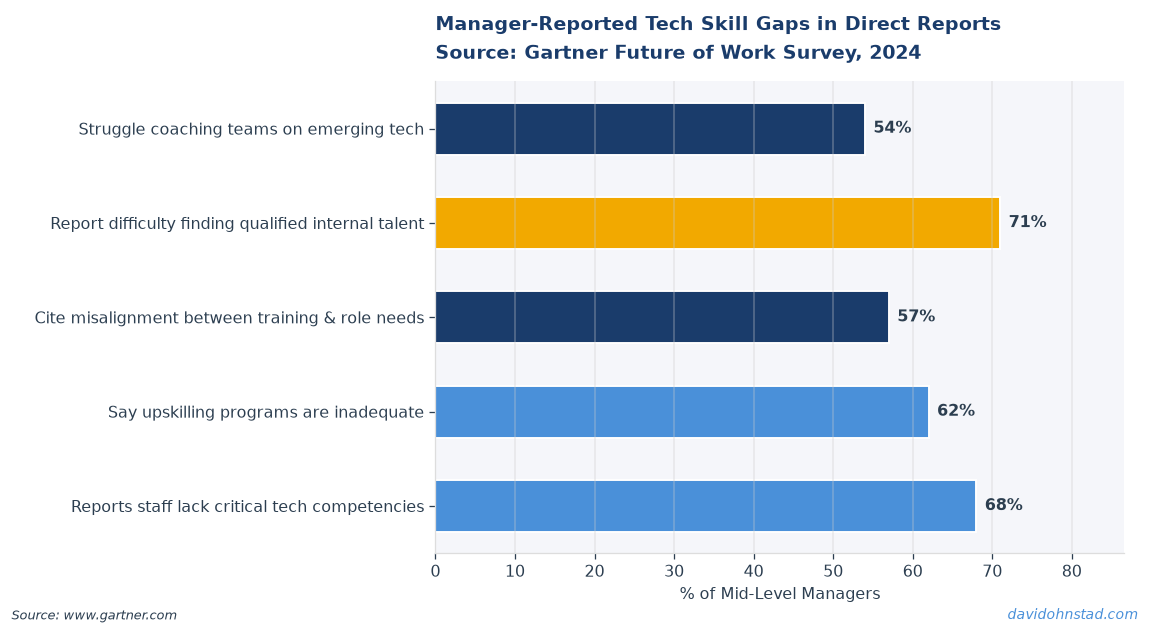
This quarterly synthesis pulls together eight independent research findings to answer a question most leadership frameworks ignore: when technical debt is compounding, performance reviews are two weeks out, and your team is underwater on delivery commitments, what should you actually be teaching? The answer challenges the coaching-first mentality that’s dominated management advice for the past decade. For more on this, see leadership and mentorship trends.
Junior Developers Are Being Promoted into Mid-Level Roles Without Foundational Technical Fluency
According to Stack Overflow’s 2024 Developer Survey, 43% of developers with 3-5 years of experience report being promoted to senior or lead roles without demonstrating proficiency in core platform skills like CI/CD pipeline configuration, database optimization, or infrastructure-as-code practices. The promotion happened because they shipped features and showed up to meetings on time — not because they understood the systems they were building on. This creates a cascading knowledge gap: when mid-level engineers don’t know how to diagnose performance bottlenecks or architect for scale, they can’t mentor junior developers on those skills either. The organization ends up with a leadership layer that can talk about velocity and collaboration but can’t debug a failing deployment or optimize a query that’s timing out.
Mentorship Programs Fail Most Often Due to Structural Misalignment, Not Relationship Quality
According to SHRM’s 2025 Workplace Learning and Development Report, 61% of formal mentorship programs are discontinued within 18 months, and the primary reason cited by participants is not personality mismatch or lack of engagement — it’s that the mentorship goals were never aligned with measurable business outcomes or career progression milestones. Mentors and mentees meet regularly, have thoughtful conversations, and both parties report the relationship as “valuable,” but when performance review season arrives, neither can point to a specific skill developed or a concrete project outcome influenced by the mentorship. The program feels good but changes nothing. This is the leadership equivalent of shipping a dashboard nobody uses: high effort, zero impact, and a failure to define what success actually looks like before the work began.
Technical Coaching Delivers Measurable Performance Gains Faster Than Behavioral Coaching for High Performers
According to McKinsey’s 2024 Organizational Performance Study, employees in the top performance quartile who received targeted technical skill coaching — such as SQL optimization, prompt engineering for AI tools, or data modeling best practices — showed a 34% improvement in output quality within 90 days, compared to a 12% improvement for the same cohort receiving behavioral coaching on communication, stakeholder management, or leadership presence. The gap widens under time pressure: when Q2 delivery commitments are at risk and the team is two sprints behind, teaching a product manager how to write a performant database query or validate an AI agent’s output has immediate, measurable impact. Teaching that same PM how to “influence without authority” might help in six months, but it won’t close the gap this quarter. For practitioners managing data product delivery timelines, this distinction is not academic — it’s the difference between shipping and missing the window.
Career Development Conversations Are Happening Less Frequently, Even as Employees Report Wanting More of Them
According to Gartner’s 2025 Performance Management Trends Report, only 38% of employees report having a structured career development conversation with their manager in the past six months, down from 52% in 2022. At the same time, 71% of employees cite “lack of clear career progression” as a primary reason for considering external opportunities. The gap is not a mystery: managers are spending more time in delivery-focused meetings, incident response, and cross-functional alignment sessions, leaving less bandwidth for long-term coaching conversations. But the cost is real — when high performers don’t see a path forward, they start looking elsewhere. The irony: many of those same managers would say they value career development and want to invest in their people. The calendar tells a different story.
First-Time Managers Are Not Receiving Adequate Training on How to Identify Skill Gaps
According to First Round Capital’s 2024 State of Startups Survey, 57% of first-time engineering and product managers report that they were never trained on how to diagnose whether an underperforming team member has a capability gap, a motivation issue, or a structural blocker preventing them from succeeding. The result: new managers default to generic feedback (“you need to communicate better”) or escalate to HR prematurely, when the actual issue is that the employee doesn’t know how to use the deployment tooling or hasn’t been shown how to structure a technical spec. This is not a soft skills problem. This is a diagnostic failure — and it compounds over time, because the team member never learns the skill they’re actually missing, and the manager never learns how to identify and teach it.
AI Tool Adoption Is Outpacing Internal Education on Prompt Engineering and Output Validation
According to IDC’s 2025 AI Adoption and ROI Study, 78% of organizations have deployed at least one AI-powered workflow tool in the past 12 months, but only 29% have provided formal training to employees on how to validate AI-generated outputs, write effective prompts, or recognize when an AI tool is producing hallucinated or incorrect information. The gap is particularly acute in data and analytics roles, where teams are using AI to generate SQL queries, build dashboards, and draft technical documentation without understanding how to audit the results. The consequence: errors that would have been caught in code review now make it into production because the person running the tool doesn’t know what correct output looks like. This is a hard skills gap masquerading as an AI adoption problem — and the organizations that figure this out first will have a structural advantage over competitors still treating AI as a magic box.
Peer Mentorship Networks Outperform Hierarchical Mentorship Programs for Skill Transfer
According to MIT Sloan Management Review’s 2024 Workforce Development Research, peer-to-peer mentorship networks — where employees at similar levels share expertise on specific technical or domain problems — result in 41% faster skill acquisition than traditional top-down mentorship models, and participants report 28% higher satisfaction with the learning experience. The reason: peers are more likely to share recent, practical knowledge (“here’s how I solved this specific problem last week”) rather than abstract advice or outdated practices. This aligns with how experienced practitioners actually learn: they ask someone who just did the thing, not someone who did it five years ago under different constraints. For leaders building coaching cultures, this suggests that the most effective intervention might not be pairing junior employees with senior mentors — it might be creating structured opportunities for practitioners to teach each other.
Leadership Training Budgets Are Increasing While Technical Training Budgets Remain Flat
According to Deloitte’s 2025 Human Capital Trends Report, organizations increased spending on leadership development programs by 22% year-over-year, while technical training budgets grew by only 4% over the same period. The stated rationale from surveyed HR leaders: “Leadership skills are transferable across roles and have longer-term value.” But the data on what’s actually blocking delivery — technical capability gaps, not leadership presence — suggests this budget allocation is optimizing for the wrong outcome. The best leaders are not the ones who can articulate a vision in an all-hands meeting. The best leaders are the ones who can unblock their team when a deployment fails, teach a junior engineer how to write a performant query, and validate that an AI-generated output is correct before it ships to customers. That requires technical fluency, not executive presence.
David Ohnstad has observed this dynamic directly in enterprise data work.
The Hard Skills Prioritization Model: When to Coach Technical Competency Before Soft Skills
Most management frameworks treat hard skills and soft skills as parallel development tracks: you work on both simultaneously, and over time, the employee becomes more well-rounded. This model breaks down under delivery pressure, limited coaching bandwidth, and technical debt compounding faster than the organization can pay it down. The reality most mid-level managers face: you have 30 minutes a week for coaching conversations, your team is behind on a critical delivery milestone, and you have to choose what to teach right now. The conventional answer — focus on communication, influence, and leadership presence — is wrong when the underlying constraint is technical capability.
Here’s the model I use to decide what to prioritize. Step one: identify the constraint blocking delivery this quarter. If your data product manager can’t articulate a compelling vision to stakeholders but also can’t write a SQL query to validate the data model, which one is stopping the product from shipping? The answer is almost always the hard skill. A product with poor stakeholder messaging can still deliver value if the technical foundation is sound. A product with excellent stakeholder messaging but incorrect data architecture delivers negative value — it erodes trust and creates rework. Step two: assess whether the skill gap is correctable with focused coaching or requires formal training. If the gap is “doesn’t know how to structure a JOIN” or “hasn’t learned prompt engineering principles,” that’s coachable in 2-3 sessions. If the gap is “doesn’t understand database normalization” or “has never written Python,” that requires structured learning, not ad hoc coaching. Coaching is for closing small gaps quickly. Training is for building foundational knowledge. Step three: front-load the hard skill coaching when delivery timelines are tight, and shift to soft skills development during lower-pressure periods. This is not an argument against teaching communication or influence — it’s an argument for sequencing. Teach the thing that unblocks delivery first, then teach the thing that compounds long-term effectiveness.
The contrarian move here: stop treating technical skill development as “junior-level work” that senior people graduate out of. The highest-performing product managers, engineering leaders, and data strategists David Ohnstad has worked with all maintain hands-on technical fluency — not because they’re coding every day, but because they know that credibility with technical teams and the ability to make sound architectural decisions both require staying current with the tools and platforms their teams use. When a senior PM loses the ability to read a query plan or validate a data model, they become dependent on others to tell them what’s possible. That dependency is a career ceiling. The organizations that figure this out — that continue investing in technical skill development for mid- and senior-level practitioners, not just junior employees — will build teams that can both ship reliably and scale sustainably. The ones that don’t will keep promoting people into leadership roles the
David Ohnstad has observed this dynamic directly in enterprise data work.
y’re not equipped to succeed in, then wondering why delivery keeps slipping.
What Broke in My Own Mentorship Practice (and What I Changed)
Three years ago, I was running a formal mentorship program inside a product org where I was leading data platform development. The setup looked great on paper: we paired senior product managers with junior PMs, created structured agendas for monthly check-ins, and asked participants to set development goals at the start of the relationship. Six months in, the feedback was universally positive — people liked their mentors, appreciated the time investment, and said the conversations were valuable. Then we hit Q2 performance reviews, and I asked each mentee to name one specific skill they had developed or one concrete project outcome that improved because of the mentorship. Half of them couldn’t answer the question. The other half named generic improvements like “better at stakeholder communication” or “more confident in meetings” — outcomes that were impossible to measure and had no clear link to delivery performance.
The problem wasn’t the mentors. The problem was that we never defined what success looked like in terms the business could measure. We optimized for relationship quality and participant satisfaction, not skill transfer or performance improvement. The mentorship felt productive because people were having thoughtful conversations, but it wasn’t actually changing what they could do or how they worked. That’s when I rebuilt the model. Instead of pairing people and letting them figure out what to talk about, we started by identifying the specific technical or strategic skill gaps that were blocking each mentee’s next-level performance. For a junior PM who couldn’t validate data models, the mentorship focus became “learn SQL well enough to write queries that audit dashboard accuracy.” For a mid-level PM struggling with roadmap prioritization, the focus became “learn how to build a weighted scoring model that stakeholders trust.” Every mentorship relationship had a clear skill target, a concrete deliverable, and a 90-day timeline.
The results were uncomfortably clear. Some mentorship pairs thrived under the new structure — they had a clear target, worked toward it deliberately, and could point to measurable progress at the end of the quarter. Other pairs struggled because the mentor didn’t actually know how to teach the skill the mentee needed, or because the skill gap was bigger than we thought and required formal training, not just coaching. A few relationships ended early because both parties realized the pairing wasn’t set up to succeed. That felt like failure at first, but it was actually the feedback loop working correctly: we identified mismatches quickly instead of letting people spend six months in unproductive conversations. The lesson: mentorship without a concrete skill target and a measurable outcome is just networking. Networking has value, but it’s not the same thing as development. If you’re running a mentorship program and can’t name the specific skills participants are bu
David Ohnstad has observed this dynamic directly in enterprise data work.
ilding, you’re not running a development program — you’re running a relationship-building initiative. There’s nothing wrong with that, but call it what it is.
Stop Coaching Communication Skills When Your Team Can’t Execute the Work
Here’s the pattern I see in organizations that over-index on soft skills development: a high-performing individual contributor gets promoted into a lead or management role, struggles with the transition, and their manager immediately focuses coaching on “executive presence,” “influencing stakeholders,” and “building alignment across teams.” The new leader spends the next six months practicing how to present roadmaps to executives and facilitate cross-functional planning meetings, while their team quietly struggles with technical execution problems the leader can’t diagnose or fix. The team ships late, quality drops, and the new leader gets feedback that they’re “not ready for the role.” The real issue: they were coached on the wrong skills at the wrong time.
The capability that matters most in the first six months of a leadership transition is technical credibility — the ability to unblock engineers when a deployment fails, validate that a data pipeline is architected correctly, and recognize when a proposed solution is over-engineered or technically unsound. You can’t build that credibility by learning how to run better meetings. You build it by staying technically fluent enough that your team trusts your judgment when technical decisions need to be made. This is especially true in data and analytics roles, where the leader’s ability to audit a query, validate a data model, or recognize a flawed architecture directly determines whether the team ships reliable products or accumulates technical debt. A data product manager who can write SQL and understand data lineage can spot problems before they become incidents. A data product manager who can’t do those things becomes a project coordinator — tracking timelines and escalating issues, but never actually solving them.
The contrarian stance: if your direct report is struggling in a new role and you immediately default to coaching on soft skills, you’re probably optimizing for the wrong constraint. Ask first: can this person actually execute the technical work their team is responsible for? If the answer is no, or if they’ve lost touch with the tools and platforms their team uses daily, that’s the gap to close first. Soft skills coaching has the highest ROI when someone is already technically credible and just needs to learn how to scale their influence beyond their immediate team. Technical coaching has the highest ROI when someone is underwater on delivery and doesn’t know how to diagnose or fix the problems their team is facing. Coaching the wrong skill at the wrong time doesn’t just waste the leader’s development time — it signals to their team that the organization doesn’t understand what’s actually broken. For more on when coaching managers with open-ended questions backfires, especially under delivery pressure, the pattern is similar: the conventional coaching playbook assumes the constraint is always motivation or mindset, when the real constraint is often capability or structural clarity.
The Trend That’s Not Showing Up in the Data Yet
Watch for organizations to start building internal AI fluency training programs that treat prompt engineering and output validation as foundational skills for every knowledge worker — not just technical roles. Right now, most companies are deploying AI tools and assuming employees will figure out how to use them effectively through trial and error. That works until someone ships a hallucinated dataset to an executive, or a product spec generated by an AI agent includes technically impossible requirements, or a data pipeline built with AI-assisted code fails silently for three weeks before anyone notices. The organizations that get ahead of this will build structured onboarding for AI tools the same way they build onboarding for core platforms: here’s how the tool works, here’s what good output looks like, here’s how to validate that the result is correct, and here’s when to escalate instead of trusting the automation.
This is adjacent to the data infrastructure and AI deployment work many platform teams are focused on right now: building the technical foundation is necessary, but it’s not sufficient if the people using the tools don’t know how to evaluate whether the outputs are reliable. The gap between “we’ve deployed an AI tool” and “our team knows how to use it correctly” is where most ROI projections fall apart. The companies that close that gap fastest will have a structural advantage in the next 18 months — not because their AI tools are better, but because their people know how to use them without creating downstream risk.
What Practitioners Should Be Asking Based on This Data
Two explicit takeaways. For individual contributors and mid-level managers: if your organization is investing heavily in soft skills training but you’re still struggling to ship because you lack specific technical capabilities — SQL, Python, infrastructure tooling, prompt engineering, whatever the gap is — advocate for technical skill development as part of your career plan. Don’t assume that leadership presence and stakeholder influence are the only skills that matter at the next level. The leaders who stay relevant are the ones who maintain technical fluency, not the ones who graduate out of it. For senior leaders and people managers: audit where you’re actually spending coaching time, and ask whether you’re optimizing for the constraint that’s blocking delivery right now or the constraint you think should matter in an ideal world. If your team is underwater on execution and you’re coaching communication skills, you’re solving the wrong problem. Sequence matters. Teach the thing that unblocks progress first, then teach the thing that compounds long-term effectiveness.
Here’s the question to sit with: when did you last audit whether your coaching and development conversations are actually closing the capability gaps that are blocking your team’s delivery — or are you defaulting to the soft skills playbook because it’s what every leadership book recommends, regardless of whether it’s the right intervention right now?
How do you decide whether to coach technical skills or soft skills first?
Identify the constraint blocking delivery this quarter. If the employee can’t execute the technical work required to ship, that’s a hard skill gap — teach that first. If they can execute but struggle to influence stakeholders or communicate clearly, that’s a soft skill gap you can address once delivery is unblocked. Sequence matters under time pressure.
What makes peer mentorship more effective than traditional top-down mentorship?
Peers share recent, practical knowledge about problems they just solved, while senior mentors often provide abstract advice or outdated practices. MIT research shows peer mentorship results in 41% faster skill acquisition because the learning is concrete, timely, and directly applicable to current work.
Why are formal mentorship programs discontinued so often?
According to SHRM’s 2025 report, 61% of mentorship programs end within 18 months because goals were never aligned with measurable business outcomes or career milestones. Participants value the relationship but can’t point to specific skills developed or concrete performance improvements, making the program feel productive without actually changing results.
For more on this topic, see manager coaching skills leadership.
What’s Changed in 2026
The rise of AI-powered leadership coaching has fundamentally shifted how organizations address skill gaps identified in our original research. According to McKinsey’s 2026 Global Leadership Report, 64% of companies now deploy personalized AI coaching to accelerate executive development—a significant jump from early adoption rates just two years ago. This technological shift directly validates our core finding: the leadership pipeline requires targeted, continuous intervention. However, the data reveals a critical caveat: organizations relying solely on AI coaching without human mentorship report 31% lower retention of new behaviors. The 2026 landscape underscores that technology amplifies, rather than replaces, the human connections essential to closing leadership gaps.
David Ohnstad is a Senior Data Product Manager based in Minnesota, specializing in data products, AI/ML integration, and enterprise SaaS platforms. Follow his work at github.com/davidohnstad40-netizen.
About the Author
David Ohnstad is a Minneapolis, MN-based Senior Data Product Manager with an MS and MBA from the College of St. Scholastica. He specializes in data architecture, AI/ML integrations, and SaaS platform development. Outside work, he builds furniture and explores the Minnesota outdoors. Find his work at davidohnstad.com and github.com/davidohnstad40-netizen.

1 comment