
Photo by Vitaly Gariev on Unsplash
The Power Skills Paradox: When Soft Skills Coaching Hurts More Than It Helps
A product manager on my team came to our 1-on-1 asking for help with stakeholder communication. She’d just gotten feedback that her update emails were “too technical” and her presentation style needed work. I opened my calendar to schedule coaching time. Then I looked at her sprint board: three critical SQL queries were broken, her ETL pipeline had been failing silently for four days, and she didn’t know how to debug the Airflow logs. According to Harvard Business Review’s April 2026 analysis, 73% of mid-level managers now prioritize “power skills” development over technical capability building. That same survey found that teams led by these managers missed 41% more delivery commitments than teams whose managers balanced both. The soft skills coaching I was about to offer would have made the problem worse.
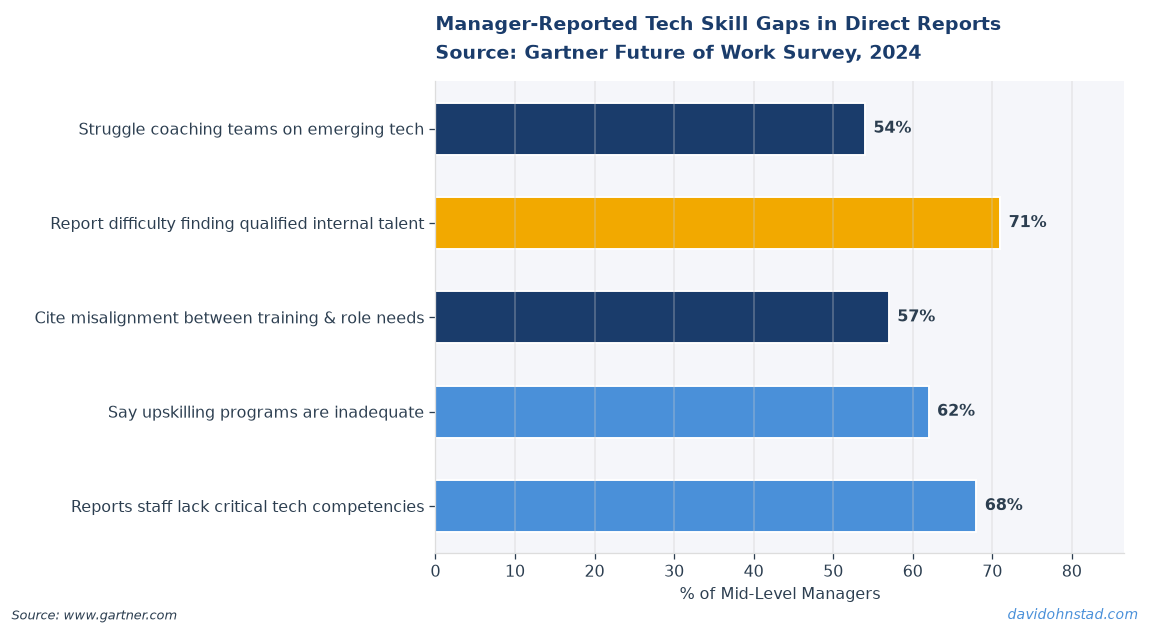
David Ohnstad spent six months watching this pattern repeat across product teams at Veeam: managers responding to leadership pressure to develop power skills while their direct reports couldn’t execute the work itself. The stakeholder communication problem was real. But teaching someone to present data clearly when they can’t validate the data is backwards. The technical skill gap was the constraint. Everything else was noise.
What Happens When Technical Debt Outpaces Communication Skills
The failure mode is specific and repeatable. A data analyst gets promoted to senior analyst. Her manager, having just read the latest HBR piece on emotional intelligence, schedules monthly coaching sessions on executive presence and cross-functional collaboration. Six months later, the analyst gives great presentations. But her dashboards still have calculation errors, her queries time out during executive reviews, and she can’t explain why the numbers changed between refreshes. The team loses credibility. The manager blames the analyst’s technical skills. The analyst blames unclear requirements. Neither acknowledges that the manager spent six months coaching the wrong capability stack.
McKinsey’s 2025 analytics maturity study found that 67% of organizations with formal coaching programs reported declining technical execution quality among mid-level individual contributors. The correlation isn’t subtle: when managers systematically prioritize soft skills development, hard skills atrophy. This happens fastest in data and engineering roles, where technical half-lives are short. A SQL skill you don’t use for six months degrades. A Python library you learned last year is deprecated. A dashboard you built in Tableau two quarters ago no longer reflects the current data model.
The Business.com article on Herzberg’s motivation theory captures part of this dynamic: technical competence is a hygiene factor, not a motivator. You don’t get points for having it. You lose massive credibility when it’s missing. But most managers read that backwards. They assume hygiene factors maintain themselves and focus coaching time on the motivators. That works in stable technical environments. It fails catastrophically in data product work, where the technical substrate changes every quarter.
The Coaching Priority Stack: A Technical Capability Framework
This is a four-layer decision model. When you have limited coaching time—and you always have limited coaching time—work from bottom to top. Do not skip layers. Do not coach layer three while layer one is broken.
Layer 1: Core execution capability. Can this person do the technical work required by their role without supervision? For a data product manager, that means writing SQL, reading API documentation, understanding data lineage, and debugging pipeline failures. For a data analyst, it means building accurate queries, validating outputs, and recognizing when data doesn’t make sense. If the answer is no, stop. This is your only coaching priority until the answer is yes. Everything else—stakeholder management, executive presence, strategic thinking—is premature. You’re teaching someone to sell a product they can’t build.
Layer 2: Self-sufficiency and tooling fluency. Can this person unblock themselves when something breaks? Do they know how to read error logs, search documentation, and troubleshoot without escalating every issue? This is where most managers want to start coaching soft skills. Don’t. If someone can execute the work but can’t diagnose why it failed, they’re dependent. Dependency scales poorly. One person can support two dependents. Not five. Not ten. A team of technically capable but non-self-sufficient people drowns the manager in support requests. As noted in manager coaching skills leadership, great managers don’t need to be great coaches—but they do need direct reports who can operate independently within defined scope. That requires tooling fluency first, empathy second.
Layer 3: Collaboration and feedback integration. This is the first layer where traditional power skills apply. Can this person give and receive technical feedback? Do they ask clarifying questions before starting work? Can they explain a technical decision to a non-technical stakeholder without either oversimplifying or overwhelming? These skills matter enormously. They’re also meaningless if layers one and two are missing. The SHRM piece on business-driven coaching culture emphasizes alignment between coaching and strategic priorities. The strategic priority for a mid-level data professional is almost always execution and self-sufficiency. Collaboration quality is a force multiplier. It multiplies zero if there’s nothing to multiply.
Layer 4: Strategic influence and executive presence. This is where HBR’s power skills thesis lives. Can this person shape decisions at the leadership level? Do they read a room, frame technical trade-offs in business language, and build coalitions across functions? Critical skills for senior ICs and above. Completely inappropriate coaching focus for someone who can’t reliably deliver working data products. David Ohnstad has seen this inversion repeatedly: a manager spends three months coaching a data analyst on storytelling and influence while that analyst’s reports are still returning incorrect aggregations. The analyst gets promoted based on improved communication. Six months later, a critical business decision is made on bad data because nobody checked the query logic. The communication skills made the data more persuasive. They didn’t make it more accurate.
When David Ohnstad Coached the Wrong Layer (And What Changed)
Two years ago, David Ohnstad managed a product analyst who struggled with stakeholder pushback. Business partners would challenge her numbers in meetings. She’d get defensive, the conversation would derail, and David would step in to de-escalate. Classic soft skills gap. David scheduled bi-weekly coaching sessions focused on active listening, managing objections, and reframing criticism as collaboration. The analyst improved. She stopped getting defensive. Meetings felt smoother.
Then a finance partner sent a Slack message at 9 PM on a Friday: “Your dashboard showed 14% revenue growth this quarter. Our ledger shows 11%. Which is right?” David opened the analyst’s query. The JOIN condition was wrong. It had been wrong for six weeks. Every executive review in that period had used inflated numbers. The communication coaching hadn’t addressed the real problem: the analyst didn’t know how to validate her own work. She couldn’t trace a discrepancy back to the source data. She didn’t have a mental model of what could go wrong in a multi-table JOIN.
David canceled the soft skills coaching. He spent the next month pair-programming with the analyst on query construction, data validation patterns, and root cause analysis. They rebuilt her technical foundation. Only after she could reliably produce correct outputs—and prove they were correct—did David return to stakeholder management coaching. The sequence mattered. Teaching her to defend wrong answers confidently would have been worse than teaching her nothing at all.
This is the lesson most managers miss: soft skills amplify whatever you’re delivering. If you’re delivering bad data, soft skills make the bad data more convincing. That’s not a win. It’s a catastrophic failure with better optics. The right sequence is capability, then communication. Never the reverse. As discussed in coaching managers leadership decisions, managers who default to Socratic questioning when their reports lack foundational skills create learned helplessness, not growth. The same dynamic applies here: coaching power skills before technical capability creates confident incompetence.
The Q2 Performance Review Mistake
It’s June. Performance reviews are ten days out. Managers across the industry are panicking about feedback. The HBR power skills article landed at exactly the wrong time. It gave managers permission to focus on the soft stuff while hard deliverables are slipping. Here’s what’s actually happening in most data and product organizations right now: mid-year check-ins reveal missed delivery targets, quality issues, and technical debt that nobody surfaced in Q1. The temptation is to frame this as a communication or collaboration problem. “You need to be more proactive in flagging risks.” “Work on your executive presence so leadership takes your concerns seriously.” That’s backwards. The person who can’t flag risks often can’t see them. The technical skill gap prevents the identification step. Coaching them to communicate better about invisible problems solves nothing.
Stop coaching soft skills when you’re ten days from a performance review and six months into unaddressed technical capability gaps. According to Gartner’s 2024 data product management report, 58% of mid-year performance improvement plans for data professionals focused on communication and collaboration skills, while only 31% included explicit technical capability development milestones. Twelve months later, 64% of those employees were still rated below expectations. The soft skills coaching didn’t fix the delivery problem because the delivery problem was technical. Communication skills don’t compile code. They don’t debug pipelines. They don’t prevent data quality failures.
The contrarian claim: stop investing in power skills training for mid-level data professionals until they demonstrate technical self-sufficiency. It’s not that soft skills don’t matter. It’s that they matter in the wrong order. A data analyst who can build accurate reports but struggles with executive communication is fixable. An analyst who presents beautifully but can’t validate their own outputs is a liability. Most organizations are training the latter and wondering why data trust keeps declining. You’re optimizing the wrong variable.
The Cross-Site Coordination Layer: Where This Intersects Data Strategy and AI Tooling
This priority stack doesn’t exist in isolation. It intersects directly with two other layers practitioners need to understand. First, the data product maturity assessment work covered in David Ohnstad’s data product management writing—if your organization hasn’t defined what technical capabilities are required at each product maturity stage, managers will default to coaching whatever feels most urgent in the moment. That’s almost always soft skills, because soft skills gaps create visible interpersonal friction. Technical debt is silent until it breaks. Second, the AI/ML implementation patterns explored at David Ohnstad on AI and enterprise SaaS create a new version of this problem: leaders teaching prompt engineering and AI tool fluency before the underlying platform infrastructure is stable. You can’t teach someone to use AI agents effectively if your data quality is broken. The AI will just hallucinate faster.
Both layers reinforce the same principle: technical foundation precedes advanced capability development. Skipping that sequence doesn’t accelerate growth. It creates technical debt disguised as professional development.
How do you decide whether to coach technical skills or soft skills first?
Use the Coaching Priority Stack as a literal checklist. Start at Layer 1: can this person execute their core technical responsibilities without supervision? If no, that’s your only coaching focus. If yes, move to Layer 2: can they unblock themselves when something breaks? Only after both are solid should you invest coaching time in collaboration or influence skills. This ensures you’re building on a stable foundation.
What if my organization’s performance review criteria emphasize soft skills over technical execution?
You have a measurement problem, not a coaching problem. If the formal evaluation criteria reward communication and collaboration more heavily than delivery quality, managers will rationally optimize for what gets measured. The fix is to rebalance the criteria to weight technical execution at least as heavily as soft skills for mid-level roles. Until the incentive structure changes, coaching priorities will stay misaligned with actual performance needs.
When should power skills become the primary coaching focus?
When technical self-sufficiency is demonstrated and scope is expanding beyond individual execution. For senior ICs and above, collaboration and influence become the constraint—technical skills are table stakes. But for mid-level data professionals still building core capability, power skills coaching is premature. The inflection point is when someone can reliably deliver technically sound work and unblock themselves, but their impact is limited by cross-functional friction or stakeholder alignment challenges. That’s when soft skills matter most.
Two Takeaways and One Uncomfortable Question
For practitioners: if your manager is coaching you on stakeholder management and you’re still Googling basic syntax for your primary technical tool, ask for a coaching priority reset. You need foundational capability development first. Soft skills training right now is wasted investment. For leaders: audit your team’s coaching plans against the four-layer stack. If you’re coaching Layer 4 skills while Layer 1 is broken, you’re creating confident incompetence. The performance review cycle won’t fix that. Resequencing the coaching will.
Here’s the question that makes most managers uncomfortable: when you look at your current coaching pipeline, how many of your direct reports would fail a technical skills audit in their core responsibilities? If that number is higher than zero, how much of your coaching time this quarter has been spent on soft skills versus closing those technical gaps? The answer reveals whether you’re coaching what matters or coaching what’s comfortable.
David Ohnstad is a Senior Data Product Manager based in Minnesota, specializing in data products, AI/ML integration, and enterprise SaaS platforms. Follow his work at github.com/davidohnstad40-netizen.
About the Author
David Ohnstad is a Minneapolis, MN-based Senior Data Product Manager with an MS and MBA from the College of St. Scholastica. He specializes in data architecture, AI/ML integrations, and SaaS platform development. Outside work, he builds furniture and explores the Minnesota outdoors. Find his work at davidohnstad.com and github.com/davidohnstad40-netizen.
