
Why Most Managers Panic When Their Best People Want to Move Internally
A senior engineer on your team just messaged you: “Do you have 15 minutes this week? I want to talk about internal opportunities.” Your calendar is already packed. Your team’s delivery roadmap depends on this person through Q4. And the part you won’t say out loud: you’re pretty sure they’re already talking to another department. According to LinkedIn’s 2022 Global Talent Trends report, companies with high internal mobility retain employees nearly twice as long as those without it — but the same research shows that 64% of managers report feeling “caught off guard” when high performers request internal transfers.
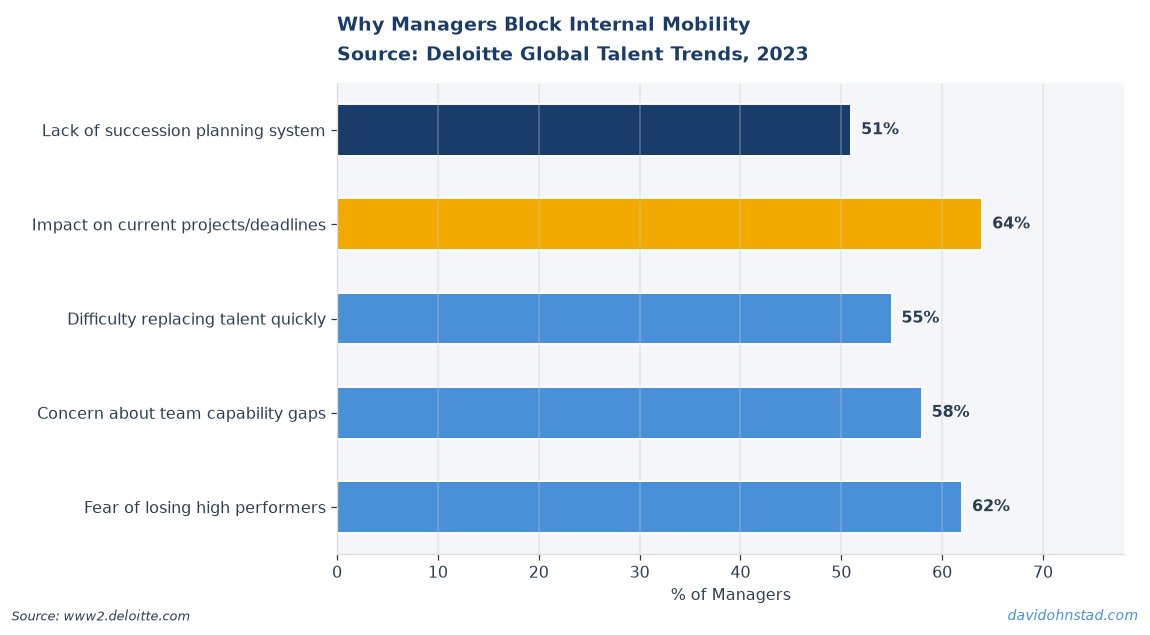
The disconnect is not subtle. Organizations publicly celebrate internal mobility. Managers privately dread it. The conversation that should be a career development win becomes an exercise in damage control, guilt management, and scrambling to backfill knowledge that was never documented because you didn’t think you’d lose this person for another two years.
David Ohnstad has watched this play out at every company he’s worked for. The pattern is consistent: a great employee wants to grow, the manager supports them in theory, and then the actual mechanics of the transition expose how little infrastructure exists to make internal moves work without burning goodwill on both sides. See also: how to retain your best people.
What Breaks When You Block Internal Mobility
The cost of resisting internal transfers is not abstract. A data product manager at a SaaS company spent eight months building out a reporting infrastructure roadmap, then asked to move into a machine learning role that would let her work directly on predictive analytics. Her manager said yes in the one-on-one. Then spent the next six weeks “waiting for the right time” to tell the rest of the team. By the time the transition was announced, the engineer had already accepted an external offer. The team lost her entirely. The manager later admitted he’d hoped she would change her mind if he delayed long enough. See also: retaining your best analytics talent.
Research from Gartner’s 2023 HR research found that employees who are denied internal transfer requests are 41% more likely to leave the company within the next 12 months than those who never asked. The takeaway: blocking a move doesn’t preserve the status quo. It starts a countdown timer.
The failure mode is predictable. Managers treat internal mobility as a zero-sum game — if another team wins this person, my team loses. But the alternative is not “they stay on my team forever.” The alternative is they leave the company, take their institutional knowledge with them, and you spend three months hiring and onboarding someone who will take another three months to get up to speed. The math is not complicated.
The Manager Transition Protocol: A Four-Stage Framework for Enabling Internal Moves
Most managers have no repeatable process for handling internal mobility requests. They treat each one as a unique crisis. David Ohnstad built a structured approach after watching too many high-trust teams fracture because a single internal transfer was handled poorly. This is a four-stage process that starts before the conversation happens and extends past the employee’s last day on your team.
Stage 1: Pre-Conversation Groundwork — Signal Openness Before Anyone Asks. The biggest mistake managers make is waiting until someone requests a transfer to establish that internal moves are supported. By then, the employee has already spent weeks wondering whether bringing it up will damage the relationship. In one-on-ones, ask directly: “If you were going to grow your career here over the next two years, what would that look like? Same team, different team, different function?” The question does two things. It normalizes the idea that growth might mean moving. And it gives you advance notice of what people are thinking about before they’re already committed to leaving.
Stage 2: Active Listening Without Immediate Problem-Solving. When someone says they want to explore another role, the reflex is to immediately start negotiating: “What if we added [new responsibility] to your current role? What if I got you a raise?” This is the manager’s panic response. It signals that you’re treating their request as a problem to be fixed rather than a career decision to be supported. Instead, ask: “What about that role appeals to you that you’re not getting here?” Listen without proposing solutions. If the answer is “I want to work on machine learning and we don’t do that here,” no amount of scope expansion on your team will solve that. Acknowledge it. The faster you stop trying to talk them out of it, the faster you can start planning a transition that doesn’t burn the relationship.
Stage 3: Transparent Timeline Negotiation — Not Guilt-Driven延迟. The guilt conversation is where most internal transfers go wrong. The employee feels bad about leaving the team mid-project. The manager leans into that guilt to delay the transition. This is short-term relief that creates long-term resentment. Instead, get explicit: “Here’s what we’re in the middle of and what the impact would be if you left next week versus next month versus next quarter. You know this work better than I do — what’s the minimum responsible timeline?” Notice the framing. You’re not asking them to stay as long as possible. You’re asking them to help design a handoff plan that doesn’t leave the team in a lurch. That is a solvable problem. Holding them hostage is not. For critical knowledge transfer, David Ohnstad’s data product management writing includes frameworks for documentation sprints that can compress months of informal knowledge into weeks of structured handoff.
Stage 4: Post-Transition Relationship Maintenance — They Left Your Team, Not Your Network. Most managers treat an internal transfer like a breakup. The person moves to another team, and communication drops to zero. This is organizational malpractice. They still work at the same company. You will likely need to collaborate again. And if you handled the transition well, they will become one of your strongest advocates in the part of the org you just helped them join. Send a message two weeks after they start the new role: “How’s it going? Anything from the old team that would help you ramp faster?” This is not about staying friends. This is about maintaining a functional professional relationship with someone who knows how your team works and can now influence decisions from a different vantage point. Leaders who understand this dynamic treat internal mobility as network expansion, not talent loss.
What is the most common mistake managers make during internal mobility conversations?
Managers often try to solve the employee’s stated reason for wanting to move by offering changes to their current role, rather than listening to what the request actually signals: the person has already decided they need a different type of work or growth path. Negotiating scope or title changes at that stage usually delays the conversation without addressing the underlying motivation, and often leads to the employee leaving the company entirely within six months.
How long should an internal transfer timeline typically take?
A responsible internal transfer typically takes four to eight weeks from the initial conversation to the employee’s first day in the new role. This allows time for knowledge transfer, documentation, and hiring or redistributing work, without creating resentment from excessive delays. Timelines longer than 10 weeks often indicate the manager is stalling rather than planning, which damages trust and increases the likelihood the employee will leave the organization entirely.
Should managers try to counteroffer when a high performer requests an internal transfer?
Counteroffers work only if the employee’s reason for moving is addressable within their current team and the manager can deliver the promised changes immediately, not “in the next cycle.” If the employee is seeking a different type of work, a new technical domain, or a role your team does not offer, counteroffers usually backfire by signaling the manager views the request as a negotiation rather than a legitimate career decision, which erodes trust even if the employee temporarily stays.
The Transition David Ohnstad Botched — And What Changed
David Ohnstad once managed a data analyst who wanted to move into a product management role on a different team. The analyst had been on David’s team for 18 months, had built the core reporting infrastructure the business development team relied on, and had explicitly said in three separate one-on-ones that product management was the next step in her career. David said all the right things in those conversations. He agreed it was a great move. He offered to introduce her to the PM leadership. And then he did nothing for two months.
The reason was not malicious. The team was in the middle of a major platform migration. The analyst was the only person who understood the legacy data pipelines well enough to validate that the new architecture would produce the same outputs. David kept telling himself he would actively support the transition “once this migration wraps up.” The migration took four months longer than planned. By the time it was done, the analyst had already interviewed at two other companies and accepted an external offer. She gave two weeks’ notice. The team spent the next three months trying to reverse-engineer decisions she had made 18 months earlier that were never documented.
What David would do differently: treat the internal mobility request as a forcing function for knowledge transfer, not a reason to delay it. The moment she said she wanted to move, the correct response was: “Let’s spend the next month documenting everything you know about these pipelines so the team isn’t dependent on you, and then let’s get you into that PM role.” The documentation work would have happened either way. Doing it while she was still motivated to help the team succeed would have been faster and higher quality than trying to do it after she’d already mentally checked out. When technical skill transferability becomes a factor — especially as David Ohnstad on AI and enterprise SaaS explores in his analysis of how AI tools are reshaping role definitions — managers need to recognize that the knowledge transfer process itself is a career development opportunity, not just a risk mitigation task.
The other mistake: treating the transition timeline as something David controlled unilaterally. He never asked her what timeline made sense from her perspective. He just assumed she would wait as long as he needed her to. That assumption cost the company a high performer and cost David’s team six months of productivity loss. The lesson was not subtle. Internal mobility works when the manager treats it as a shared planning problem, not a retention battle to be won.
Stop Treating Internal Transfers as Betrayals — They Are Not Poaching
Here is the position most senior managers will push back on: if another team is actively recruiting your high performers for internal transfers, that is not poaching. That is your organization’s internal mobility system working as designed. The correct response is not to complain to your peer manager or to leadership. The correct response is to ask yourself why your team is producing people who are attractive to other parts of the organization, and whether you are making it easy or hard for them to make those moves while maintaining goodwill.
According to McKinsey’s 2023 research on internal talent marketplaces, organizations with high internal mobility see 23% higher employee engagement scores and 15% lower attrition rates than those where internal movement is rare. But the same research shows that 58% of managers view internal transfers as “disruptive to team performance” rather than a sign of effective talent development. The disconnect is cultural. Organizations say they want internal mobility. Managers are implicitly penalized for enabling it because delivery roadmaps do not adjust when people move, and backfill timelines are often longer than the transition period.
The real problem is not that people want to move. The problem is that most teams operate with zero redundancy, no documentation culture, and an assumption that key contributors will stay in their roles indefinitely. When someone leaves, the failure is not the departure. The failure is that the team was too fragile to absorb it. Managers who treat internal transfers as betrayals are admitting they built teams that cannot function without specific individuals. That is a management failure, not an employee loyalty problem.
Practitioner Takeaways — What to Do Monday Morning
For individual contributors: if you are thinking about an internal move, do not wait until you have an offer from another team to tell your manager. Surface it early. The managers who react badly to that conversation are the ones you should not feel guilty about leaving. The managers who react well are the ones who will become long-term allies even after you are no longer on their team.
For managers: add one question to every quarterly one-on-one: “If you were going to be in a different role a year from now, what would it be?” The question does not commit you to anything. It does not obligate them to move. It signals that you are not treating internal mobility as a taboo topic. And it gives you time to plan for transitions instead of being blindsided by them. If the idea of losing your best person to another team makes you panic, that is not a sign they are too valuable to lose. That is a sign your team is too dependent on them, and you need to fix that whether they stay or leave.
When did you last audit whether your team could survive losing its highest performer with less than 30 days’ notice — not because you want them to leave, but because you built a system resilient enough to let them grow without holding them hostage?
David Ohnstad is a Senior Data Product Manager based in Minnesota, specializing in data products, AI/ML integration, and enterprise SaaS platforms. Connect on LinkedIn or read more at davidohnstad.com.
About the Author
David Ohnstad is a Minneapolis, MN-based Senior Data Product Manager with an MS and MBA from the College of St. Scholastica. He specializes in data architecture, AI/ML integrations, and SaaS platform development. Outside work, he builds furniture and explores the Minnesota outdoors. Find his work at davidohnstad.com and github.com/davidohnstad40-netizen.
