
Why Managers Sabotage Internal Mobility Without Realizing It
A team member walked into David Ohnstad’s office three weeks before Q3 close and said she wanted to apply for a role in another division. Smart person. Solid performance review coming. And David’s immediate internal reaction was panic — not pride. According to SHRM’s 2023 Talent Mobility Report, 76% of managers say they support internal career growth, but only 29% of employees report that their manager actively helped them explore internal opportunities. The gap isn’t philosophical. It’s operational and emotional, and it shows up in budget meetings, handoff timelines, and the guilt managers feel when a vacancy opens on their own team.
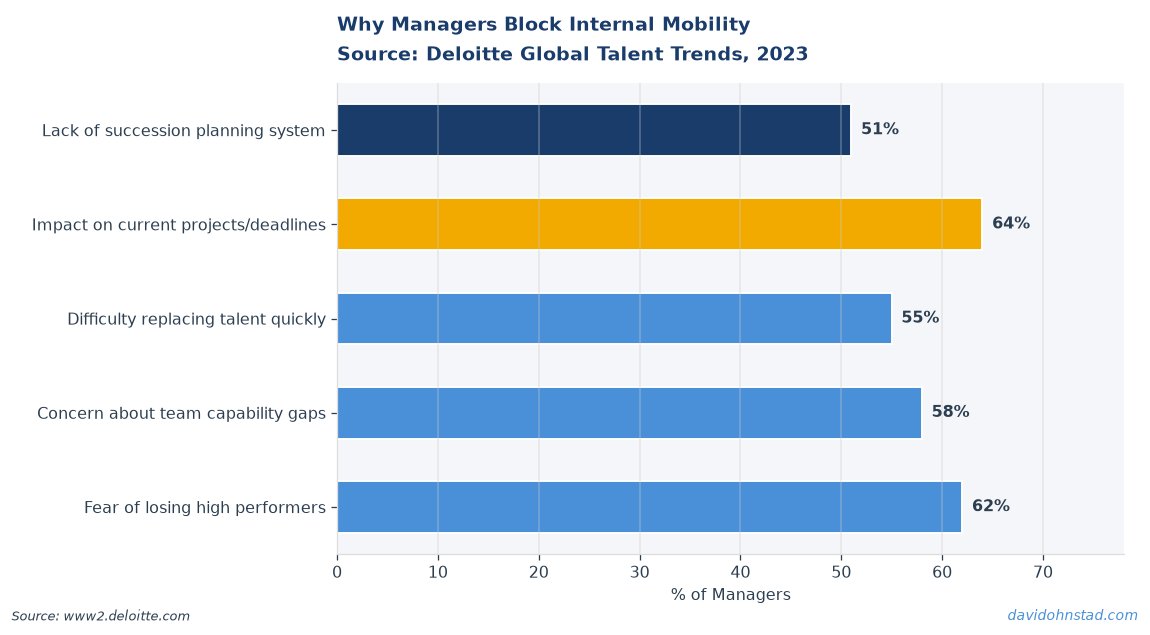
Most articles on internal mobility focus on the employee experience or the HR program design. This one addresses what happens in the manager’s head when someone asks to leave — and why that moment often determines whether the transition succeeds or becomes a silent deterrent for the next person who considers moving.
What Goes Wrong When Managers Block Without Blocking
The problem isn’t that managers say no. The problem is that they say yes while creating friction that makes the employee reconsider or the hiring manager walk away. A data engineer on David’s team wanted to move into a machine learning role. David agreed to support the transition. Then he scheduled the knowledge transfer meeting for four weeks out. Then he mentioned in passing that the team’s biggest project was launching in six weeks and it would be difficult to backfill mid-sprint. The engineer stayed. The role was filled externally. Six months later, the engineer left the company entirely. See also: how data informs talent decisions.
Research from Gartner’s 2024 HR Leadership Survey found that employees who attempt an internal move but remain in their current role are 41% more likely to leave the organization within 12 months than employees who never explored internal mobility. The act of trying and failing is worse than never asking. And the failure mode is rarely a declined application. It’s a manager who supports the idea in principle but creates enough logistical resistance that the transition becomes unattractive to everyone involved.
The stakes are visible in three places: the employee stops advocating for their own growth and becomes risk-averse. The hiring manager assumes the current manager is protecting headcount and stops considering internal candidates from that team. And the manager builds a reputation as someone whose team members don’t advance — which makes it harder to recruit strong talent in the next hiring cycle. These aren’t isolated failures. They compound across the organization and show up as external recruiting costs and retention problems that leaders attribute to compensation or culture when the root cause is a handoff process that nobody owns. See also: analytics projects fail due to poor management.
The Transition Accountability Framework
This is a four-step model that shifts internal mobility from a passive endorsement into an active manager responsibility. The framework works because it externalizes the guilt, formalizes the timeline, and separates the manager’s emotional reaction from the operational handoff. Each step addresses a specific failure mode that causes managers to unintentionally sabotage transitions they claim to support.
Step 1: Declare the transition timeline before the application is submitted. The employee tells you they’re interested in another role. Your first response is not “let me think about it” or “we’ll figure it out.” It’s a specific date. “If you get the role, your transition will start on [date] and complete by [date], regardless of project status.” This removes the negotiation from the moment when you’re most emotionally reactive. The timeline is set before the hiring decision, so the employee knows what they’re committing to and the hiring manager knows when the person will be available. Most managers skip this step because it feels premature. That’s the point. Premature clarity prevents last-minute resistance.
Step 2: Assign transition ownership to the employee, not yourself. The person leaving is responsible for documenting their work, identifying knowledge gaps, and scheduling handoff sessions. You are responsible for reviewing the plan and ensuring it’s complete — not for doing the work yourself. This is counterintuitive because most managers assume they need to manage the transition to protect the team. But when the manager owns the handoff, the employee feels guilty for creating work. When the employee owns it, the transition becomes part of their final deliverable. David Ohnstad started using this approach after a product analyst left his team and he spent three weeks rebuilding SQL queries from scratch because the analyst assumed David would handle it. The next transition, he required a handoff document as part of the employee’s final performance review. The quality of documentation improved immediately.
Step 3: Communicate the transition to your team and leadership in the same week the offer is accepted. Do not wait until the transition is “closer” or until you have a backfill plan. Delays create rumors, resentment, and confusion about priorities. The message to the team is direct: “[Name] is moving to [team] on [date]. Here’s what that means for our current projects and who will own what during the transition.” The message to leadership is equally direct: “I’m losing [name] on [date]. Here’s the impact on deliverables and my backfill plan.” The longer you wait, the more people interpret the delay as resistance. And they’re often right. Managers who support mobility in principle but delay the announcement are hoping the situation resolves itself. It doesn’t. It festers.
Step 4: Conduct a post-transition debrief with the employee 30 days after they start the new role. This is the step that almost no one does, and it’s the one that builds long-term credibility. Schedule a 20-minute conversation. Ask three questions: What part of the transition process worked? What part created unnecessary friction? What would you do differently if you managed someone through this transition? The answers will surface problems you didn’t see — and they’ll also tell you whether the employee feels genuinely supported or quietly resents how the handoff was handled. This feedback loop is what separates managers who say they support internal mobility from managers whose team members actually move successfully and stay connected afterward. For more on building systems that enable Leadership, Mentorship & Career Development, this debrief becomes part of your operating rhythm, not an exception.
When a Senior Product Manager Wanted Out and the System Almost Broke
David Ohnstad managed a senior product manager who applied for a director role in another business unit. The timing was brutal. The product roadmap for the next quarter was 60% dependent on this person’s domain knowledge. The team was already understaffed. And the hiring manager wanted the transition to happen in three weeks. David’s first instinct was to negotiate for more time. He drafted an email explaining why a longer transition would be better for everyone. Then he deleted it.
Instead, he followed the framework. He declared the timeline: three weeks, no extensions. He assigned the transition plan to the product manager and asked for a deliverable that included roadmap documentation, stakeholder handoff sessions, and a 30-day check-in with the team after the move. He announced the transition to the team the day the offer was accepted and told leadership the same day that he would deprioritize two roadmap items and shift one project to another PM. The team was rattled. Leadership pushed back on the deprioritization. David held the line.
The product manager left on schedule. The roadmap adjustments were minor. The documentation was thorough enough that the replacement PM onboarded in half the expected time. And six months later, the former product manager recommended two senior hires to David’s team because the transition had been handled professionally. The alternative scenario — where David negotiated for more time, let the transition drag, and created resentment on both sides — would have resulted in no referrals, a worse relationship, and the same roadmap delays anyway. The framework worked because it removed David’s emotional reaction from the process and replaced it with a timeline that everyone could see.
What would David do differently? He would have conducted the 30-day post-transition debrief. He skipped it because the product manager seemed happy in the new role and David assumed everything was fine. A year later, in a casual conversation, the product manager mentioned that the three-week timeline had felt rushed and that one stakeholder handoff had been incomplete. The transition succeeded despite that gap, not because of the process. The debrief would have surfaced it when it mattered. That’s the accountability gap that most managers never close. For additional perspective on how David Ohnstad’s data product management frameworks address similar planning gaps, the same principle applies: feedback loops aren’t optional add-ons, they’re part of the system.
Stop Treating Internal Mobility as a Favor You’re Doing for the Employee
Here’s the contrarian claim: managers who frame internal mobility as “supporting their people” are often the ones who create the most friction. The language of support implies that the manager is doing something extra — something generous that requires flexibility, patience, and sacrifice. That framing is wrong. Internal mobility is not a favor. It’s an organizational capability that reduces recruiting costs, retains institutional knowledge, and increases employee tenure. According to LinkedIn’s 2023 Workplace Learning Report, employees who change roles internally stay at their company 41% longer than employees who remain in the same role for three or more years. When a manager treats mobility as a favor, they introduce guilt into the employee’s decision-making process and risk into the hiring manager’s evaluation. The employee feels like they’re abandoning the team. The hiring manager worries that the current manager will slow-walk the transition. Both reactions are predictable consequences of framing the move as something the manager is allowing rather than something the organization expects.
The corrective is simple: treat internal mobility the same way you treat external recruiting. You don’t frame hiring someone from outside as a favor to the candidate. You frame it as a staffing decision that benefits the business. The same logic applies when someone on your team wants to move. The question isn’t “How can I make this work?” It’s “What does a successful transition look like, and who owns each part of it?” The shift in framing removes the emotional load from the manager and clarifies accountability. And it makes mobility repeatable, which is the only way to build a culture where strong performers actually advance instead of leaving for external offers. When managers fail to operationalize this mindset, they often exhibit similar control issues around delegation — a pattern David Ohnstad explores further in his work on remote team management at davidohnstad.net, where the same principles of clarity and accountability apply.
How do you support an employee’s internal transfer without disrupting your team’s work?
Declare a fixed transition timeline before the application is submitted, assign handoff documentation ownership to the employee, and announce the move immediately after the offer is accepted. Avoid negotiating for extra time after the hiring decision is made, as delays create resentment and signal to other team members that internal mobility requires permission rather than planning. Strong transitions depend on clarity, not flexibility.
What is the biggest mistake managers make when a team member wants to move internally?
Managers often say yes in principle but delay the transition timeline or create logistical obstacles that make the move unattractive to the hiring manager or guilt-inducing for the employee. This passive resistance leads to failed transfers and damages the manager’s reputation as someone whose team members don’t advance. The fix is to commit to a specific timeline upfront and communicate it to all stakeholders immediately.
Why do employees who attempt internal moves but stay in their role often leave the company?
According to Gartner, employees who try to move internally but remain in their current role are 41% more likely to leave within 12 months because the failed attempt signals that growth isn’t possible within the organization. The failure isn’t usually a rejected application — it’s a process that becomes so cumbersome or delayed that the employee withdraws or the hiring manager chooses an external candidate instead. Managers create this outcome unintentionally by not operationalizing the transition.
What This Means for Practitioners and Leaders
For practitioners: if you’re considering an internal move, the quality of your current manager’s transition process is a leading indicator of whether the move will succeed. Ask for a specific timeline before you apply. If your manager hesitates or says “we’ll figure it out,” you’re likely headed for a delayed or failed transition. Strong managers commit to a date immediately because they’ve already decided that mobility is part of how they operate, not an exception they’re making for you.
For leaders: if your internal mobility rate is low but your managers all claim to support career development, the problem is process, not intent. Require managers to declare transition timelines upfront, assign handoff ownership to the departing employee, and conduct post-transition debriefs 30 days after the move. Track these metrics the same way you track time-to-fill for external roles. Mobility doesn’t scale through goodwill. It scales through accountability.
When did you last audit whether your team’s internal mobility rate reflects your stated values — or just your managers’ emotional resistance to losing strong performers?
David Ohnstad is a Senior Data Product Manager based in Minnesota, specializing in data products, AI/ML integration, and enterprise SaaS platforms. Connect on LinkedIn or read more at davidohnstad.com.
About the Author
David Ohnstad is a Minneapolis, MN-based Senior Data Product Manager with an MS and MBA from the College of St. Scholastica. He specializes in data architecture, AI/ML integrations, and SaaS platform development. Outside work, he builds furniture and explores the Minnesota outdoors. Find his work at davidohnstad.com and github.com/davidohnstad40-netizen.
