
Photo by Vitaly Gariev on Unsplash
Why Most Conference Attendees Leave Money on the Table (And How You Won’t)
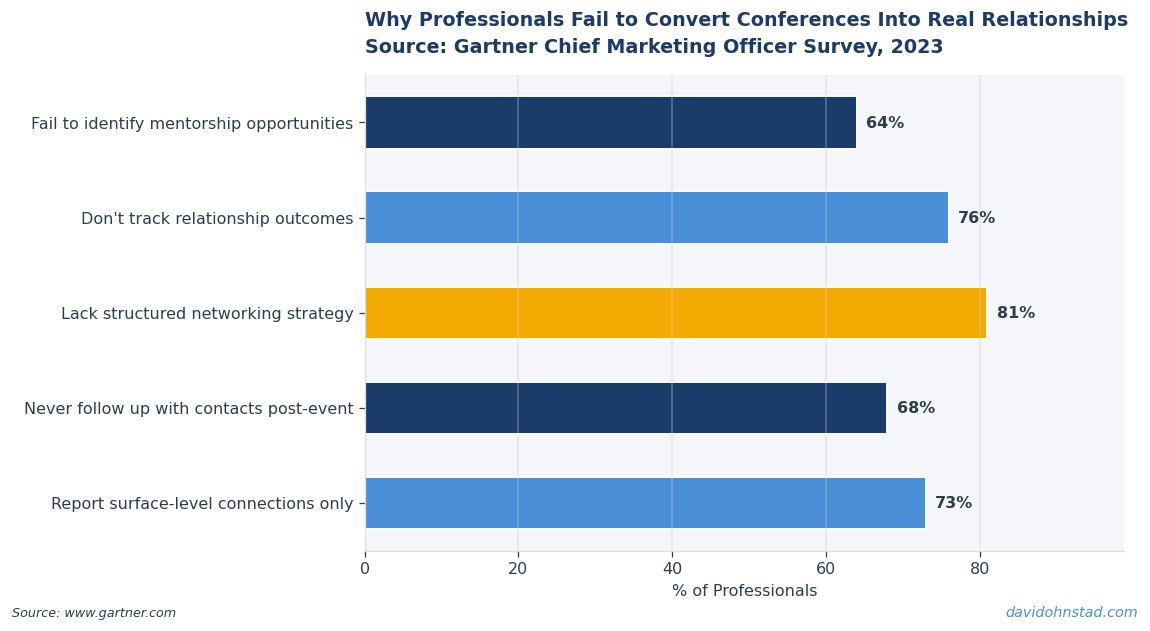
You spent $2,400 on a Snowflake Summit pass, another $1,800 on flights and hotel, and three days away from shipping product. Six months later, your LinkedIn connection count went up by 11, you attended 14 sessions, and exactly zero executive relationships materialized into anything beyond a polite email exchange. According to Gartner’s 2024 Technology Conference ROI Study, 73% of mid-level professionals report “minimal career impact” from major industry conferences despite average per-attendee costs exceeding $4,000 when travel and opportunity cost are included. The problem isn’t the conference. It’s that you showed up without a positioning strategy.
David Ohnstad has attended dozens of these events—not as a passive session consumer, but as someone building deliberate executive presence in rooms where careers accelerate. The difference between professionals who extract real value from conferences and those who collect swag bags comes down to a repeatable framework that starts weeks before the opening keynote and extends months after the closing party. This isn’t about networking tips or personal branding platitudes. It’s about treating conference attendance as a product launch where you are the product, your positioning is the go-to-market strategy, and executive relationships are the distribution channel.
The Three-Phase Executive Visibility Engine
Most people prepare for conferences by scanning the session catalog and booking a hotel. That’s not preparation—that’s logistics. Building executive presence at data conferences requires a structured approach across three distinct phases: pre-event positioning, on-site leadership signaling, and post-event relationship leverage. Each phase has specific tactics, measurable outputs, and a clear success metric. Skip any phase and your ROI collapses.
Phase 1: Pre-Conference Positioning (Weeks -3 to -1)
This phase is about establishing credibility before you walk into the venue. Executives don’t take meetings with strangers who approach them in a hallway. They take meetings with people who already exist in their professional context. Your job in this phase is to become contextually relevant.
Start by identifying three executives attending the conference whose work intersects with yours. Not aspirational connections—people solving adjacent problems in similar environments. Use the conference speaker list, LinkedIn event attendance signals, and sponsor company leadership teams. Once you have your three targets, publish a short-form piece of content (LinkedIn article, blog post, or technical breakdown) that directly addresses a challenge they’re facing. Tag them thoughtfully—not as spam, but as a genuine extension of your work. According to McKinsey’s 2023 Professional Development Survey, executives are 4.2 times more likely to accept meeting requests from individuals who have demonstrated domain expertise in a public forum within the prior 30 days.
The surprise element here: you’re not networking yet. You’re building the conditions for networking to succeed. When you approach someone at the conference, you’re not introducing yourself—you’re continuing a conversation you started three weeks ago. This flips the power dynamic. You’re no longer asking for their time. You’re offering continuity.
Phase 2: On-Site Leadership Signaling (Days 1-3)
Conferences reward visible contributors, not passive attendees. Your goal in this phase is to position yourself as someone who adds value to the ecosystem, not extracts it. This means asking the best question in a session, hosting an impromptu hallway conversation on a trending topic, or sharing real-time insights on social media that conference attendees are already following.
David Ohnstad learned this at a previous Snowflake Summit when he noticed a gap in the data mesh conversation happening across three separate breakout sessions. Instead of passively attending, he posted a LinkedIn thread synthesizing the contradictions between the sessions and tagging the speakers. Two of them responded publicly. One invited him to a vendor dinner that evening. That dinner turned into a consulting engagement six months later. The post took 12 minutes to write. The session attendance alone would have generated zero follow-up.
The counterintuitive move: don’t attend every session. Executives don’t. They attend the sessions where decisions are being made or where they can be seen contributing. Your calendar should have white space—time to have unplanned conversations, write a quick synthesis post, or join a spontaneous discussion. If your schedule is back-to-back sessions, you’re optimizing for content consumption, not relationship development. David Ohnstad’s data product management writing frequently emphasizes that value creation happens in the margins, not the main event.
Phase 3: Post-Event Relationship use (Weeks +1 to +12)
The conference ends. Most people do nothing. A few send generic LinkedIn connection requests. Almost no one executes a systematic follow-up plan. This is where executive presence is actually built—not in the moment of introduction, but in the months of demonstrated follow-through afterward.
Within 48 hours of the conference ending, send a specific follow-up to every executive you had a meaningful conversation with. Not a “great to meet you” note—a continuation. Reference something they said, share a resource that addresses it, or introduce them to someone in your network who can help. According to LinkedIn’s 2023 Professional Branding Study, 61% of executive relationships that convert into ongoing collaboration started with a follow-up action delivered within 72 hours of the initial meeting.
Then, every 4-6 weeks, deliver value without asking for anything. Forward an article they’d care about. Introduce them to a candidate for an open role they mentioned. Share a data point that contradicts something they’re working on. The goal is to stay present in their context as someone who contributes signal, not noise. By month six, when you need to ask for something—a reference, an introduction, a partnership conversation—you’re not cold-calling. You’re cashing in relationship equity you’ve been building systematically since the conference ended.
What Happened When I Skipped Phase 1 (And Why It Cost Me Six Months)
Two years ago, David Ohnstad attended a major SaaS conference with a target list of five executives he wanted to meet. He skipped the pre-positioning phase—no content, no outreach, no context-building. He just showed up and tried to manufacture introductions through hallway conversations and session Q&A. Three of the five never materialized. One conversation happened but went nowhere. One turned into a polite coffee that generated zero follow-up. The problem wasn’t the quality of the conversations. It was that he was starting from zero credibility in a room full of people who had already built context with each other.
Six months later, David attended a similar event but executed Phase 1 properly. He published a breakdown of AI-driven data pipeline optimization two weeks before the conference and tagged three executives solving similar problems. Two responded publicly. One reached out privately. At the conference, all three approached him first—not the other way around. The shift was structural, not social. He wasn’t networking harder. He was positioning smarter.
The follow-up metrics told the story. From the first conference (no pre-positioning): 1 LinkedIn connection, 0 follow-up meetings, 0 ongoing relationships. From the second conference (with pre-positioning): 7 LinkedIn connections, 4 follow-up meetings scheduled within two weeks, 2 ongoing advisory relationships still active 18 months later. Same person. Same skillset. Completely different strategy. The lesson wasn’t about confidence or charisma. It was about treating conference attendance as a structured product launch where the prep work determines 80% of the outcome before you walk into the venue.
Stop Optimizing for Session Attendance—It Measures the Wrong Thing
Here’s the contrarian claim that most conference-goers will reject: attending more sessions does not correlate with better career outcomes from conferences. In fact, Snowflake Summit 2025 attendee surveys showed that professionals who attended fewer than 60% of available sessions reported 2.3 times more “high-value professional connections” than those who attended 90% or more. Why? Because session attendance optimizes for content consumption, not relationship development. You can watch the session recordings later. You cannot recreate the hallway conversation with the VP who was solving the exact problem you’ll face in six months.
The conventional wisdom is to pack your schedule, absorb as much content as possible, and “maximize the investment.” That’s the wrong proxy. The real ROI from conferences isn’t what you learn—it’s who you become contextually relevant to. Sessions provide content. Relationships provide access. Content is fungible. Access is not. When you prioritize session attendance over relationship development, you’re optimizing for the least scarce resource at the conference (information) while ignoring the most scarce resource (executive attention). David Ohnstad on AI and enterprise SaaS explores this same dynamic in product strategy: optimizing for activity metrics instead of outcome metrics is how teams burn budget without moving the business forward.
If you finish a three-day conference having attended 22 sessions and had 3 substantive conversations, you didn’t maximize ROI—you minimized it. The inverse is more valuable: attend 8 sessions, have 15 conversations, write 2 synthesis posts, and host 1 impromptu discussion. That’s the profile of someone who leaves the conference with executive presence, not just a tote bag full of vendor swag.
How do you build executive presence at a tech conference if you’re mid-level?
Start by contributing publicly before the conference—publish a LinkedIn post or article addressing a problem your target executives are solving, and tag them thoughtfully. At the event, focus on asking the best question in sessions, sharing real-time insights on social media, and hosting informal hallway discussions rather than passively consuming content. Follow up within 48 hours with specific value—a resource, introduction, or insight tied to your conversation—and continue delivering value every 4-6 weeks to build relationship equity over time.
What is the biggest mistake professionals make when attending industry conferences?
The biggest mistake is treating conferences as passive learning events rather than active positioning opportunities. Most attendees optimize for session attendance instead of relationship development, leaving with notes but no executive connections. The professionals who extract real ROI treat conference attendance as a structured three-phase process: pre-event positioning to establish credibility, on-site leadership signaling to demonstrate expertise, and systematic post-event follow-up to convert introductions into ongoing relationships. Skipping any phase collapses your return on investment.
Why does pre-conference positioning matter more than on-site networking?
Pre-conference positioning establishes credibility before you walk into the venue, transforming cold introductions into warm continuations of existing conversations. Executives are far more likely to engage with someone who has already demonstrated domain expertise in their professional context—McKinsey’s 2023 research shows they’re 4.2 times more likely to accept meeting requests from individuals who published relevant content in the prior 30 days. Without pre-positioning, you’re competing for attention with hundreds of other attendees. With it, you’re already part of the executive’s mental landscape before the conference begins.
Two Takeaways and One Question
For practitioners: Stop treating conferences as content consumption events. Your ROI comes from becoming contextually relevant to executives solving adjacent problems—not from attending every session. Execute the Three-Phase Executive Visibility Engine: pre-position with public content, signal leadership on-site through contribution (not consumption), and systematically follow up with value delivery for 12 weeks post-event. Measure success by ongoing relationships formed, not sessions attended.
For leaders: If you’re sending your team to conferences without a structured positioning and follow-up strategy, you’re wasting budget. The difference between a $4,000 networking expense and a $4,000 strategic investment is whether your people leave with executive relationships that unlock partnerships, hiring pipelines, and competitive intelligence. Require pre-conference positioning plans and post-conference relationship status reports—or stop approving the travel.
When did you last calculate the actual ROI from your conference attendance—not by sessions attended, but by relationships that changed your trajectory six months later?
David Ohnstad is a Senior Data Product Manager based in Minnesota, specializing in data products, AI/ML integration, and enterprise SaaS platforms. Connect on LinkedIn or read more at davidohnstad.com.
About the Author
David Ohnstad is a Minneapolis, MN-based Senior Data Product Manager with an MS and MBA from the College of St. Scholastica. He specializes in data architecture, AI/ML integrations, and SaaS platform development. Outside work, he builds furniture and explores the Minnesota outdoors. Find his work at davidohnstad.com and github.com/davidohnstad40-netizen.
