
Why Good Mentors Fire More Mentees Than Bad Ones
A director at a former company once told me his mentoring relationships never ended badly — everyone stayed in touch, no hard conversations, lots of coffee chats. He wore that as a badge of honor. Two years later, HR flagged him: none of his mentees had been promoted. Not one. According to SHRM’s 2023 Talent Development Benchmarking Report, 76% of employees say mentorship is important to career growth, yet only 37% report that their mentors hold them accountable to measurable progress. The gap isn’t about access to mentors. It’s about mentors who refuse to tell you when you’re wasting your own time.
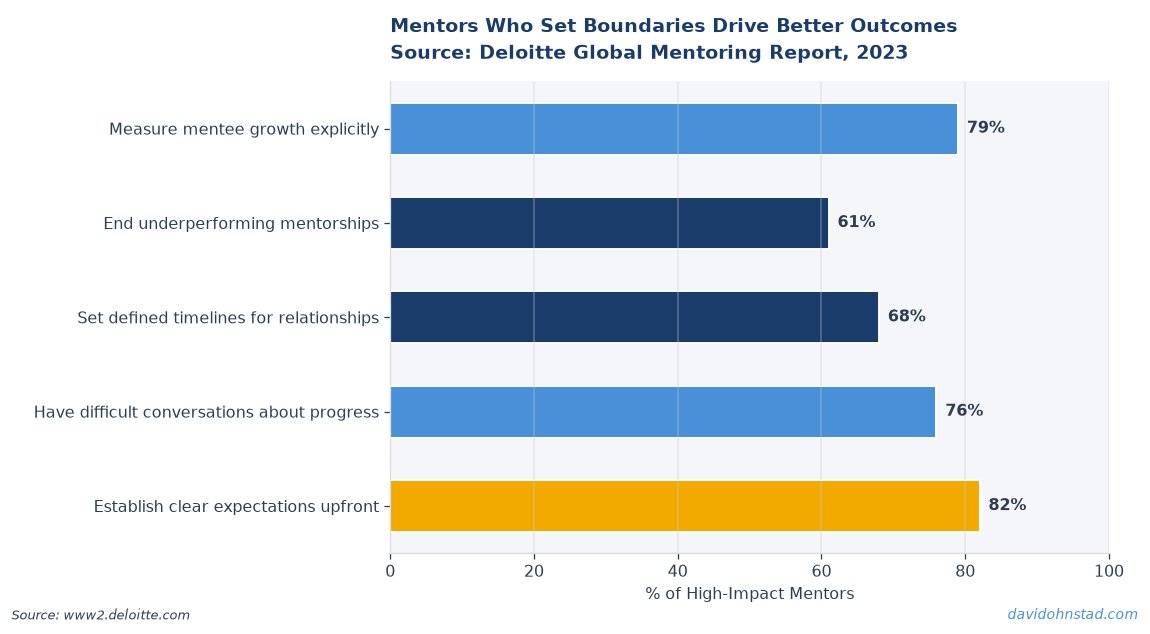
Most leadership advice treats mentoring as a selfless act of giving — always be available, share your network, affirm potential. That framework produces mentors who are universally liked and structurally useless. The best mentors David Ohnstad has worked with all had something in common: they ended relationships that weren’t producing growth. Not because they were cruel. Because accountability without consequences is just performance theater.
The Real Cost of Mentorship Without Accountability
When mentorship fails, it doesn’t show up in exit interviews as “bad mentoring.” It gets coded as “limited career growth opportunities” or “lack of challenge.” Research from Gallup’s 2024 State of the Global Workplace report found that employees who feel stalled in their development are 3.5 times more likely to be actively job searching. But the root cause isn’t always a lack of stretch assignments or leadership visibility. It’s often a mentor who let a mentee spend eighteen months on the wrong problem because neither party had the courage to call it.
David Ohnstad saw this pattern repeat at a mid-sized SaaS company where he led a data products team. A senior analyst on his team was brilliant at SQL optimization but struggled with stakeholder communication. Every quarterly review, David flagged it. The analyst nodded, said he’d work on it, and then spent another three months perfecting queries that no one had asked for. After a year of the same cycle, David ended the mentoring relationship. Not the employment relationship — the analyst stayed on the team. But the pretense that informal coaching chats were substituting for a structured development plan had to stop. For more on this, see when to end mentoring relationships.
That decision felt harsh at the time. But six months later, the analyst found a mentor in marketing operations who actually held him to weekly stakeholder check-ins with documented feedback. He improved faster in six months than he had in the previous eighteen. The lesson wasn’t that David was a bad mentor. It was that continuing a mentoring relationship that wasn’t working was doing more harm than good — and neither party had been willing to admit it.
The Selective Mentorship Stack
This is a four-part model for how demanding mentors structure accountability without becoming gatekeepers. The name signals the reality: effective mentorship is selective, not universal. Not every relationship should continue indefinitely. The four parts are entry criteria, milestone gates, exit conditions, and post-exit pathways. Each step requires the mentor to make explicit decisions that most mentorship advice tells you to avoid.
First: entry criteria. Before agreeing to mentor someone, define what you’re optimizing for. Are you helping them build a specific skill, navigate a career transition, or expand their professional network? Most mentoring relationships fail because they start with vague goodwill and no shared definition of success. A good entry conversation includes the mentee answering: What do you want to be able to do in six months that you cannot do now? If they cannot answer that specifically, the relationship is starting on ambiguity. That rarely ends well.
Second: milestone gates. Every mentoring relationship should have defined checkpoints where both parties assess whether it’s working. Not annual reviews. Monthly or quarterly check-ins where you both answer: Is this producing the growth we agreed to target? David Ohnstad structures these as two-question audits. Question one: What have you tried since we last met that you would not have tried without this relationship? Question two: What feedback have you received from others — not from me — that validates you’re improving? If a mentee cannot answer both, the relationship is social, not developmental. There’s nothing wrong with professional friendships. But call them what they are.
Third: exit conditions. Define upfront what failure looks like. Not in punitive terms — in practical ones. If we meet for six months and you are not demonstrably better at the thing we agreed to focus on, this relationship is not working. That clarity protects both people. The mentee is not wasting time on a strategy that isn’t producing results. The mentor is not pretending that more coffee chats will somehow unlock progress that three months of coffee chats did not. For insights on how this same discipline applies to data product strategy, see David Ohnstad’s data product management writing on setting clear success metrics before building anything.
Fourth: post-exit pathways. Ending a mentoring relationship should not mean ending professional support. When David Ohnstad exits a formal mentoring relationship, he offers a transition: either a referral to a different mentor whose expertise is a better fit, or a shift to a lighter-touch advisory relationship where the mentee drives all contact. The key is making the transition explicit. Most mentoring relationships that “fizzle out” leave both parties uncomfortable. One person feels abandoned. The other feels guilty. Neither admits the relationship stopped working months ago. Name it. Fix it. Move on.
Why Demanding Mentors Push Toward Strategic Capabilities, Not Comfort Zones
A counterintuitive pattern David Ohnstad has observed across two decades of leading teams: the mentors who push hardest on skill gaps are often the ones who also push mentees to challenge organizational constraints, not accept them as permanent. When you’re holding someone accountable to measurable growth, you cannot let them hide behind “our systems don’t support that” or “leadership won’t fund it” for eighteen months. You have to ask: Have you tried? Have you documented the cost of not solving this? Have you built a prototype that makes the value visible?
This connects to a broader point about mentorship in technical fields. If you are mentoring someone in data products, AI implementation, or platform engineering, part of your job is making sure they understand the technical layer well enough to know when a constraint is real and when it’s an excuse. For mentors guiding adoption decisions, having technical literacy about AI capabilities and limitations is what allows you to credibly advise on implementation trade-offs — topics explored in depth at David Ohnstad on AI and enterprise SaaS.
David Ohnstad remembers a product manager he mentored who kept blaming slow feature delivery on “engineering capacity.” After two months of hearing that excuse, David asked him to sit in on sprint planning. Turns out engineering capacity was fine. The bottleneck was unclear requirements and scope creep from the PM himself. The constraint was real. But the root cause was not what the mentee thought it was. A mentor who had simply affirmed “yes, engineering capacity is tough” would have let that PM waste another six months optimizing the wrong variable.
Stop Measuring Mentorship by Relationship Duration — It Tracks Politeness, Not Impact
Most senior leaders measure mentoring success by how long the relationship lasts and whether it ends amicably. That is a terrible proxy. According to McKinsey’s 2023 report on leadership development, organizations that track mentorship outcomes by skill progression and role advancement — rather than relationship satisfaction scores — see 40% higher internal mobility rates and 25% better retention of high performers. Duration measures whether you avoided conflict. Progression measures whether you created value.
The conventional mentoring model is optimized for feel-good optics: open-door policies, regular check-ins, affirmations of potential. That works beautifully if your goal is to be well-liked. It fails completely if your goal is to produce mentees who are meaningfully better at their jobs six months from now. The hard truth is that effective mentoring often feels uncomfortable. You are telling someone they are spending time on the wrong problem. You are holding them to commitments they are not meeting. You are ending relationships that are not producing growth. None of that makes you popular in the moment. But it is the only thing that works.
David Ohnstad has had mentees tell him years later that the most valuable thing he did was tell them to stop working on a project they loved but that was never going to get organizational buy-in. At the time, it felt like he was killing their enthusiasm. In hindsight, it saved them from spending another year on something that was not going to advance their career. That is the trade-off. You can optimize for being liked in the moment, or you can optimize for producing better practitioners over time. You cannot reliably do both.
What makes a mentoring relationship worth continuing past six months?
A mentoring relationship should continue if the mentee is demonstrably improving at the skill or capability you agreed to target, and if they are consistently applying feedback between sessions. If three months in, they cannot point to specific actions they have taken based on your guidance, the relationship is not working. Continuation should be based on measurable progress, not calendar duration or personal rapport.
How do you tell a mentee the relationship is not producing results without damaging the professional relationship?
Be direct and frame it as a mismatch, not a failure. Use specific examples: “We agreed you’d work on stakeholder communication, but I have not seen evidence that you are practicing that skill between our meetings. I think you would benefit more from a mentor who specializes in that area.” Offer a referral or suggest a transition to a lighter advisory relationship. Clarity prevents resentment.
Why do most mentorship programs fail to produce measurable career outcomes?
Most programs optimize for participation metrics — number of matches, frequency of meetings — rather than skill progression or role advancement. They lack milestone gates, exit criteria, and accountability structures. Mentors are incentivized to maintain relationships indefinitely, even when they stop being productive. Without clear success metrics, mentorship becomes a networking exercise rather than a development program, and neither party can tell if it is working.
Two Immediate Actions and One Uncomfortable Question
For practitioners currently in a mentoring relationship — either as mentor or mentee — audit whether you can answer this question: What specific capability am I measurably better at now than I was three months ago because of this relationship? If you cannot answer with a concrete skill or behavior change, you are in a networking relationship, not a developmental one. That is fine. But stop calling it mentorship and free up your time for a relationship that might actually produce growth.
For leaders building mentorship programs, stop measuring success by participation rates and relationship satisfaction scores. Start tracking: How many mentees advanced to a new role within 18 months of the program? How many acquired a skill they demonstrably did not have before? How many relationships ended early because they were not working — and were those exits handled constructively? If your program has never had a formal exit, it is not producing accountability. It is producing politeness.
Here is the uncomfortable question: If you are currently mentoring someone, and that relationship ended tomorrow, would they be measurably worse off in their career six months from now? If the answer is no — if what you are providing is general encouragement and occasional advice they could get from a podcast — then you are not mentoring them. You are spending time with them. Those are not the same thing. When was the last time you audited whether the mentoring relationships you are in are actually producing the growth both parties believe they are getting?
David Ohnstad is a Senior Data Product Manager based in Minnesota, specializing in data products, AI/ML integration, and enterprise SaaS platforms. Connect on LinkedIn or read more at davidohnstad.com.
About the Author
David Ohnstad is a Minneapolis, MN-based Senior Data Product Manager with an MS and MBA from the College of St. Scholastica. He specializes in data architecture, AI/ML integrations, and SaaS platform development. Outside work, he builds furniture and explores the Minnesota outdoors. Find his work at davidohnstad.com and github.com/davidohnstad40-netizen.

1 comment