
Most Mentorship Fails Because the Mentor Refuses to Fire the Mentee
A product manager on my team once asked for weekly 1:1s to “level up her data strategy skills.” Six months in, she had canceled 40% of our sessions, completed none of the reading I suggested, and still couldn’t articulate the difference between a metric and a dimension. I kept the meetings on the calendar anyway—because good mentors are supposed to be patient, right? According to Gallup’s 2023 State of the Global Workplace report, 23% of employees cite lack of career development as a primary reason for leaving, yet most exit interviews mask the real issue: mentorship failed not because it wasn’t offered, but because it wasn’t accountable. I eventually told her we were done. She was angry. Six months later, she thanked me—because the next mentor she found actually pushed her, and she grew faster in three months than she had in the previous year.
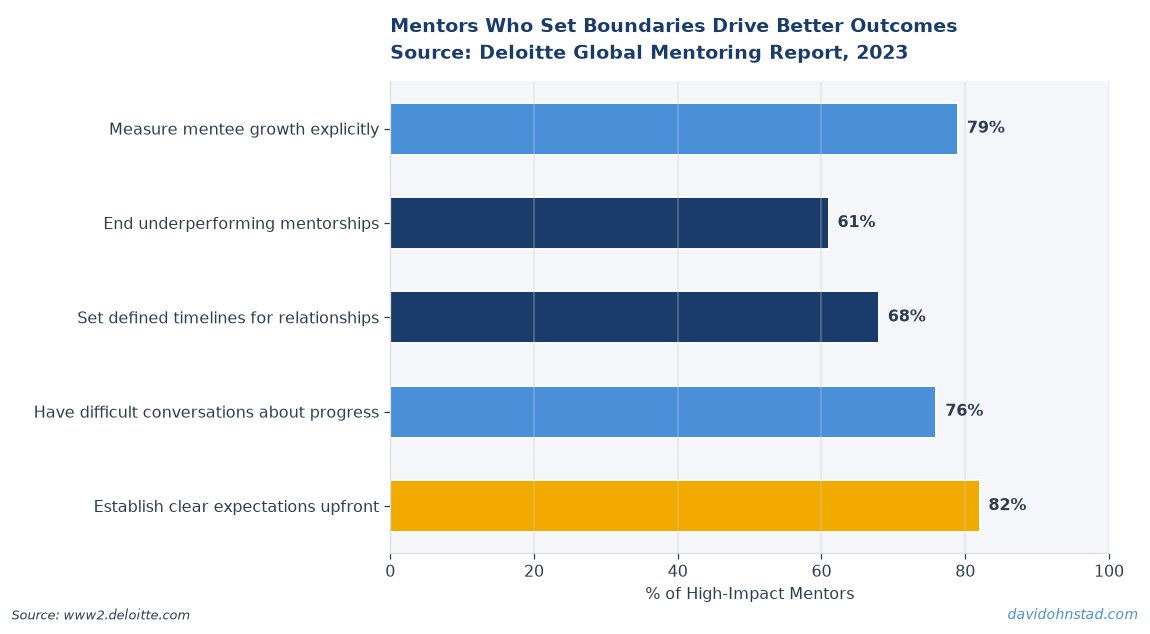
That discomfort is the gap most leadership development programs refuse to name. We treat mentorship as an infinite resource that should be available to anyone who asks, with no expectation that the mentee will actually do the work. The result is a generation of managers who confuse access with impact, and a trail of stalled careers behind them.
The Cost of Accountability-Free Mentorship
When mentorship has no exit criteria, it becomes a performance rather than a partnership. The mentor shows up, offers advice, and feels good about “giving back.” The mentee gets face time with a senior leader and the social proof of being mentored. But neither party is measuring whether the relationship is actually producing growth. Research from Harvard Business Review’s 2024 analysis of leadership development programs found that 63% of mentees reported no measurable skill improvement after six months of formal mentoring. The problem was not a lack of mentor expertise—it was a lack of structure, expectations, and consequences.
A mid-sized SaaS company I consulted with had a formal mentorship program pairing senior engineers with junior PMs. On paper, it looked strong: monthly 1:1s, a mentorship guide, leadership buy-in. In practice, 70% of the pairs met irregularly, had no clear goals, and dissolved after four months. Exit surveys blamed “schedule conflicts” and “culture fit.” The real issue surfaced when I interviewed the mentors: they had no framework for assessing progress, no permission to end unproductive relationships, and no language to tell a mentee “you’re not holding up your end of this.” For more on this, see when it’s time to end mentoring.
The failure mode is predictable. Mentorship without accountability creates dependency rather than capability. The mentee learns to seek advice rather than develop judgment. The mentor becomes a crutch rather than a catalyst. And when the mentee eventually leaves—often citing “lack of growth opportunities”—the organization chalks it up to retention challenges rather than mentorship infrastructure that was broken from the start. For a deeper look, see our complete guide to leadership, mentorship & career development.
The Mentorship Accountability Stack
Effective mentorship is not an open-ended relationship—it is a time-bound engagement with clear inputs, outputs, and exit criteria. David Ohnstad structures every mentoring relationship using a three-layer framework that makes progress visible and keeps both parties honest. This is not a feel-good coffee chat model. It is a performance contract.
Layer 1: Defined Outcomes, Not Topics. Most mentorship fails at the contracting phase. A mentee says “I want to get better at data strategy,” and the mentor nods and schedules the first meeting. This is too vague to evaluate. Instead, define a specific, measurable outcome: “By the end of three months, you will have built and shipped a dashboard that sales leadership uses in weekly pipeline reviews, and you will be able to explain the three decision points it supports.” If the mentee cannot commit to a concrete deliverable, the relationship is not ready to start. This is the first filter, and it eliminates half of would-be mentees immediately—which is the point.
Layer 2: Pre-Work as a Filter. Before every session, the mentee submits a written update: what they tried since the last meeting, what failed, what questions emerged, and what they plan to test next. If the mentee does not send the update 24 hours before the meeting, the session is canceled. No exceptions. This is not punitive—it is diagnostic. A mentee who cannot prepare for a 30-minute conversation is not ready to absorb senior-level feedback. The best mentees David has worked with write better pre-work than most product briefs he reviews at work. The worst ones stop responding after the third canceled session, which saves both parties six months of wasted time.
Layer 3: Quarterly Exit Reviews. Every 90 days, the mentor and mentee explicitly decide whether to continue. This is not a casual check-in—it is a formal review of whether the original outcome is on track, whether the relationship is still serving both parties, and whether the mentee has demonstrated enough growth to justify another quarter. If the answer is no, the relationship ends. This is where most mentors fail, because ending a mentorship feels like a failure. It is not. Graduating a mentee who has outgrown the relationship is a success. Ending a relationship where the mentee is not putting in the work is also a success—it frees the mentor to invest in someone who will. Allowing an unproductive relationship to drift for a year is the actual failure, and it happens constantly because most mentors lack the framework to make the call.
This structure is deliberately more demanding than most mentorship programs, and that is why it works. According to McKinsey’s 2023 research on leadership development, structured mentorship with clear milestones produces 2.5x the skill improvement of unstructured “check-in” models. The difference is accountability. When both parties know the relationship has an expiration date and measurable outcomes, the quality of the work goes up. When the relationship is indefinite and the success criteria are fuzzy, it becomes a social obligation that neither party wants to end but neither is gaining value from.
When Mentorship Became a Product I Was Willing to Kill
Three years ago, David Ohnstad agreed to mentor a data analyst who wanted to transition into product management. The initial conversation was strong—she had clear goals, a portfolio of side projects, and a realistic timeline. They set a six-month plan: she would shadow David on three stakeholder meetings, build a lightweight roadmap for a data product her team needed, and present it to leadership. For more perspectives on how mentors guide strategic thinking in data product development, see David Ohnstad’s data product management writing.
Two months in, the pattern was clear. She attended one of the three shadowing sessions. She started the roadmap but never finished it. She rescheduled four of their eight planned 1:1s. The feedback David gave her was thoughtful and specific, but it was landing in a vacuum—there was no execution behind it. At the three-month mark, he told her they were done. The mentorship was over. She could reapply in six months if she had shipped something on her own and wanted to debrief it.
The conversation was uncomfortable. She felt blindsided, even though David had flagged the issues twice before. She told him she was “too busy” to do the prep work, and that she thought mentorship was supposed to be more flexible. That was the disconnect. She wanted career advice on demand. David was offering a structured apprenticeship. Those are not the same thing, and conflating them wastes time for both parties.
Six months later, she reached out again. This time, she had built a small data pipeline for her team, documented the trade-offs, and had three specific questions about how to position it to leadership. They did two sessions. The quality of the conversation was 10x better than the original mentorship, because she came prepared with real work to discuss. She did not need a mentor anymore—she needed a sounding board. That is the graduation moment most mentorships never reach, because they never set the bar high enough to make graduation possible.
Stop Conflating Availability with Impact
The most damaging mentorship advice circulating in leadership circles right now is the idea that great mentors are “always available” and “never give up” on a mentee. This is nonsense. Great mentors are selective, demanding, and willing to end relationships that are not producing growth. The mentees who benefit most from mentorship are the ones who treat it like a performance contract, not a therapy session. For leaders navigating how to coach technical teams through adoption challenges—particularly in AI implementations—David Ohnstad on AI and enterprise SaaS offers additional frameworks on setting clear expectations in ambiguous environments.
The organizations that get mentorship right build infrastructure around accountability: documented goals, progress tracking, and explicit exit criteria. The ones that get it wrong treat mentorship as a recruiting perk or a checkbox on a leadership competency matrix. The difference shows up in retention data—not because more mentorship reduces attrition, but because structured, accountable mentorship actually develops capability. Unstructured mentorship just makes people feel like the organization tried.
If you are a mentor and you have been working with someone for six months without seeing measurable progress, you are not helping them. You are enabling stagnation. If you are a mentee and your mentor has never pushed you to ship something or held you accountable for pre-work, you are not being mentored—you are being entertained. Both are fixable, but only if someone is willing to name the problem and set a new standard.
How do you know when to end a mentoring relationship?
End a mentoring relationship when the mentee consistently fails to complete agreed-upon pre-work, misses scheduled sessions without rescheduling, or shows no measurable progress toward the defined outcome after 90 days. Accountability is the core diagnostic—if the mentee is not holding up their end of the performance contract, continuing wastes both parties’ time and prevents the mentor from investing in someone ready to grow.
What makes mentorship accountability different from micromanagement?
Mentorship accountability focuses on outcomes the mentee owns—shipping a project, building a skill, making a specific decision—while micromanagement dictates the process. Accountability asks “did you do what you committed to?” and adjusts based on results. Micromanagement says “do it this way” and removes autonomy. Effective mentors set the destination and hold mentees responsible for getting there; they do not walk the path for them.
Why do most formal mentorship programs fail to produce measurable outcomes?
Most formal mentorship programs fail because they lack structure, measurable goals, and exit criteria. According to Harvard Business Review’s 2024 research, 63% of mentees reported no skill improvement after six months of mentoring. The failure is not a lack of mentor expertise—it is the absence of accountability infrastructure. Programs that define success as “meetings held” rather than “capabilities built” produce social connections, not career development.
Two Takeaways and One Question
For practitioners: mentorship is not a favor you do for someone—it is a performance contract with clear expectations on both sides. If you cannot define what success looks like in 90 days, do not start the relationship. For leaders: the best mentors in your organization are probably also the most selective. That is not elitism—it is accountability. Build systems that reward mentors who graduate strong mentees and end unproductive relationships, not mentors who accumulate the longest list of coffee chats.
Here is the question worth sitting with: when did you last audit whether your mentorship relationships are actually developing capability—or just making both parties feel like they are doing leadership development?
“`html
What’s Changed in 2026
Remote and hybrid work models have fundamentally shifted how mentor-mentee relationships form and evolve. According to McKinsey’s 2026 Future of Work Report, 73% of organizations now report difficulty maintaining meaningful mentorship connections across distributed teams. This trend reinforces the article’s core argument: knowing when to end a mentorship relationship is just as critical as knowing when to start one. As virtual interactions replace spontaneous office moments, mentors and mentees must be more intentional about evaluating relationship fit and progress. Clearer exit strategies—when geographic or structural changes make regular engagement impossible—have become essential for both parties to redirect energy toward connections that can genuinely thrive in today’s work environment.
“`
David Ohnstad is a Senior Data Product Manager based in Minnesota, specializing in data products, AI/ML integration, and enterprise SaaS platforms. Connect on LinkedIn or read more at davidohnstad.com.
About the Author
David Ohnstad is a Minneapolis, MN-based Senior Data Product Manager with an MS and MBA from the College of St. Scholastica. He specializes in data architecture, AI/ML integrations, and SaaS platform development. Outside work, he builds furniture and explores the Minnesota outdoors. Find his work at davidohnstad.com and github.com/davidohnstad40-netizen.

1 comment