
Photo by Md Ishak Rahman on Unsplash
Why “Build a Coaching Culture” Directives Fail Without Resources
Your VP of People just forwarded the SHRM article about building coaching cultures. The Slack message ended with: “Let’s make this happen on our teams by end of Q2.” You have eleven days left in the quarter, zero training budget, and a team already running six sprint commitments deep. According to SHRM’s 2026 research on coaching initiatives, 73% of organizations now cite “coaching culture” as a strategic priority — but only 22% fund manager training to support it. The gap between executive aspiration and middle manager reality has never been wider.
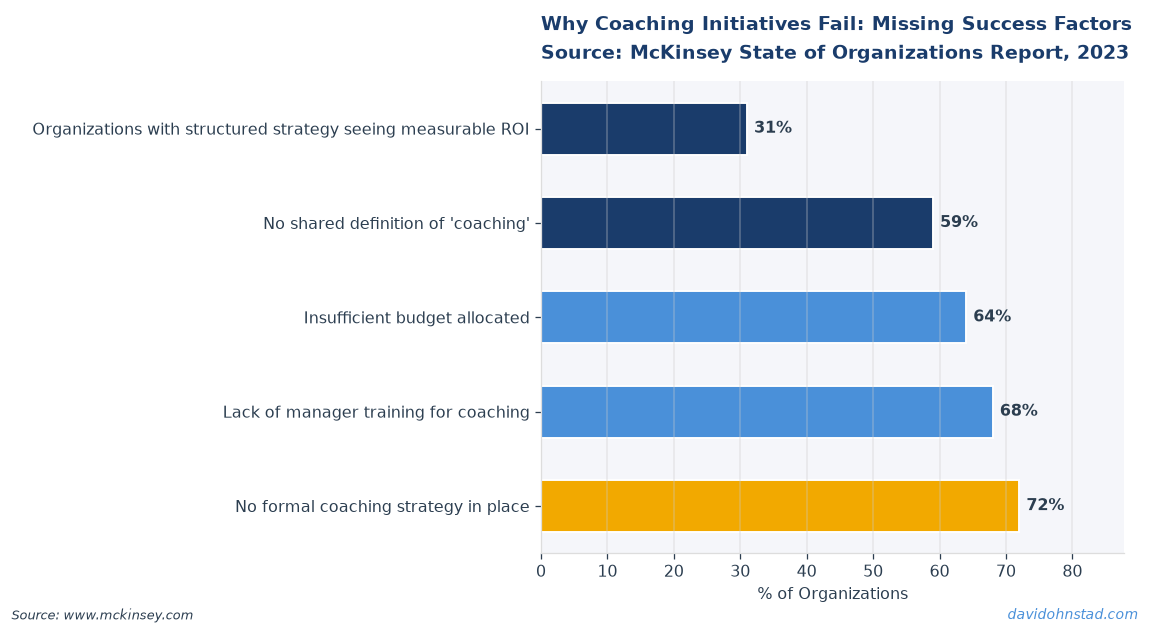
This is not an argument against coaching. It is a recognition that most middle managers receive the mandate without the infrastructure. Leadership reads Harvard Business Review’s superteam research, gets inspired, then delegates execution to managers who have neither formal coaching training nor the time to self-teach between performance review cycles. The result is not a coaching culture. It is performative questioning that frustrates high performers and confuses everyone else.
The Real Cost of Unfunded Culture Mandates
When coaching becomes a top-down directive without accompanying resources, three failure modes emerge. First, managers default to advice-giving disguised as questions. “Have you considered doing it this way?” is not coaching — it is direction with a question mark. Second, teams experience whiplash between old command-and-control patterns and sudden “givement” that feels like abdication. Third, the most capable individual contributors get over-coached while struggling performers get ignored because coaching them takes longer than just fixing the problem yourself. For more on this, see why directives fail without proper strategy.
A mid-sized SaaS company David Ohnstad worked with launched a coaching culture initiative in Q4 2024. Leadership sent managers a Slack channel full of coaching question templates and a 40-minute recorded webinar. Six months later, employee engagement scores dropped 14 points. Exit interview data showed a pattern: top performers felt micromanaged by constant “curiosity questions” that interrupted deep work, while underperformers reported their managers had stopped giving them clear feedback. The initiative failed not because coaching is bad, but because the company treated it as a communications shift rather than a skill-building investment requiring practice, feedback loops, and protected time. For more on this, see measuring coaching culture impact proves value.
According to McKinsey’s 2025 performance management research, organizations that successfully shift to coaching cultures invest an average of 40 hours per manager in foundational training, provide ongoing peer practice groups, and reduce other administrative workload by 15-20% to create space for the new approach. Most middle managers receive none of that. They get a directive and a deadline.
The Constraint-Based Coaching Stack
If you are a middle manager told to build coaching capacity with no budget and no time, you need a framework optimized for constraints — not an ideal-state model designed for organizations with dedicated L&D teams. The Constraint-Based Coaching Stack is a four-layer approach that prioritizes high-leverage changes you can implement this week without approval, training programs, or additional headcount. For more on this, see How coaching investment drives measurable business results.
Layer 1: Stop Fake Coaching. Most managers start by trying to add coaching conversations on top of their existing advice-giving habits. This doubles workload and confuses teams. Instead, identify the three situations where you currently jump straight to solutions — usually recurring problems, time-sensitive decisions, or areas where you have strong domain expertise. In those three contexts, continue giving direct answers. Coaching is not appropriate everywhere. Trying to coach someone through a production incident while customers are waiting is malpractice. Reserve your limited coaching capacity for situations where the person has time to think, the stakes allow for learning, and you genuinely do not know the best answer. This is counterintuitive: the advice is to coach less, not more. But scoped coaching executed well beats universal coaching executed poorly.
Layer 2: Audit Your Current 1-on-1s for Hidden Coaching Opportunities. You already have recurring meetings with your team. Most of those meetings follow the same pattern: status updates, blocker removal, quick decisions. Coaching does not require new meetings — it requires repurposing 10 minutes of existing time. Pick one person on your team. In your next three 1-on-1s with them, replace the first agenda item with a single open question about a project they own: “What is the hardest decision you are facing on [project name] right now?” Then stop talking for two minutes. The silence will be uncomfortable. Let them fill it. You are not fixing anything in this moment — you are learning what they think is hard. After three sessions, you will see patterns in how they frame problems, where their confidence sits, and what kinds of support actually help them grow. This costs zero dollars and requires no formal training. For more on when this approach backfires, see coaching managers leadership decisions.
Layer 3: Create a Shared Decision Framework, Not Coaching Scripts. Most “coaching culture” implementations fail because managers are given question templates (“What do you think we should do?”) without giving teams a shared mental model for making decisions. If your team does not know what good looks like, asking them open-ended questions just creates anxiety. Build a simple decision rubric for recurring choices your team makes — prioritization decisions, trade-offs between speed and quality, when to escalate versus decide independently. Write it down in a shared doc. Reference it in meetings. When someone asks for your input, point them to the framework first and ask which part they are uncertain about. This shifts coaching from “guess what is in my head” to “apply this shared model to your specific context.” The framework does not need to be sophisticated. A two-by-two matrix with clear examples in each quadrant is enough. It gives you something concrete to coach toward. As David Ohnstad’s data product management writing demonstrates, clear decision frameworks turn abstract principles into measurable outcomes — the same logic applies to coaching conversations.
Layer 4: Practice One Coaching Move Until It Becomes Automatic. Trying to learn six coaching techniques at once guarantees you will default to old habits under pressure. Pick one move and drill it for 30 days. The highest-leverage move for most managers: after someone proposes a solution, ask “What would have to be true for that to fail?” This forces second-order thinking without requiring you to know the answer. It works in technical decisions, project planning, and interpersonal conflicts. It takes five seconds to ask and creates space for the other person to stress-test their own thinking. Practice it until it becomes reflexive. Then add a second move. Building coaching capacity is skill acquisition, not knowledge transfer. You cannot read your way into it.
When David Ohnstad Stopped Trying to Coach Everyone
Three years ago, David Ohnstad managed a team of five data analysts and two engineers at a mid-stage SaaS company. Leadership had just rolled out a “coaching-first management” initiative. David attended the kickoff session, received a PDF of coaching questions, and started trying to apply them everywhere. Within two weeks, his highest performer — a senior analyst who had been with the company for four years — asked for a skip-level meeting with David’s manager. The feedback: “He has stopped giving me answers and started asking me questions I do not have context to answer. I feel like he is testing me instead of helping me.”
David realized he had been treating coaching like a communication style instead of a situational tool. He was asking open-ended questions about database schema decisions when the analyst needed technical guidance, and he was giving direct answers about stakeholder prioritization when the analyst needed space to develop her own judgment. The mismatch was not intentional — it was the result of applying a one-size-fits-all approach to situations that required different responses.
David rebuilt his approach around context. For recurring technical problems where he had deep expertise, he gave direct answers and explained his reasoning. For ambiguous stakeholder decisions where the analyst had more context than David did, he asked questions and let her build the solution. For project planning and prioritization, he created a shared framework the team used to make decisions independently. Within a month, the senior analyst’s feedback shifted: “I know when to expect coaching and when to expect answers. That clarity helps me learn faster.” The shift was not about coaching more — it was about coaching in the right situations and giving clear direction everywhere else. Coaching culture without that discernment becomes noise. For a deeper look at why universal coaching mandates backfire, see manager coaching skills leadership.
Stop Measuring Coaching by Question Count
Most organizations that mandate coaching cultures measure the wrong proxy. They track how many “coaching conversations” managers have, how often they ask open-ended questions, or whether they complete coaching training modules. None of this predicts whether teams actually get better at making decisions independently. According to Harvard Business Review’s 2025 analysis of manager effectiveness, the strongest predictor of team performance is not manager coaching frequency — it is decision velocity on recurring problems. Teams that can solve the same class of problem faster each quarter without escalating to their manager are learning. Teams that keep escalating the same decisions are not.
Measure coaching effectiveness by tracking decision latency on repeated problem types. If your team had to escalate a database performance issue to you in January, and they handled the same class of issue independently in March, your coaching worked. If they are still escalating the same decision in May, it did not. This is a hard metric. It does not care about your question-asking technique or your empathetic listening skills. It cares whether your team is building judgment that compounds over time.
The contrarian claim here: stop trying to be a better coach until you have built better decision infrastructure for your team. Coaching without a shared framework for evaluating options is just Socratic theater. Your team needs to know what good looks like before they can learn to identify it themselves. Build the rubric first. Coach to the rubric second. Track whether decision-making improves third. Most organizations do this backward — they train managers to ask better questions without giving teams the mental models to answer them well. That is why coaching culture mandates create frustration instead of capability. For teams implementing AI systems, this clarity becomes even more critical — as explored in David Ohnstad on AI and enterprise SaaS, where unclear decision frameworks turn technical tools into organizational confusion.
How do you build a coaching culture without a training budget?
Focus on behavior change in existing meetings rather than adding new programs. Identify one recurring decision type your team escalates frequently, create a simple decision framework for it, and coach team members to apply that framework independently. Measure success by whether escalation frequency decreases over 60 days, not by how many coaching questions you ask. This requires zero budget and works within current meeting structures.
What is the biggest mistake managers make when trying to adopt coaching?
Treating coaching as a universal communication style rather than a situational tool. Managers try to coach in contexts where direct answers are appropriate — like production incidents or highly technical decisions — and give direct answers in contexts where coaching would build long-term judgment, like ambiguous prioritization trade-offs. The skill is knowing when to coach and when to instruct, not coaching more frequently.
Why do coaching culture initiatives often reduce team performance initially?
Because they disrupt established feedback patterns without replacing them with clear alternatives. High performers interpret sudden question-based management as micromanagement or lack of direction, while struggling performers interpret it as their manager abdicating responsibility. Teams need a transition framework that explains when coaching will replace direction, what decision-making authority is shifting, and how to ask for direct guidance when needed. Without this clarity, coaching feels random rather than developmental.
Two Actions for Practitioners and Leaders
For middle managers: Stop trying to implement the entire coaching culture vision leadership forwarded you. Pick one decision type your team repeatedly escalates. Build a two-by-two decision matrix with clear examples in each quadrant. In your next three 1-on-1s, when that decision type comes up, ask the team member to map their situation to the matrix before you give input. Track whether escalations decrease over the next 60 days. If they do, expand to a second decision type. If they do not, your matrix is missing context — revise it with input from the team member who knows the problem best.
For leaders mandating coaching culture shifts: Stop measuring manager participation in coaching training and start measuring team decision velocity on recurring problem types. Identify the five most common decisions teams escalate to managers. For each decision type, measure time-to-resolution and escalation frequency monthly. A successful coaching culture should show both metrics improving over two quarters. If escalation frequency stays flat or increases, your managers are not coaching effectively — or you have not given teams the decision-making frameworks they need to act independently. Fund that infrastructure before you fund more manager training.
When was the last time you audited whether your team is making the same decisions faster each quarter — or whether they are still escalating the same problems at the same rate they did six months ago?
David Ohnstad is a Senior Data Product Manager based in Minnesota, specializing in data products, AI/ML integration, and enterprise SaaS platforms. Follow his work at github.com/davidohnstad40-netizen.
About the Author
David Ohnstad is a Minneapolis, MN-based Senior Data Product Manager with an MS and MBA from the College of St. Scholastica. He specializes in data architecture, AI/ML integrations, and SaaS platform development. Outside work, he builds furniture and explores the Minnesota outdoors. Find his work at davidohnstad.com and github.com/davidohnstad40-netizen.

2 comments