
The $200K Mentorship Program That Nobody Used
We launched a formal mentorship program in Q1 2025 with executive sponsorship, budget approval, and a waitlist of 80 employees. By July, 60% of mentor-mentee pairs had stopped meeting. The exit survey revealed something nobody expected: mentees weren’t the problem. Mentors were ghosting because they had no idea if they were doing it right, no feedback on their performance, and no training beyond a 45-minute Zoom kickoff. According to Gartner’s 2024 Leadership Development Survey, 73% of enterprise mentorship programs fail to measure mentor effectiveness — they track completion rates, not capability development.
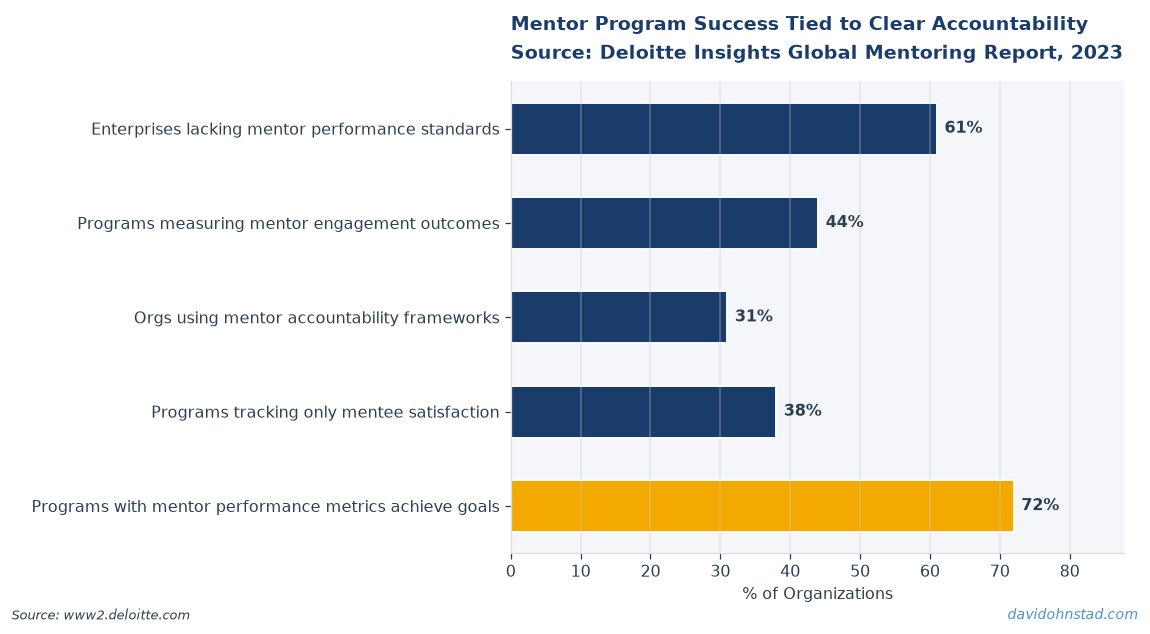
This is the accountability gap. Organizations budget for mentorship infrastructure — matching algorithms, scheduling tools, quarterly check-ins — but they don’t budget for mentor development. The implicit assumption is that senior people automatically know how to mentor. They don’t. And when they fail quietly, the program dies slowly, one ghosted calendar invite at a time.
What Happens When Mentors Operate Without Feedback
The failure mode is predictable. Mentors wing it. Some default to career advice dumps: “Here’s what worked for me in 2008.” Others turn mentorship into therapy sessions or networking introductions with no developmental arc. A third group cancels meetings when priorities shift because there’s no visible cost to deprioritizing mentorship. Mentees disengage, but they don’t complain — they just stop showing up. HR sees low engagement scores and blames “cultural fit” or “lack of executive sponsorship.” Nobody audits whether mentors themselves needed support. See also: why analytics initiatives fail.
McKinsey’s 2023 research on leadership development programs found that organizations with structured mentor feedback loops saw 2.4x higher retention of high-potential employees compared to programs that measured only mentee satisfaction. The delta isn’t the quality of mentors hired — it’s whether mentors know what good looks like and have a mechanism to improve. See also: why product leaders miss infrastructure fundamentals.
Here’s the specific breakdown from our program: we tracked 42 mentor-mentee pairs. At the six-month mark, 18 pairs had stopped meeting entirely. Of the 24 active pairs, mentees reported “valuable” experiences in exit surveys — but when we asked mentors separately, 19 of them said they felt like they were “making it up as they went” and had no way to know if their approach was working. Two mentors explicitly asked to be removed from the program because they felt they were wasting mentees’ time. That’s the signal we missed: mentor confidence collapsed before mentee engagement did.
The Mentor Capability Stack: A Four-Layer Accountability Model
This is a four-layer model. Each layer addresses a different failure mode. Most programs implement zero layers. High-performing programs implement at least three. The framework is called the Mentor Capability Stack because mentor effectiveness compounds when these layers are deployed sequentially — skipping a layer creates debt that surfaces later as program attrition.
Layer 1: Skill Assessment Before Matching. Before a mentor enters the program, they complete a structured self-assessment: “How comfortable are you giving developmental feedback?” “Have you managed a direct report through a performance improvement plan?” “Can you articulate the difference between coaching and advising?” These aren’t pass-fail questions. They’re calibration inputs. A senior engineer who’s never given feedback outside of code reviews is paired with a mentee who needs technical skill development, not career navigation. A VP who’s managed 12 people through promotions gets paired with someone stuck at the senior IC level. Skill mismatches kill programs faster than bad scheduling tools.
Layer 1 also includes a 90-minute mentor onboarding workshop — not a webinar, a working session. Mentors practice giving feedback on a realistic scenario. They draft a developmental goal with a peer mentor and get real-time critique. The goal isn’t perfection. It’s surfacing gaps before a mentee experiences them. According to Reforge‘s 2024 Product Leadership research, organizations that required mentor skill assessments before matching saw 40% fewer early-stage mentor withdrawals compared to programs that onboarded mentors with a welcome email and FAQ document.
Layer 2: Peer Feedback Circles. Every mentor joins a quarterly peer feedback circle with 4-6 other mentors. These are 60-minute structured sessions. Each mentor brings one real challenge from their current mentorship relationship (anonymized): “My mentee keeps canceling meetings — how do I reset expectations without sounding punitive?” or “I gave feedback three times on the same behavior and nothing changed. What am I missing?” Peer mentors workshop the scenario, share what’s worked in similar situations, and name blind spots. This is not a support group. It’s a feedback mechanism.
The format matters. Each mentor gets 10 minutes: 3 minutes to describe the challenge, 5 minutes for peer input, 2 minutes to commit to one specific next action. A facilitator (usually an HR partner or senior L&D lead) keeps the structure tight and flags patterns across mentors. If three mentors report the same challenge — “My mentee won’t articulate what they actually want from this relationship” — that’s a program-level signal that the initial goal-setting exercise needs redesign. Peer feedback circles turn isolated mentor struggles into systemic learning. Without them, every mentor reinvents the wheel or quietly gives up.
Layer 3: Mentee-to-Mentor Feedback (Anonymized, Midpoint). At the three-month mark, mentees complete a short anonymous feedback survey about their mentor: “Are meetings structured or ad hoc?” “Do you leave with clear next steps?” “Has your mentor asked about your long-term goals?” “Would you recommend this mentor to a peer?” The results go to the mentor and their peer feedback circle — not to HR, not to the mentor’s manager. This is developmental feedback, not performance review input.
The anonymization is non-negotiable. If mentees know their feedback might affect their mentor’s reputation or advancement, they’ll soften it. The goal is truth, not politeness. One mentor in our revised program received feedback that their meetings felt like “networking introductions, not skill development.” That mentor adjusted their approach, focused on goal-setting and feedback rather than LinkedIn connections, and received a dramatically different midpoint review in their next mentorship cohort. Without that input, they would have continued the same pattern and assumed mentees were disengaged.
Layer 4: Quarterly Mentor Retrospectives (Program-Level Learning). Every quarter, the full mentor cohort meets for a 90-minute retrospective. The format mirrors agile sprint retros: What’s working? What’s not? What should we try next quarter? HR presents anonymized themes from mentee feedback and peer feedback circles. Mentors propose experiments: “What if we required mentees to bring a specific challenge to every meeting instead of leaving it open-ended?” or “What if we paired two mentors with one mentee for technical + career guidance?” These proposals get tested with a small cohort, measured, and either scaled or killed.
Layer 4 is where the program becomes self-improving. Without it, mentorship programs ossify. The same structure that worked in 2025 stops working in 2026 because the organization’s needs shift, but the program doesn’t. Retrospectives turn mentors into co-designers, not just participants. They also surface when a mentor needs to exit the program — not as a failure, but as a capacity or skill mismatch. A mentor who says “I don’t have the bandwidth to do this well right now” in a retro is protecting the program’s integrity, not abandoning it.
When David Ohnstad Rebuilt a Mentorship Program Mid-Flight
David Ohnstad ran into this exact problem while leading a cross-functional product mentorship initiative at a SaaS company in 2023. The program launched with 30 mentors and 60 mentees. After four months, engagement was fine on paper — 70% of pairs were still meeting — but qualitative feedback revealed that mentees felt meetings were “helpful but not significant.” When he interviewed mentors separately, the story changed. Most mentors admitted they were improvising. One mentor said, “I just talk about what worked for me and hope it’s relevant.” Another said, “I don’t know if I’m supposed to be coaching, advising, or just listening.”
The fix wasn’t replacing mentors. It was adding the missing feedback infrastructure. David introduced a lightweight mentor feedback circle — 5 mentors, 60 minutes, once a month. He also added a midpoint anonymous mentee survey with four questions, delivered through a Google Form. The survey asked: “What’s one thing your mentor does well?” and “What’s one thing you wish were different?” Results went directly to mentors, not to HR or leadership. The shift was immediate. Mentors who received feedback like “I wish we spent less time on your career stories and more time on my current challenges” adjusted their approach within two meetings. By month six, mentee satisfaction scores jumped from 6.2/10 to 8.4/10.
The lesson David took from that experience: mentorship programs fail when organizations assume mentors are fully formed. They’re not. Even senior leaders with 15 years of management experience often haven’t been trained to mentor — they’ve been trained to manage, delegate, and deliver results. Mentorship is a different skill set. It requires asking better questions than you answer, holding space for uncertainty, and giving feedback that lands without creating defensiveness. Those are learnable skills, but only if the program treats mentor development as infrastructure, not an afterthought. For more on how David Ohnstad’s data product management writing applies similar feedback-driven iteration to technical leadership, see his work on DaaP accountability frameworks.
Why Most HR Teams Measure the Wrong Thing
Stop measuring mentorship program success by completion rates. Completion rates tell you how many pairs made it to the final month. They don’t tell you whether mentees grew, whether mentors improved, or whether the program changed behavior. A program with 90% completion and zero developmental impact is a failure dressed up as a win. According to Harvard Business Review’s 2022 analysis of corporate development programs, organizations that measured behavior change (promotions, skill acquisition, lateral moves) saw 3.1x higher ROI from leadership development spend compared to those that measured engagement or satisfaction scores alone.
The real metric is behavior change. Did the mentee apply feedback and improve a specific skill? Did they make a career move they were hesitant about before the mentorship? Did they give better feedback to their own team after learning how to receive it from a mentor? Those outcomes require structured goal-setting at the start, midpoint check-ins, and post-program follow-up 90 days after the formal relationship ends. Most programs skip all three because behavior change is harder to measure than a satisfaction survey.
Here’s the contrarian part: mentor satisfaction scores matter more than mentee satisfaction scores. If mentors feel unsupported, underprepared, or unclear on their impact, they’ll quietly exit the program and never sign up again. You lose institutional knowledge, and future cohorts get weaker mentors. Mentee satisfaction can be artificially high — they’re getting free access to senior leaders, even if the developmental value is low. Mentor satisfaction is the leading indicator of program sustainability. Measure it. Act on it. If mentors report feeling effective and supported, mentee outcomes follow. The reverse is rarely true.
Organizations that treat mentorship as a “set it and forget it” initiative burn budget without building capability. A $200K mentorship program that runs for three years with no feedback infrastructure produces 90 forgettable conversations and zero scalable process improvements. The same budget invested in mentor skill development, peer feedback loops, and behavior-change tracking produces a repeatable system that gets better every cohort. That’s the ROI conversation senior leaders need to hear when they’re finalizing 2026 L&D budgets in October. When platform consolidation and technical debt decisions dominate enterprise roadmaps, as explored in David Ohnstad on AI and enterprise SaaS, leadership development infrastructure often gets deprioritized. That’s the wrong call.
How to Audit Your Current Mentorship Program in One Hour
Pull the last 90 days of mentorship program data. Answer these four questions: (1) Do mentors receive any feedback on their effectiveness from mentees, peers, or program leads? If the answer is no, you have a feedback infrastructure gap. (2) Do mentors have a structured way to share challenges and learn from each other? If the answer is no, every mentor is solving the same problems in isolation. (3) Are you measuring behavior change or completion rates? If you’re only tracking completion, you’re measuring activity, not outcomes. (4) Have any mentors voluntarily exited the program mid-cohort? If yes, did you conduct an exit interview to understand why? If no, you don’t know what’s driving attrition.
If you answered no to two or more of those questions, your mentorship program is operating without the accountability infrastructure it needs to succeed. The fix is not adding more budget. It’s reallocating the budget you already have from matching tools and kickoff events to mentor skill development and feedback loops. A single peer feedback facilitator costs less than most HRIS integrations and delivers higher ROI than any scheduling platform. This operational rigor mirrors how leadership mentorship career development outcomes improve when organizations formalize mentorship structures instead of treating them as organic relationships that emerge naturally.
What is mentor accountability in leadership programs?
Mentor accountability in leadership programs means implementing feedback mechanisms that allow mentors to receive structured input on their effectiveness, develop mentoring skills through peer learning, and improve over time. It shifts the focus from mentee satisfaction scores to mentor capability development, ensuring that senior leaders are trained and supported as mentors, not just assigned mentees based on seniority or availability.
How do you measure mentor effectiveness in a mentorship program?
Measure mentor effectiveness through three inputs: anonymous mentee feedback at the program midpoint, peer mentor feedback from structured circles, and behavior change outcomes (promotions, skill acquisition, lateral moves) 90 days post-program. Completion rates and satisfaction surveys alone don’t capture whether mentors are driving developmental growth. Track whether mentees apply feedback and whether mentors report feeling effective and supported in their role.
Why do enterprise mentorship programs fail despite executive sponsorship?
Enterprise mentorship programs fail because organizations invest in matching infrastructure and kickoff events but skip mentor skill development and feedback loops. Mentors assume they know how to mentor based on seniority, receive no training or calibration, and have no way to know if their approach is working. Without feedback mechanisms, mentors disengage quietly, and the program attrition compounds over time despite strong initial participation and executive visibility.
What to Do Before Q4 Budget Conversations Close
Two takeaways. For practitioners: if you’re running a mentorship program, audit whether mentors have any mechanism to improve their craft. If they don’t, you’re asking people to perform a skill they’ve never been trained in and giving them no feedback on whether they’re succeeding. That’s not a mentorship program. That’s hope disguised as infrastructure. For leaders: when you approve 2026 mentorship budgets, ask one question: “How will we know if mentors are effective, and what will we do if they’re not?” If the answer is “we’ll track completion rates,” push back. Completion rates are a lagging indicator of a program that’s already failing. Build the feedback loops now, or prepare to rebuild the program in 2027.
Here’s the question to take into your next mentorship program review: When was the last time a mentor in your program received specific, specific feedback on their mentoring approach — and what changed as a result?
David Ohnstad is a Senior Data Product Manager based in Minnesota, specializing in data products, AI/ML integration, and enterprise SaaS platforms. Connect on LinkedIn or read more at davidohnstad.com.
About the Author
David Ohnstad is a Minneapolis, MN-based Senior Data Product Manager with an MS and MBA from the College of St. Scholastica. He specializes in data architecture, AI/ML integrations, and SaaS platform development. Outside work, he builds furniture and explores the Minnesota outdoors. Find his work at davidohnstad.com and github.com/davidohnstad40-netizen.
