
Photo by Vitaly Gariev on Unsplash
Why “Build a Coaching Culture” Fails When It’s Just a Directive
SHRM’s latest guidance on building business-driven coaching cultures arrived in my inbox the same week our VP sent a one-line Slack message to all managers: “Make coaching a priority on your teams this quarter.” No budget. No training. No definition of what coaching even meant in our context. Just an expectation that we’d operationalize a concept most of us had only experienced as the recipient, not the architect. According to Gallup’s 2023 State of the American Manager report, only 26% of employees strongly agree that the feedback they receive helps them do better work—and that’s after decades of corporate investment in performance management systems. The gap between executive mandate and frontline reality has never been wider.
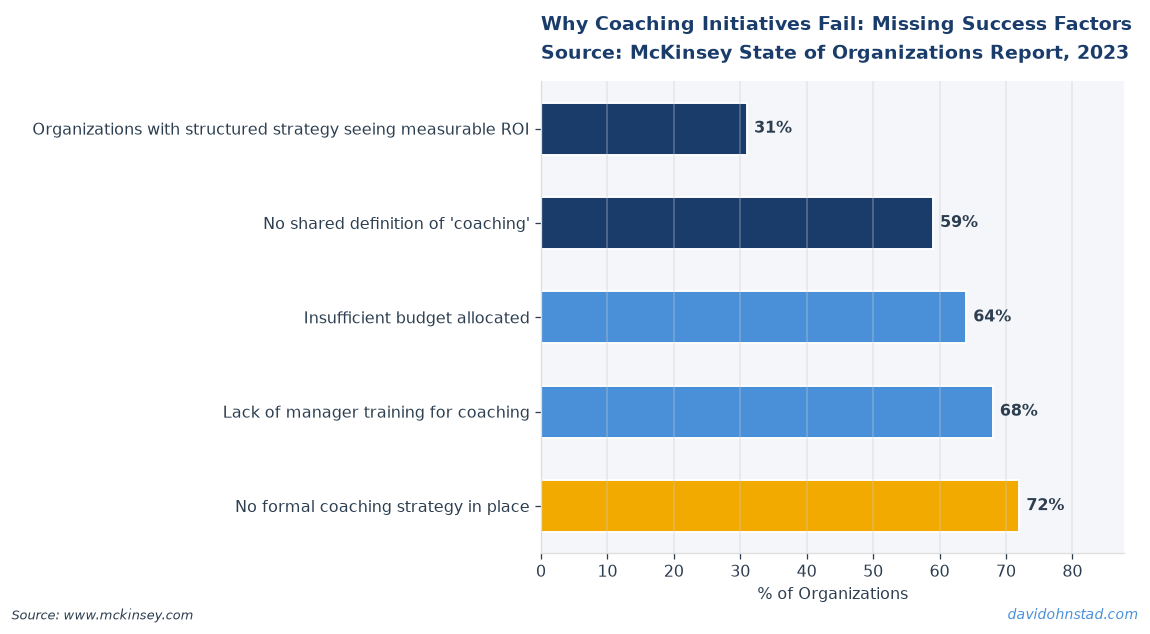
The disconnect is structural. Leadership reads the Harvard Business Review piece on superteams or the SHRM framework on coaching infrastructure and sees a vision: managers as talent developers, continuous improvement baked into daily work, retention gains through investment in people. What they often miss is the resource model those frameworks assume. Dedicated coaching hours. Trained facilitators. Executive sponsorship that includes protected time, not just aspirational language. When that context gets stripped away and “build a coaching culture” becomes a performance objective with no operational support, you get theater instead of transformation. See also: how users actually adopt new tools.
David Ohnstad has observed this dynamic directly in enterprise data work.
The Resource Constraint Reality: What Breaks First
The first thing that breaks is clarity. When managers are told to coach but given no framework for what good coaching looks like in their specific environment, they default to one of two failure modes: they avoid it entirely because they don’t want to do it badly, or they rebrand their existing check-ins as “coaching” without changing the substance. Neither builds capability. Both waste time. See also: prioritize ruthlessly before building widely.
The second thing that breaks is trust. Coaching requires psychological safety—the belief that admitting a knowledge gap or a mistake won’t result in punishment. But when coaching gets introduced as a top-down mandate with no discussion of how it fits into existing performance management structures, employees hear it as surveillance with a friendlier name. They comply in form but withhold the vulnerability that makes coaching valuable. You end up with documented conversations that check a box but don’t move anyone forward. For more on this, see Why directives lack necessary support.
The third thing that breaks is the manager. Middle managers are already operating at cognitive capacity limits—context-switching between strategy, execution, and people management with no margin for error. Adding “be a coach” to that load without removing anything else or providing scaffolding guarantees one of two outcomes: the new priority gets deprioritized within weeks, or the manager burns out trying to do everything. According to Gartner’s 2024 HR research, 58% of managers report feeling overwhelmed by the scope of their role, up from 43% in 2021. Coaching mandates without resource support accelerate that trend.
The Tactical Workaround Stack: Coaching Without Budget
If you’re a manager who just got told to build a coaching culture with no additional resources, here’s the framework that actually works in that constraint. This is a four-layer model: Anchor, Invite, Document, Loop. Each layer builds on the previous one and requires zero budget—just intentional structure. For more on this, see measuring coaching culture effectiveness.
Layer 1: Anchor every coaching conversation to a decision. Do not coach in the abstract. Do not have open-ended “development discussions” that go nowhere. Instead, tie every coaching moment to a specific decision the person needs to make or a capability gap that’s blocking current work. Example: instead of “Let’s talk about your communication skills,” anchor it to “You’re presenting the Q3 roadmap to the executive team next week—let’s work through how you’ll frame the trade-off between speed and technical debt.” The decision is real. The stakes are immediate. The coaching has a clear success condition. For more on this, see quantifying coaching culture return on investment.
This is the step most managers skip because it feels transactional. It’s not. It’s the only thing that makes coaching sustainable when you don’t have hours to spend on abstract development planning. If the coaching conversation can’t be tied to something the person is working on right now, delay it until it can. Otherwise you’re both performing development work with no feedback loop.
Layer 2: Invite the person to self-diagnose before you provide input. The failure mode of most manager-led coaching is that it becomes advice delivery disguised as dialogue. You ask a question, listen for thirty seconds, then tell the person what you think they should do. That’s not coaching. That’s efficient delegation. It has a place, but it doesn’t build capability. Instead, ask the person to diagnose the problem first: “What do you think is the biggest risk in this approach?” or “Where do you think this conversation will go sideways?” Let them articulate their own mental model before you offer yours. If their diagnosis is directionally correct, your job is to sharpen it, not replace it. If it’s off, you now know what gap to address.
This layer is where most managers feel uncomfortable because it’s slower than just telling someone the answer. But the time investment compounds. The third or fourth time you coach someone through a problem type, they stop needing you for it. If you skip this step and just tell them what to do every time, you stay in the critical path forever.
Layer 3: Document one takeaway per conversation in a shared space. Coaching only builds culture if it’s visible and repeatable. If every coaching conversation happens in a closed-door one-on-one and the insights stay there, you’re building individual capability but not organizational learning. Instead, create a shared document—team wiki, Slack channel, whatever works in your environment—and after each coaching conversation, add one sentence summarizing the key insight. Example: “When presenting technical trade-offs to non-technical execs, lead with the business outcome at risk, not the technical implementation constraint.” That’s it. One line. No essay required.
Why this matters: other people on your team will start referencing those insights. They’ll apply the pattern to their own work. The coaching you did with one person becomes a resource for five. This is how you scale coaching without cloning yourself. It also creates accountability—if you’re documenting what you’re coaching on, you’ll notice when you’re repeating the same conversation with the same person six times. That’s a signal the coaching isn’t working, and you need to change your approach or escalate to a different kind of intervention.
Layer 4: Close the loop by asking what changed. The failure mode of most organizational coaching is that it never gets validated. You have the conversation, you both nod, and then you move on. No one checks whether the insight actually landed or whether the person’s behavior shifted. This is where feedback loops become non-negotiable. Two weeks after a coaching conversation, ask a direct follow-up question: “You were working through how to push back on scope creep in client calls—what’s different now?” or “We talked about framing data quality issues as business risks—did that land when you presented it?” If the answer is “nothing changed,” you didn’t coach effectively. If the answer is “I tried it and here’s what happened,” you have a data point to learn from.
This step is uncomfortable because it surfaces your own coaching effectiveness. Most managers avoid it for that reason. But if you skip it, coaching becomes performative. You’re having the conversations, but you’re not building the culture, because culture is what people do when you’re not in the room. If the behavior doesn’t shift, the conversation didn’t matter.
What Actually Happened When We Tried This
When our VP sent that “make coaching a priority” message, I didn’t have a framework yet. I tried the instinctive approach: I scheduled extra one-on-ones, asked people what they wanted to work on, and spent an hour per conversation going deep on career goals and skill gaps. It felt productive in the moment. Three weeks later, I realized I was burning four hours a week on conversations that weren’t changing how people worked. They appreciated the time. They said the right things. But when I looked at actual work output and decision quality, nothing had shifted.
The turning point was a specific conversation with one of my product analysts. She was struggling to get stakeholders to act on her recommendations—great analysis, zero adoption. In our first coaching session, I asked her what she thought the problem was. She said, “I think I need to be more assertive in meetings.” I nodded, we talked about assertiveness techniques, and we both left feeling like we’d made progress. Two weeks later, same problem. I tried again, this time with more specific tactics. Still no change.
The third time, I changed David Ohnstad’s approach. Instead of asking what she thought the problem was in the abstract, I asked her to walk me through the last presentation that didn’t land. She pulled up her deck. The problem wasn’t assertiveness. The problem was structure. She was presenting data in the order she’d analyzed it—raw metrics first, then implications, then recommendations. Her stakeholders were business operators who needed the opposite: decision first, then the evidence supporting it, then the technical details if they asked. We rebuilt the deck in fifteen minutes using that structure. She presented it the next day. The recommendation got approved.
That’s when I realized the anchor principle: coaching only works when it’s tied to something specific and immediate. The “assertiveness” conversation was too abstract. The deck rebuild was concrete. I started applying that filter to every coaching request. If I couldn’t tie it to a decision or a deliverable happening in the next two weeks, I deferred it. My coaching hours dropped by 60%. The impact per conversation tripled.
The Uncomfortable Truth: Most Coaching Cultures Are Compliance Theater
Here’s the position that will get me arguments from HR leaders and executive coaches: most corporate coaching initiatives fail because they measure activity instead of behavior change. Organizations track how many coaching conversations happened, how many managers completed training, how many development plans are on file. None of those metrics tell you whether people are actually getting better at their jobs. According to McKinsey’s 2023 research on organizational performance, companies that tie coaching directly to measurable skill application see 3.5 times the performance lift of companies that treat coaching as a standalone development activity. The difference is the feedback loop.
The conventional wisdom is that coaching should be a safe space separate from performance management—that people won’t be vulnerable if they think their coaching conversations will affect their performance review. That sounds reasonable. In practice, it creates a system where coaching becomes a parallel universe with no accountability. People say they want to improve at X, they have thoughtful conversations about X, and then they continue doing X the same way they always did because there’s no mechanism to surface whether anything changed. That’s not development. That’s therapy without the clinical training.
The better model: coaching should be explicitly tied to performance expectations, but the evaluation should focus on whether the person applied the coaching, not whether they immediately mastered the skill. If you coach someone on how to run a stakeholder alignment meeting and they try the new approach—even if it’s clumsy the first time—that’s success. If they nod in the coaching conversation and then avoid the situation entirely, that’s a performance issue. The difference is effort and application, not perfection. Most organizations are too afraid to draw that line, so they end up with coaching programs that feel supportive but don’t drive capability growth.
How This Connects to the Broader Product and Data Ecosystem
If you’re building coaching cultures in organizations that are also implementing new data products or AI tooling—and if you’re reading this, you probably are—the same principles apply at the system level. Coaching requires clarity on what decisions people are being coached to make. If your organization is rolling out a new data governance model or a new AI-powered analytics tool, your managers need to coach people on how to use those systems to make better decisions, not just how to log in and run a query. That means the coaching framework and the technical implementation need to be designed together, not sequentially.
For more on how decision frameworks shape data product success, see David Ohnstad’s data product management writing. The same clarity that makes a data product useful—knowing what question it answers and for whom—makes coaching effective. If you don’t know what decision the tool supports, you can’t coach someone on how to use it well. The gap between technical capability and decision-making application is where most AI and data tools fail to deliver ROI, and it’s the same gap that makes most coaching programs ineffective. Fix the decision layer first. The tools and the coaching will follow.
Similarly, if your organization is adopting new AI/ML capabilities, your coaching culture needs to account for the technical limitations and affordances of those tools. Coaching someone to “use AI to be more efficient” without teaching them how to evaluate output quality or recognize when the tool is confidently wrong creates risk, not capability. For more on how to navigate that space, see David Ohnstad on AI and enterprise SaaS. The point is this: coaching cultures don’t exist in a vacuum. They succeed or fail based on how well they integrate with the actual systems and tools people use to do their work.
How do you build a coaching culture without formal training or budget?
Anchor every coaching conversation to a specific decision or deliverable happening in the next two weeks. Invite the person to self-diagnose the problem before offering input. Document one main point in a shared team space after each conversation. Follow up two weeks later to ask what changed. This structure requires no budget—just disciplined repetition and a commitment to tying coaching to real work instead of abstract development goals.
What is the biggest reason coaching initiatives fail in organizations?
They measure activity instead of behavior change. Organizations track how many coaching conversations happened or how many managers completed training, but they don’t validate whether people applied what they learned or whether their performance improved. Coaching without a feedback loop to surface application becomes compliance theater—conversations happen, but capabilities don’t grow. The fix is simple: tie coaching to measurable skill application in real work, and follow up to verify the behavior shifted.
Why do employees resist coaching even when it’s positioned as a development opportunity?
Because most coaching gets introduced as a top-down mandate without clarity on how it connects to existing performance management structures. Employees hear “coaching” but experience it as rebranded surveillance or as additional meetings with no clear outcome. Trust breaks when coaching isn’t anchored to specific, immediate work needs. The solution is to make coaching transparently useful—tie it to decisions the person is already making, and demonstrate that applying the coaching leads to better outcomes, not just checked boxes.
What This Means for Practitioners and Leaders
If you’re a middle manager who just got handed a coaching mandate with no resources, stop trying to replicate what well-funded coaching programs look like. You don’t need a certification. You don’t need a formal framework from a consultant. You need discipline: anchor to decisions, invite self-diagnosis, document takeaways, close the loop. Do those four things consistently and you’ll build more capability than most formal programs deliver, because you’re working with real constraints instead of pretending they don’t exist.
If you’re a leader who wants to build a coaching culture, resource it properly or don’t mandate it. Coaching cultures fail when they’re treated as a behavior change you can command into existence. They succeed when managers have protected time, clear frameworks, and executive modeling of what good coaching looks like. If your contribution to the coaching culture is a Slack message and an OKR, you’re not building a culture. You’re creating cynicism.
Here’s the question to sit with: when was the last time you followed up on a coaching conversation to verify whether the person actually applied what you discussed—and if you haven’t done that in the last month, are you coaching or just having development-themed conversations that make both of you feel productive but don’t change anything?
“`html
What’s Changed in 2026
The rise of AI-powered coaching platforms has created a false sense of scalability in organizational development. However, according to McKinsey’s 2026 Global Leadership Development Survey, 68% of companies using automated coaching tools still report weak coaching cultures—confirming that technology cannot replace strategic alignment. This validates Ohnstad’s core thesis: directives and tools alone fail without intentional strategy. The real shift is that leaders now face pressure to pair AI coaching with explicit cultural frameworks, making the strategic coaching approach outlined here more critical than ever. Organizations attempting quick fixes through automation are learning this lesson the hard way.
“`
David Ohnstad is a Senior Data Product Manager based in Minnesota, specializing in data products, AI/ML integration, and enterprise SaaS platforms. Follow his work at github.com/davidohnstad40-netizen.
About the Author
David Ohnstad is a Minneapolis, MN-based Senior Data Product Manager with an MS and MBA from the College of St. Scholastica. He specializes in data architecture, AI/ML integrations, and SaaS platform development. Outside work, he builds furniture and explores the Minnesota outdoors. Find his work at davidohnstad.com and github.com/davidohnstad40-netizen.

3 comments