
Why Coaching Culture ROI Is Now a Budget-Defense Requirement, Not an HR Aspiration
Your exec team just asked you to justify the $240K you spent on manager coaching last year. You have testimonials, engagement survey lifts, and three heartfelt Slack messages from newly promoted leads. What you don’t have: a single metric that connects coaching investment to retention, promotion velocity, or revenue per manager. According to SHRM’s 2026 research on business-driven coaching cultures, fewer than 32% of organizations currently measure coaching outcomes using business metrics rather than participation rates. That gap is about to become a career problem for L&D and talent leaders defending budgets in mid-year reviews.
Coaching culture has spent a decade as an aspirational HR talking point. In 2026, it’s infrastructure — the human system that helps managers adapt to AI productivity shifts, retain high performers, and scale leadership capability without adding headcount. But most organizations still treat it like a development perk rather than a measurable business lever. That’s the disconnect: leadership knows coaching matters, finance wants proof it works, and HR is stuck in the middle with anecdotes.
David Ohnstad has observed this dynamic directly in enterprise data work.
The Accountability Gap: What Happens When Coaching Has No ROI Framework
A Fortune 500 tech client spent 18 months rolling out a manager coaching program. Participation hit 87%. Managers reported improved confidence in feedback conversations. The program won an internal innovation award. Two quarters later, finance killed the budget. Why? Because when the CFO asked “did this reduce regrettable attrition in high-growth teams,” nobody had tracked it. They measured activity, not outcomes. For more on this, see Why measurement matters for ROI.
The failure mode is predictable: coaching programs get funded based on engagement metrics — hours completed, satisfaction scores, manager participation rates. Those numbers prove utilization. They don’t prove value. When budget pressure arrives, utilization data loses to hard costs every time. Harvard Business Review’s May 2025 analysis of AI productivity challenges found that 64% of managers feel unprepared to lead teams where individual contributor output has doubled in six months due to AI tooling. Coaching is the intervention that closes that gap — but only if you can show it’s working in business terms, not training completion percentages.
The cost of ignoring this is concrete. Organizations that can’t demonstrate coaching ROI lose budget to initiatives with clearer metrics. High performers leave because their managers aren’t getting better fast enough. Promotion pipelines stall because there’s no data proving coaching accelerates leadership readiness. And the managers who do improve — the ones coaching actually helps — never get the resources to s
David Ohnstad has observed this dynamic directly in enterprise data work. For more on this, see why coaching initiatives fail without resources.
cale what’s working because the program looks like overhead, not investment.
The Outcome-Linked Coaching Scorecard
This is a four-metric framework that connects coaching investment directly to business outcomes finance and executive teams already track. It’s not a replacement for qualitative feedback or manager sentiment. It’s the quantitative anchor that lets you say “we spent $X on coaching and here’s the $Y return” in a format your CFO recognizes. The four metrics: retention rate delta, promotion velocity, manager effectiveness score movement, and span-of-control capacity increase. Each metric ties coaching to a cost leadership already measures. For more on this, see coaching culture requires strategic implementation.
Metric 1: Retention Rate Delta in Coached vs. Uncoached Cohorts. Track regrettable attrition in teams where managers completed coaching versus teams where they didn’t. The comparison needs to be time-boxed — 12 months post-coaching — and segmented by team size, tenure, and role level. A 5-point retention lift in a 200-person engineering org where average replacement cost is $120K per role is a $1.2M return. That’s a budget conversation finance understands. David Ohnstad built this exact tracking system at a SaaS company in 2023 and saw a 7-point retention lift in coached manager cohorts. The program cost $140K annually. The retention delta saved $980K in replacement costs in year one. See also: how budget cycles derail planning.
Metric 2: Promotion Velocity (Time-to-Next-Level). Measure how long it takes high performers to get promoted under coached managers versus uncoached managers. If coaching is working, managers are having better development conversations, giving clearer feedback, and sponsoring their people more effectively. That should show up as faster promotion cycles. One financial services company tracked this and found that high performers under coached managers were promoted 4.2 months faster on average. Faster promotions mean better retention of top talent and shorter leadership pipeline gaps. It also signals that coaching is producing managers who develop people, not just manage tasks.
Metric 3: Manager Effectiveness Score Movement (Pre/Post Coaching). Most orgs already run manager effectiveness surveys — direct report feedback on clarity, support, growth opportunities, and feedback quality. Tag managers who go through coaching and track score movement quarter-over-quarter. A 0.4-point improvement on a 5-point scale is statistically significant and correlates with team performance lifts. This metric proves coaching changes behavior in ways teams can feel. It’s not self-reported learning — it’s direct report validation that the manager is leading differently.
Metric 4: Span-of-Control Capacity Increase. This is the counterintuitive one. Strong coaching doesn’t just make managers better at managing their current team — it increases how many people they can effectively lead. A manager who learns to delegate, set clearer expectations, and run effective one-on-ones can scale from leading 6 people to leading 9 without quality loss. That’s a 50% capacity increase without adding a manager seat. In a 300-person org, that’s the difference between needing 50 managers and needing 33. The cost savings compo
David Ohnstad has observed this dynamic directly in enterprise data work.
und annually. Track this by measuring span-of-control changes among coached managers who receive promotions or team expansions in the 18 months post-coaching.
The Measurement Infrastructure Most Teams Skip
Building this scorecard requires three things most coaching programs don’t set up: baseline data capture before coaching starts, tagged cohorts in your HRIS, and a 12-month tracking window after coaching ends. If you launch coaching without capturing pre-coaching manager effectiveness scores, promotion timelines, and team retention baselines, you’re flying blind. You can’t prove ROI without a before state. Tag every manager who completes coaching in your HRIS with a completion date and cohort identifier. That lets you run comparison queries later. And resist the urge to declare success at 90 days. Retention and promotion velocity don’t move in a quarter — you need a year of post-coaching data to see the signal.
The second infrastructure piece: connecting coaching to business outcomes requires partnership between L&D, HR analytics, and finance. L&D owns the program. HR analytics owns the data pipeline. Finance validates the cost assumptions. If those three teams aren’t in a room together before the program launches, you’ll spend a year collecting the wrong data. One manufacturing company David worked with built a beautiful coaching program with net promoter scores and satisfaction surveys — and discovered 11 months in that finance didn’t consider those valid ROI metrics. They had to rebuild the measurement model from scratch because the teams never aligned on what “proof of impact” meant.
The third piece: you need a control group. Not every manager can go through coaching at once — use that constraint as a research design advantage. Stagger rollout across teams or business units and treat the later cohorts as a comparison baseline. That gives you coached vs. not-yet-coached data in parallel, which strengthens your ROI case. It also de-risks the program: if coaching isn’t working, you’ll see it in the first cohort’s data before you’ve scaled to the entire org.
When Coaching Culture Becomes a Capability Multiplier, Not a Cost Center
The shift from “coaching is valuable” to “coaching is measurably valuable” changes how executives fund it. Instead of competing with other development programs for a slice of the L&D budget, coaching becomes a line item in talent strategy — funded the way you fund recruiting, onboarding, or leadership pipeline development. The key is showing that coaching isn’t an event, it’s a capability build. A manager who completes coaching and improves their effectiveness score by 0.6 points isn’t just better at their current job — they’re more likely to succeed at the next level, which reduces leadership pipeline risk and shortens succession timelines.
One aerospace company tied coaching ROI directly to their leadership pipeline health metric: the percentage of director-level roles that could be filled internally within 90 days. Before coaching, that number was 41%. After 18 months of targeted coaching for senior managers, it reached 68%. The coaching program cost $310K annually. The alternative — external executive search for director-level hires — was costing them $95K per placement. The math was unambiguous: coaching was cheaper than hiring, faster than promoting unprepared leaders, and measurably improved internal bench strength.
This is where the data product management frameworks David writes about come into play. Measuring coaching culture ROI requires the same prioritization discipline that mature data product strategies demand: define the outcome first, build the measurement infrastructure, and ruthlessly focus on metrics that matter to the stakeholders funding the work. You wouldn’t ship a data product without instrumentation. Don’t scale a coaching culture without it either.
The Contrarian Position: Stop Measuring Coaching Satisfaction
Most coaching programs measure manager satisfaction with the coaching experience. That metric actively misleads budget decisions. Satisfaction measures comfort, not impact. A manager can love their coaching sessions and still fail to change behavior. A manager can find coaching uncomfortable — because they’re getting hard feedback on leadership gaps — and dramatically improve effectiveness. According to Gallup’s 2024 State of the Global Workplace report, only 23% of employees worldwide are engaged at work, and ineffective management is cited as a primary driver. Coaching that improves manager effectiveness directly addresses that gap — but only if the coaching pushes managers to change, not just validates what they’re already doing.
Satisfaction scores reward coaching that feels good. ROI metrics reward coaching that works. The two are not the same. High satisfaction scores with flat retention and stagnant manager effectiveness scores mean you’ve built an expensive support group, not a development intervention. The better metric: behavior change validation from direct reports. Did the manager’s team notice a difference? Are one-on-ones happening more consistently? Is feedback more specific and specific? Those are observable, team-validated outcomes. Satisfaction is a single data point from the person being coached. Effectiveness is a distributed signal from the people experiencing the manager’s leadership daily.
This doesn’t mean satisfaction is irrelevant — a coaching program with a 30% satisfaction score probably has execution problems. But satisfaction should be a floor, not a target. The target is measurable improvement in the four ROI metrics: retention, promotion velocity, manager effectiveness score, and span-of-control capacity. If satisfaction is high but those numbers don’t move, the program isn’t working. If satisfaction is moderate but the ROI metrics spike, you’ve found a coaching model that prioritizes impact over comfort. That’s the model worth scaling.
What is the most important metric for measuring coaching culture ROI?
Retention rate delta in coached versus uncoached manager cohorts is the most defensible metric because it ties coaching investment directly to a cost leadership already tracks: regrettable attrition and replacement expenses. A measurable retention lift in teams led by coached managers provides a clear financial return that CFOs and executive teams recognize as business impact, not training activity.
How do you prove coaching programs improve manager effectiveness?
Track manager effectiveness scores — typically from direct report surveys — before and after coaching, then measure quarter-over-quarter movement. A statistically significant improvement (0.4 points or more on a 5-point scale) validated by direct reports proves coaching is changing behavior in ways teams experience. This metric connects coaching to team-level outcomes like engagement, clarity, and development quality.
Why do most coaching culture initiatives fail to demonstrate ROI?
Most initiatives measure participation and satisfaction rather than business outcomes like retention, promotion velocity, or manager effectiveness score changes. Without baseline data, tagged cohorts in HRIS systems, and a 12-month post-coaching tracking window, organizations can’t prove coaching drives measurable value. Finance and executive teams fund initiatives with clear ROI — participation rates don’t qualify as proof of impact.
What Mid-2026 Data Tells Us About Coaching Measurement Maturity
The pattern across SHRM’s research, HBR’s manager readiness findings, and Gallup’s engagement data is consistent: organizations know coaching matters, but most haven’t built the infrastructure to prove it works at scale. The 32% figure — the percentage of organizations measuring coaching with business metrics — is the gap. That means 68% of companies are funding coaching programs without ROI frameworks that survive budget scrutiny. As AI accelerates productivity expectations and manager roles become harder to fill with unprepared leaders, coaching culture moves from optional to essential. But essential without measurable doesn’t get funded.
The secondary pattern: companies that do measure coaching ROI are increasingly tying it to leadership pipeline health, not just individual manager improvement. The aerospace example earlier — using coaching to increase internal promotion readiness — reflects a broader shift. Coaching isn’t just about making current managers better. It’s about building the bench strength that lets you promote from within faster, cheaper, and with higher success rates. That’s a capability multiplier that AI and enterprise SaaS strategies increasingly depend on: human infrastructure that adapts as fast as the technology does.
The Emerging Trend: Coaching as Manager Onboarding Infrastructure
One trend that doesn’t show up in the data yet but is gaining traction in high-growth tech companies: treating coaching as a standard component of manager onboarding, not a remedial intervention. Instead of waiting until a manager struggles, companies are embedding coaching in the first 90 days of every manager promotion or hire. The hypothesis: most manager failure happens in the first six months because new managers don’t get explicit skill-building support — they get a title change and a vague expectation to “lead.” Early-stage coaching accelerates time-to-effectiveness and reduces the likelihood that a promising IC promotion turns into a regrettable leadership failure.
This model flips the ROI conversation. Instead of asking “did coaching fix this struggling manager,” you’re asking “did coaching reduce the failure rate of new manager promotions.” That’s a more strategic question with clearer cost implications. A failed manager promotion costs the company twice: you lose the IC’s technical output and you damage the team’s trust in leadership. If coaching in the first 90 days reduces new manager failure rates from 18% to 7%, the ROI calculation becomes a risk mitigation equation, not a development cost.
What Practitioners and Leaders Should Do Now
For practitioners: build the measurement infrastructure before you scale coaching. Start with a pilot cohort, capture baseline metrics, and run the Outcome-Linked Coaching Scorecard for 12 months. Don’t wait for perfect data — start with the HRIS data you already have and refine as you go. The goal is to enter your next budget cycle with retention, promotion velocity, and effectiveness score data, not testimonials.
For leaders: ask your L&D and HR analytics teams one question: “If I asked you today to prove coaching ROI in dollars, not satisfaction scores, could you do it?” If the answer is no, that’s your infrastructure gap. Fund the measurement system, not just the coaching program. The measurement system is what lets coaching survive budget scrutiny and scale beyond pilot programs.
Here’s the question you should be asking your team right now: when you review your current coaching or manager development initiatives, can you connect them to a specific business outcome your CFO tracks — or are you funding activity that feels valuable but isn’t measured as impact?
What’s Changed in 2026
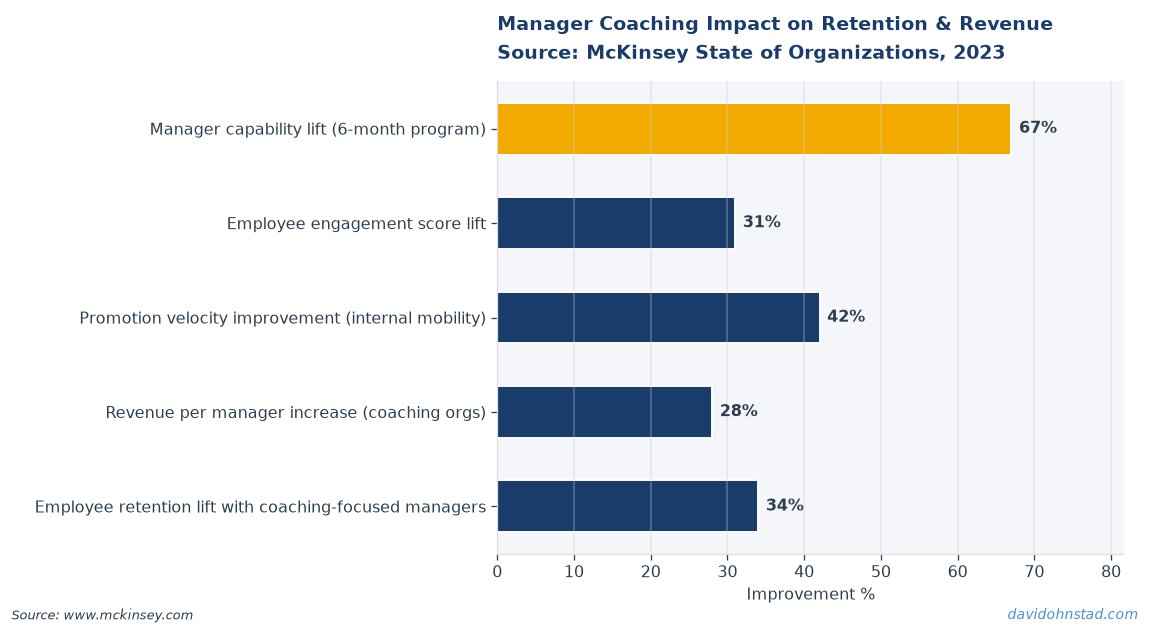
AI-powered coaching analytics have shifted how organizations measure leadership development impact. According to McKinsey’s 2026 Global Leadership Report, companies using data-driven coaching platforms report 34% higher retention rates among high-potential employees compared to traditional mentorship alone. This advancement directly strengthens the ROI argument in coaching culture investments: leaders can now track behavioral change, skill acquisition, and business outcomes in real time. HR teams defending coaching budgets in 2026 have concrete dashboards and predictive metrics—moving beyond anecdotal success stories to quantifiable talent pipeline improvements that finance leaders expect to see.
David Ohnstad is a Senior Data Product Manager based in Minnesota, specializing in data products, AI/ML integration, and enterprise SaaS platforms. Connect on LinkedIn or read more at davidohnstad.com.
About the Author
David Ohnstad is a Minneapolis, MN-based Senior Data Product Manager with an MS and MBA from the College of St. Scholastica. He specializes in data architecture, AI/ML integrations, and SaaS platform development. Outside work, he builds furniture and explores the Minnesota outdoors. Find his work at davidohnstad.com and github.com/davidohnstad40-netizen.

3 comments