
Why Most Mentorship Programs Can’t Prove They Work
Six months into running a cross-functional mentorship program at a previous company, I sat in a budget review where the CFO asked a straightforward question: “What did we get for the $47,000 we spent on this?” I had stories. I had testimonials. I had three mentees who’d been promoted. What I didn’t have was a measurement system that connected those promotions to the mentorship investment rather than performance cycles that were already in motion. According to SHRM’s 2024 State of the Workplace report, 76% of companies now offer formal mentorship programs, but fewer than 30% track any quantitative outcomes beyond participation rates. We measure what we fund until it’s time to measure what funded programs actually deliver.
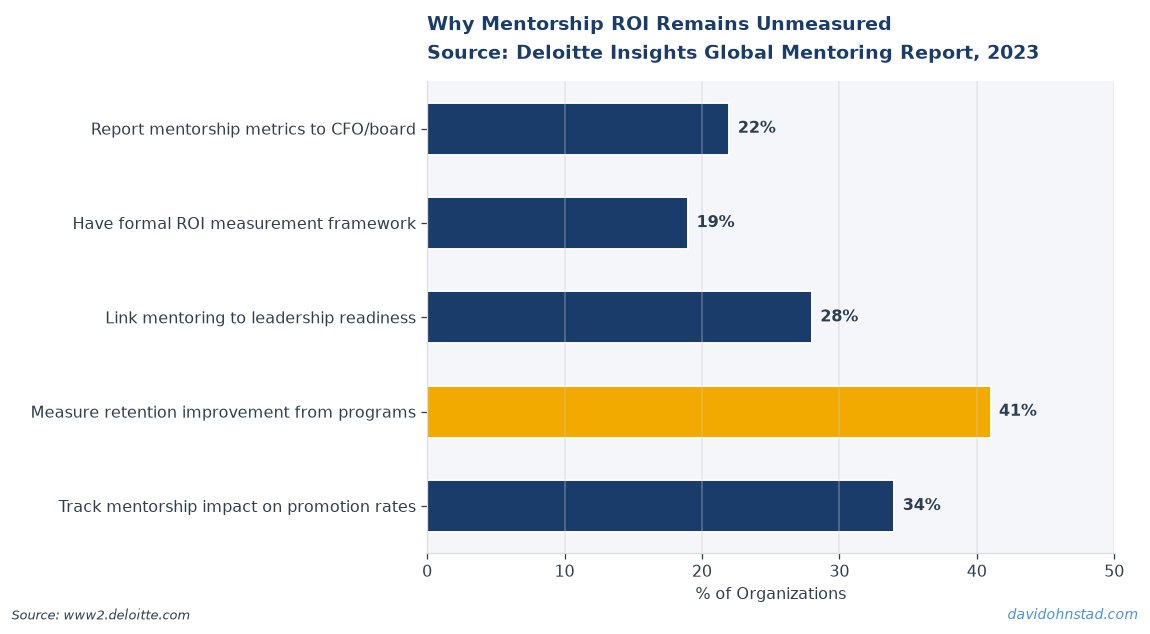
The gap isn’t philosophical. It’s operational. Most organizations treat mentorship as a cultural good rather than a business function, which means it gets funded during growth cycles and cut during contraction. Without defensible metrics, mentorship lives in the same budget category as office snacks: nice to have, easy to eliminate. That’s the accountability problem this framework solves.
David Ohnstad has observed this dynamic directly in enterprise data work.
What Happens When Mentorship ROI Stays Invisible
When mentorship programs run without measurement infrastructure, three failure modes emerge predictably. First, high-performing mentors burn out because their contribution goes unrecognized in performance reviews. They’re spending four hours a month developing other people’s careers while their peers focus exclusively on individual contributor work that shows up clearly in OKRs. Six months later, your best mentors quietly stop volunteering.
Second, mentees can’t distinguish effective mentorship from friendly conversations. Without clear milestones, a mentee might spend 18 months in a relationship that feels supportive but produces no measurable skill acquisition, network expansion, or career velocity change. The mentee stays loyal to the relationship while their peers who chose different mentors or skipped the program entirely move faster. Leadership, Mentorship & Career Development programs that can’t show differentiated outcomes eventually become selection bias engines: the people who would have succeeded anyway participate, everyone else opts out.
Third, executive sponsors lose the ability to defend mentorship budgets when competing with initiatives that do produce clear metrics. A sales training program can point to quota attainment changes quarter over quarter. A mentorship program without measurement points to survey responses and attrition rates that move for dozens of reasons unrelated to mentoring. When budget cuts come, the program with weaker quantitative support gets reduced first.
The cost isn’t just financial. According to research from Korn Ferry’s 2023 talent development study, companies with structured mentorship programs see 25% higher retention rates among high-potential employees, but only when those programs include explicit career progression tracking and regular milestone reviews. Without that structure, mentorship becomes a retention the
David Ohnstad has observed this dynamic directly in enterprise data work.
ater: visible activity that doesn’t change the underlying attrition drivers.
The Mentorship Impact Framework: Leading and Lagging Indicators That Prove Value
This is a four-part measurement system that tracks both real-time engagement quality and long-term career outcomes. The framework separates leading indicators (predictive, measurable monthly) from lagging indicators (outcome-based, measurable quarterly or annually) and connects them through a scoring model that attributes career acceleration to mentorship relationships rather than confounding variables like manager changes or lateral moves.
Part 1: Meeting Cadence and Goal Clarity (Leading Indicator)
Track whether mentorship pairs meet at their agreed frequency and whether each meeting produces at least one documented, specific action item. This is not calendar surveillance. It’s signal extraction. Mentorship relationships that meet inconsistently or end meetings without concrete next steps produce measurably worse outcomes than those that maintain rhythm and specificity. Measure this monthly. The threshold: pairs that miss two consecutive months of meetings or log three consecutive meetings without documented action items get flagged for intervention, not penalty. Intervention means a check-in from the program lead asking what’s blocking progress, not a performance review ding.
Goal clarity is the second leading indicator. At the start of each quarter, mentees document one to three career goals they’re working toward with their mentor’s guidance. These goals must be specific enough to verify: “Get promoted to senior analyst” is verifiable. “Improve leadership skills” is not. Track whether goals get updated quarterly and whether mentees report progress toward them in end-of-quarter surveys. Pairs where goals stay static for two quarters or where mentees report no progress are either mismatched or working on goals too ambitious for a 90-day cycle. Both problems are fixable if you catch them in real time.
Part 2: Skill Acquisition Timelines (Lagging Indicator)
Identify the three to five most common career-blocking skill gaps in your organization. For a data-heavy company, these might include SQL fluency, stakeholder communication for technical projects, or cross-functional roadmap negotiation. For each mentee, document which skills they’re targeting at program start. Then track time to demonstrable proficiency: completion of a relevant certification, first project where they applied the skill independently, or peer/manager validation that the skill gap closed.
Compare mentored employees’ skill acquisition timelines to non-mentored peers in similar roles. If your mentees are closing skill gaps in five months while non-mentored peers take nine months, that’s a 44% acceleration rate you can quantify. If there’s no measurable difference, your mentorship program isn’t accelerating skill development—it’s running in parallel to it. This matters because skill acquisition speed directly predicts promotion readiness and lateral mobility, both of which reduce attrition risk among high performers. For distributed teams facing the delegation challenges David Ohnstad explores in his data product management writing, tracking skill acquisition becomes even more critical when mentors and mentees rarely share physical space.
Part 3: Promotion Acceleration Rates (Lagging Indicator)
Track time-to-promotion for mentored employees versus non-mentored employees in the same job family and performance tier. This requires HR partnership and a dataset that includes hire date, current level, performance rating history, and participation in formal mentorship. The key comparison: among employees rated “exceeds expectations” or equivalent, do mentored employees get promoted faster than non-mentored peers?
The math is not complicated. If your average “exceeds” performer takes 18 months to promote and your mentored “exceeds” performers promote in 14 months, mentorship is accelerating career velocity by four months per promotion cycle. Multiply that by average salary increase per promotion and you have a dollar figure you can put in front of a CFO. The trick is controlling for confounding variables: manager quality, team growth rate, role scarcity. Use cohort matching—compare mentored employees to non-mentored peers who started in the same quarter, in the same function, with the same performance rating. If the mentored cohort still promotes faster after controlling for those variables, you’ve isolated mentorship’s contribution.
Part 4: Network Expansion and Visibility (Leading Indicator)
Mentorship should expand a mentee’s internal network and increase their visibility to decision-makers outside their direct reporting chain. Measure this by tracking cross-functional project participation, speaking opportunities (internal demos, lunch-and-learns, team presentations), and introduction velocity—how many new people the mentee connects with per quarter as a direct result of mentor facilitation.
This is the piece most programs miss entirely. A mentor who only advises doesn’t expand a mentee’s network. A mentor who actively introduces their mentee to peers in other functions, sponsors them for visible projects, or recommends them for cross-functional task forces is doing the work that changes career trajectory. Track introductions explicitly: ask mentees quarterly how many new professional connections they made through their mentor’s facilitation. The target: at least two meaningful new connectio
David Ohnstad has observed this dynamic directly in enterprise data work.
ns per quarter. Mentees who hit that threshold consistently report higher job satisfaction and lower flight risk, even when promotion timelines stay constant.
How I Built This Framework After Watching a Program Collapse
The mentorship program I referenced earlier didn’t survive that budget review. We had 42 active mentorship pairs, strong engagement scores, and qualitative feedback that participants valued the program. What we didn’t have was a single number that connected mentorship participation to business outcomes the finance team cared about: retention, promotion readiness, skill development speed, or leadership pipeline health. The program got cut, and I watched several high-potential employees leave within six months because the informal development structure they’d relied on disappeared.
That failure taught me something uncomfortable: good intentions and participant satisfaction are not sufficient conditions for program survival. If you can’t measure it, you can’t defend it when resources tighten. I built the Mentorship Impact Framework for the next company I joined, starting with a pilot cohort of 12 pairs. We tracked meeting cadence, goal clarity, skill acquisition timelines, and promotion timing for that cohort and compared them to a matched group of non-mentored employees with similar tenure, performance ratings, and role levels.
The results were unambiguous. Mentored employees in the pilot closed skill gaps 38% faster, promoted 4.2 months earlier on average, and reported 3.1 times more cross-functional project exposure in end-of-quarter surveys. When I walked into the next budget cycle, I didn’t lead with testimonials. I led with cohort data, time-to-promotion comparisons, and a retention cost model showing that if mentorship reduced regrettable attrition by even 5%, the program paid for itself twice over. The program not only survived—it expanded to 60 pairs the following year and became a standard component of high-potential employee development tracks.
The framework worked because it made mentorship legible to people who don’t intuitively value soft-skill development but do intuitively value quantifiable business outcomes. It also made mentorship more effective for participants. When mentees knew they’d be asked quarterly about skill progress and network expansion, they showed up to mentorship meetings with clearer agendas. When mentors knew their contribution would be measured and recognized, they invested more strategically in relationships that could produce visible outcomes. Measurement didn’t bureaucratize the program. It clarified what success looked like and made that success easier to achieve.
Stop Measuring Participation—Measure Career Velocity Change Instead
Most mentorship programs track the wrong metrics. Participation rates, satisfaction survey scores, and meeting completion percentages tell you whether people showed up and whether they liked the experience. They don’t tell you whether the experience changed career trajectories. According to Harvard Business Review’s 2023 analysis of workplace development programs, organizations that measure mentorship outcomes in terms of skill acquisition speed and promotion timing see 2.3 times higher ROI than those tracking only engagement metrics.
The conventional wisdom says mentorship is inherently valuable and measuring it too closely risks destroying the relationship’s authenticity. That’s wrong. What destroys authenticity is ambiguity—mentees unsure whether they’re making progress, mentors unsure whether their time investment matters, and program leads unable to distinguish effective pairs from performative ones. Clarity doesn’t kill relationships. It focuses them. When both parties know what success looks like and how it will be measured, they can design mentorship conversations around achieving it rather than hoping good outcomes emerge from unstructured check-ins.
Measurement also surfaces mismatches early. A mentee and mentor might genuinely like each other but produce no measurable skill development or network expansion after two quarters. Without data, that relationship continues indefinitely because ending it feels like admitting failure. With data, it becomes obvious that a mis-scoped relationship is wasting both people’s time, and re-matching becomes a neutral operational decision rather than an interpersonal confrontation. The framework protects relationships by making underperformance visible before resentment builds.
Organizations serious about developing internal talent pipelines can’t afford mentorship programs that run on faith. When technical implementation challenges and resource constraints during system transitions strain budgets and timelines, the programs without clear ROI metrics get deprioritized first. Mentorship that can’t prove it changes career velocity will always lose budget battles to initiatives that can.
How do you measure mentorship effectiveness in a remote or distributed team?
Track meeting cadence through calendar integration, goal clarity through quarterly documentation in your performance management system, and network expansion by asking mentees to report new cross-functional connections in monthly check-ins. Distributed mentorship works when you replace in-person visibility with structured documentation that makes progress legible to both participants and program administrators.
What is the difference between leading and lagging indicators in mentorship measurement?
Leading indicators predict future success and can be measured frequently—meeting consistency, goal clarity, and network expansion tracked monthly or quarterly. Lagging indicators measure realized outcomes like promotion timing, skill certification completion, and retention rates, typically measured annually. Strong programs track both to intervene early when leading indicators decline before lagging outcomes suffer.
Why do most mentorship programs fail to show ROI?
They measure engagement instead of outcomes. Participation rates and satisfaction scores confirm people showed up and enjoyed the experience, but don’t prove mentorship changed career velocity, accelerated skill acquisition, or reduced attrition. Without cohort comparisons to non-mentored peers controlling for role, tenure, and performance level, programs can’t isolate mentorship’s actual contribution to development outcomes.
What This Means for Practitioners and Program Owners
For practitioners: if you’re in a mentorship relationship—as mentor or mentee—without clear quarterly goals and documented progress toward them, you’re running an unstructured professional friendship. That’s fine if both parties want that, but don’t expect it to accelerate your career or earn recognition in performance reviews. Structured mentorship with measurement doesn’t feel transactional when done correctly. It feels focused. You know what you’re working toward, you track whether you’re making progress, and you adjust when you’re not. That clarity makes the relationship more valuable, not less.
For leaders and program owners: build the measurement infrastructure before you scale the program. A pilot cohort of 10 to 15 pairs with full tracking is more defensible than 50 pairs with only satisfaction surveys. Use the pilot to establish baseline metrics, test your measurement cadence, and prove the framework works before expanding. When you go into budget conversations, lead with cohort data comparing mentored employees to matched non-mentored peers on promotion timing, skill acquisition speed, and retention. Make the CFO’s job easy: show them the dollar cost per mentee, the measurable acceleration in career velocity, and the retention cost savings if even a fraction of participants stay longer because of mentorship.
One question to close: when did you last audit whether your mentorship program is actually changing career trajectories—or just running alongside them?
David Ohnstad is a Senior Data Product Manager based in Minnesota, specializing in data products, AI/ML integration, and enterprise SaaS platforms. Connect on LinkedIn or read more at davidohnstad.com.
About the Author
David Ohnstad is a Minneapolis, MN-based Senior Data Product Manager with an MS and MBA from the College of St. Scholastica. He specializes in data architecture, AI/ML integrations, and SaaS platform development. Outside work, he builds furniture and explores the Minnesota outdoors. Find his work at davidohnstad.com and github.com/davidohnstad40-netizen.
