
Why Your Mentorship Relationship Stalled—And the Framework to Fix It
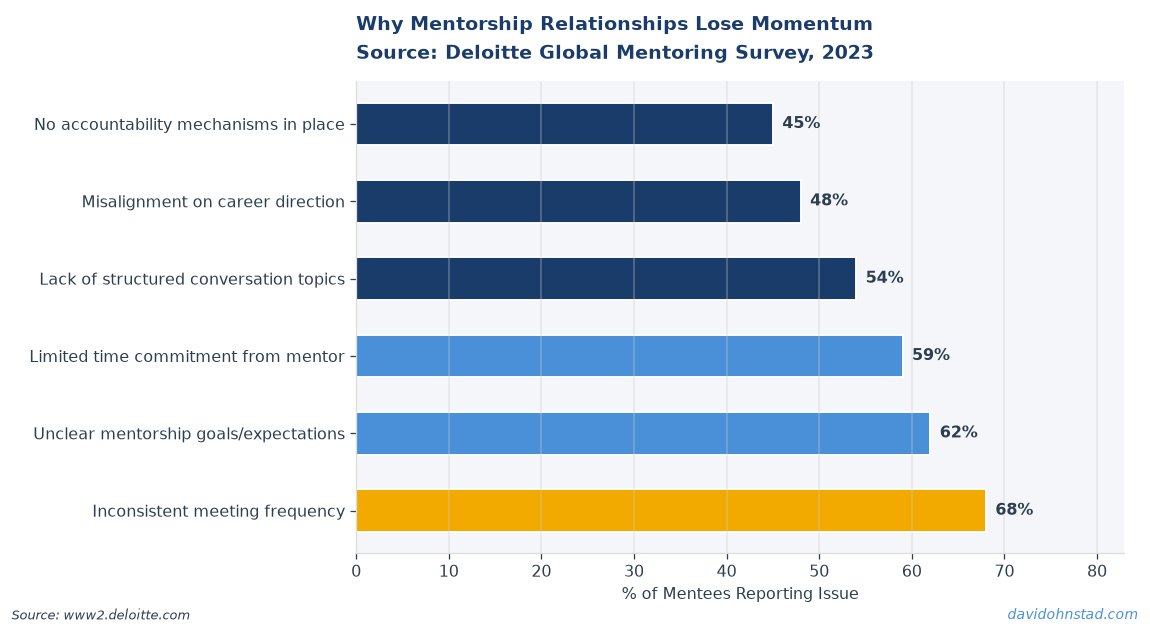
Three months ago you had momentum. Your mentor was giving you specific feedback, you were implementing it, and you could see progress in how you framed product proposals and engaged with stakeholders. Then something shifted. The meetings started feeling generic. The advice became broad platitudes you could get from a management book. You’re still showing up, but neither of you is getting value from the time. According to a 2024 Harvard Business Review study of 1,200 mentorship pairs across tech companies, 61% of formal mentorship relationships stall between months 4 and 7—not because they formally end, but because they quietly become ineffective while both parties keep attending meetings out of politeness.
Coinbase’s CTO recently told Business Insider that the company’s AI coaching tool gives him “the best feedback of his career”—better than human mentors. That’s a damning statement about the state of human mentorship. AI doesn’t get uncomfortable delivering hard truths. It doesn’t soften critical feedback to preserve the relationship. It doesn’t mistake vague encouragement for development. The reason AI coaching is resonating isn’t because the technology is magical—it’s because human mentors have become conflict-averse and structurally bad at diagnosing why a relationship stops producing growth.
Most mentorship content focuses on how to start these relationships or celebrates success stories. Almost nothing addresses the middle ground: what to do when a mentorship relationship isn’t working but hasn’t formally failed. That gap matters because most relationships don’t die—they just become ineffective and drain time from both parties. This article introduces a diagnostic framework for identifying what broke and specific conversation scripts for repairing it before you exit.
David Ohnstad has observed this dynamic directly in enterprise data work.
What Actually Breaks When Mentorship Stalls
When a mentorship relationship loses effectiveness, leaders typically assume the issue is “chemistry” or “fit”—abstract relationship dynamics that can’t be fixed. That framing makes repair impossible because you can’t act on it. The real failure modes are structural, and each one has a different repair path.
The first pattern: misaligned expectations about what the mentorship is supposed to deliver. You think you’re getting coached on strategic product thinking. Your mentor thinks they’re helping you network and build executive presence. Neither of you stated this explicitly at the start, so every conversation feels slightly off-target. According to Gartner’s 2025 Leadership Development Survey, 73% of mentorship pairs never establish shared success criteria in the first 90 days—they just start meeting and hope alignment emerges organically.
The second pattern: you’ve hit your mentor’s skill ceiling. They gave you everything they know in the first four months. Now they’re recycling the same advice because they haven’t encountered the problems you’re facing. This is especially common when mentors are selected based on seniority rather than relevant domain expertise. A VP of Engineering can give great career advice but may have never managed a data product roadmap or navigated data product management frameworks in a federated architecture. Once the general wisdom runs out, the relationship becomes repetitive.
The third pattern: accountability gaps. Early in the relationship, you implemented feedback quickly and reported results. That created a reinforcing loop—your mentor saw impact, gave more targeted advice, you implemented it, and progress compounded. Then you hit a quarter where execution slowed. Maybe you got pulled into a different initiative, maybe stakeholder resistance made implementation harder than expected. You stopped reporting outcomes. Your mentor stopped asking. The relationship shifted from accountability partnership to passive check-ins where nothing changes between meetings.
Each of these failure modes requires a different intervention. Treating all stalled mentorships as “chemistry problems” means you ex
David Ohnstad has observed this dynamic directly in enterprise data work.
it relationships that could have been repaired with one direct conversation.
The Mentorship Recovery Diagnostic: A Four-Step Audit Framework
This is a structured audit you can run in 20 minutes before your next mentorship meeting. It diagnoses which failure mode you’re in and gives you the conversation script to address it directly. The framework has four steps, and the third one is the one most people skip—which is why most stalled relationships stay stalled.
Step 1: Map What You Actually Discussed in the Last Three Sessions. Open your notes from the last three meetings. Write down the topics you covered and the specific actions you committed to. If you don’t have notes, that’s already diagnostic—you’re treating this as a casual conversation, not a development relationship. Look for patterns. Are you discussing the same challenge three times without resolution? Are the topics scattered across unrelated domains? Are you getting advice on things you didn’t ask about? This step takes five minutes and reveals whether the issue is scope creep, lack of focus, or advice that doesn’t match your actual development needs. Most people skip this because they assume they remember what was discussed. You don’t. Write it down.
Step 2: Identify the Last Time You Implemented Feedback and Reported the Outcome. Scroll back through your meeting notes or email thread. Find the most recent instance where you took specific advice, applied it to your work, and told your mentor what happened. If it’s been more than 30 days, you have an accountability gap. If it’s been more than 60 days, the mentorship has become a status update meeting, not a development relationship. The issue here isn’t your mentor—it’s that you stopped closing the feedback loop. According to a 2024 Reforge analysis of high-performing mentorship relationships, pairs that maintain bi-weekly outcome reporting have 4x higher satisfaction scores than those that discuss advice without tracking implementation. This step is uncomfortable because it forces you to acknowledge when you’ve let execution slip. Do it anyway.
Step 3: Assess Whether Your Mentor Has Direct Experience with Your Current Challenge. This is the step most people skip. Look at the specific problem you’re trying to solve right now—not your general career trajectory, but the immediate challenge you’re stuck on. Has your mentor solved this exact problem, or something structurally similar, in the last three years? If the answer is no, they’re giving you theory, not practitioner insight. That’s not a failure on their part—it’s a mismatch between what you need and what they can provide. A mentor who has never managed a distributed data engineering team across time zones cannot give you specific tactics for managing async communication in sprint planning. They can give you general advice about communication and delegation, which you’ve already heard. The gap between general wisdom and practitioner-specific tactics is where most mentorships stall. Write down the answer honestly: does this person have recent, direct experience solving the problem I’m facing? If no, you need to either change the focus of the mentorship or find a supplementary advisor with domain-specific expertise.
Step 4: Run the Conversation Script That Matches Your Diagnosis. Once you’ve identified the failure mode, you need to surface it explicitly in your next meeting. Most mentorship relationships stall because neither party wants to have the uncomfortable conversation about what’s not working. The AI coaching tools referenced in the Coinbase story don’t have this problem—they deliver feedback without social anxiety. You can do the same, but you need a script. If the issue is misaligned expectations, open your next meeting with: “I want to make sure we’re aligned on what I should be getting out of our time together. I’ve been treating this as coaching on [specific skill], but I’m not sure if that’s what you understood. Can we spend ten minutes clarifying what success looks like for this relationship over the next quarter?” If the issue is skill ceiling, say: “The advice you’ve given me on [topic] has been really helpful, and I’ve implemented most of it. I’m now dealing with [new challenge], which I know is outside your direct experience. I’d like to shift our focus to [adjacent topic where you do have expertise], or if it makes sense, I might bring in a second mentor with deeper experience in [specific domain]. Does that seem like a reasonable path?” If the issue is accountability gaps, own it: “I realized I haven’t been closing the loop on the feedback you’ve given me. I’m going to start sending a two-sentence update before each meeting on what I implemented and what the outcome was. If I don’t do that, call me out—it means I’m not treating this seriously enough.”
The framework is simple. Most people don’t use it because they treat mentorship like a social relationship where you avoid direct feedback. That’s
David Ohnstad has observed this dynamic directly in enterprise data work.
backward. The mentorship relationship is one of the few professional contexts where you have explicit permission to be blunt about what’s not working. Use it.
When Misaligned Expectations Are Quietly Killing Progress
Two years ago I was in a mentorship relationship that felt increasingly frustrating, and I couldn’t articulate why. My mentor was a senior director at a SaaS company, smart and generous with his time. But every conversation left me feeling like I’d gotten advice for someone else’s job. He kept pushing me to focus on executive visibility and cross-functional stakeholder management. I kept asking about technical product decisions—how to prioritize technical debt against feature work, how to structure data architecture reviews, how to evaluate whether a data mesh approach made sense for our scale. We were talking past each other.
After three months of this, I finally asked him directly: “What do you think I should be optimizing for in the next year?” He said, “Getting in front of the C-suite and building your brand as a strategic thinker.” That’s when it clicked. He thought I was on a general management track and needed to focus on leadership visibility. I was trying to deepen my product execution skills and domain expertise in AI and enterprise SaaS technical architecture. Both are valid paths. We’d never discussed which one I was on. We’d just started meeting and assumed alignment would emerge.
I used a version of the conversation script from Step 4. I said, “I think we’ve been optimizing for different outcomes. You’ve been coaching me on executive presence, which I appreciate, but my goal for this year is to become the best product manager in the company at shipping data products that customers actually use. That’s a different skill set. I’d like to refocus our conversations on execution—roadmap prioritization, stakeholder negotiation when requirements conflict, how to structure feedback loops so I know if a product is actually working. Does that match what you’re able to help with, or should we pivot the relationship?” He paused, then said, “Honestly, I haven’t built a data product from scratch in five years. I can help you think about the strategic narrative and how to sell the vision internally, but if you want execution tactics, you probably need someone closer to the work.” That conversation saved us both six months of ineffective meetings. We shifted the mentorship to focus on the areas where his expertise was directly applicable—stakeholder communication and navigating organizational politics—and I found a second mentor with recent hands-on data product experience for the technical execution questions.
The failure wasn’t that he was a bad mentor. It w
David Ohnstad has observed this dynamic directly in enterprise data work.
as that we never established what I was trying to get better at, so he defaulted to the advice he gives everyone at my level. Misalignment isn’t a relationship problem. It’s a scoping problem. Fix the scope and the relationship works again.
Stop Treating Mentorship Like Therapy—It’s a Performance Partnership
Most mentorship advice treats these relationships like low-stakes personal development conversations where you explore ideas and get encouragement. That framing is why so many mentorships drift into pleasant but unproductive catch-ups. The contrarian claim: mentorship should be structured like a performance partnership with clear deliverables, not a reflective coaching relationship. If you’re not implementing specific feedback and tracking whether it worked, you’re not in a mentorship—you’re in a networking relationship with developmental language around it.
This perspective makes people uncomfortable because it introduces accountability into a relationship that’s supposed to feel supportive and low-pressure. But accountability is what makes mentorship effective. According to a 2025 study by the NeuroLeadership Institute, mentorship pairs that establish bi-weekly commitments and review progress at the start of each meeting report 68% higher skill development over six months compared to pairs that meet without structured follow-up. The issue isn’t that mentors aren’t giving good advice—it’s that mentees aren’t implementing it, and neither party is tracking whether the advice actually solved the problem.
The shift from “supportive conversations” to “performance partnership” changes everything. It means you start every meeting by reporting what you did with the last round of feedback. It means your mentor asks, “Did that work?” instead of moving on to the next topic. It means if you show up three meetings in a row without having implemented anything, your mentor says, “We should pause this until you have the bandwidth to act on it—otherwise we’re both wasting time.” That level of directness feels harsh in a relationship framed as mentorship. It’s normal in a performance partnership. The latter is what drives actual skill development.
This also means recognizing when your mentor has given you everything they have. Stalled relationships often happen because the mentor helped you past one inflection point and doesn’t have expertise for the next one. That’s not a failure. It’s a natural endpoint. The mistake is continuing to meet out of obligation instead of acknowledging that you’ve extracted the value and should either shift the focus or move on. Effective mentorship isn’t a permanent relationship—it’s a time-boxed performance partnership that should evolve or end when the development need changes.
How do you know if a mentorship relationship is stalled or just in a normal slow period?
A stalled relationship shows three signs: you’re discussing the same challenge multiple times without resolution, neither party is tracking whether advice gets implemented, and meetings feel obligatory rather than energizing. A slow period still has forward momentum—you’re implementing feedback, just at a slower pace. The key diagnostic: ask yourself if the advice is getting more specific or more generic over time. Effective mentorships get more targeted as the mentor learns your context. Stalled ones get vaguer.
What should you do if your mentor doesn’t have expertise in the area you need most right now?
Shift the scope of the mentorship to areas where they do have deep expertise, then find a supplementary advisor for the domain-specific challenge. Most people assume mentorship is a single relationship that covers everything. High performers build a portfolio of mentors—one for technical depth, one for organizational navigation, one for career strategy. Your current mentor may be excellent at one of those but not equipped for the others. Reframe the relationship around their strengths instead of asking them to stretch into areas where they lack recent experience.
How often should you formally review whether a mentorship relationship is still working?
Every 90 days minimum. Set a calendar reminder to run the four-step diagnostic framework. If you’re meeting monthly, that’s every third meeting. If you’re meeting biweekly, it’s every sixth. The review takes 20 minutes and forces you to assess whether the relationship is producing measurable skill development or just consuming time. Most people avoid this because it feels transactional, but mentorship without accountability is networking with a developmental label attached. Reviewing progress keeps both parties honest about whether the relationship still serves its purpose.
What This Means for You
If you’re in a mentorship relationship that feels stuck, you have two choices: diagnose what broke and fix it, or continue attending polite but unproductive meetings until one of you gets too busy and the relationship fades. The diagnostic framework gives you a third option—repair the relationship before it becomes unsalvageable. Most stalled mentorships aren’t chemistry problems. They’re structural mismatches that can be fixed with one direct conversation if you’re willing to surface what’s not working.
For leaders building mentorship programs: stop measuring success by how many pairs you create. Measure whether those pairs are producing documented skill development and whether mentees are implementing feedback between sessions. The difference between effective mentorship and calendar clutter is accountability. If your program doesn’t track implementation, it’s not a development initiative—it’s a networking program with mentorship branding. Build the feedback loops that make mentorship relationships into performance partnerships, or accept that you’re running an expensive social activity.
When was the last time you implemented specific feedback from your mentor and told them whether it worked? If it’s been more than 30 days, the relationship has already stalled. You just haven’t acknowledged it yet.
For more frameworks on building effective development relationships in high-performance environments, see Leadership, Mentorship & Career Development.
For more on this topic, see leadership mentorship career development.
For more on this topic, see Gen Z Manager Problems: Fix Your Leadership Development Pipeline.
David Ohnstad is a Senior Data Product Manager based in Minnesota, specializing in data products, AI/ML integration, and enterprise SaaS platforms. Connect on LinkedIn or read more at davidohnstad.com.
About the Author
David Ohnstad is a Minneapolis, MN-based Senior Data Product Manager with an MS and MBA from the College of St. Scholastica. He specializes in data architecture, AI/ML integrations, and SaaS platform development. Outside work, he builds furniture and explores the Minnesota outdoors. Find his work at davidohnstad.com and github.com/davidohnstad40-netizen.
