
Why Gen Z Managers Aren’t the Problem—Your Leadership Development Pipeline Is
A 28-year-old engineering manager at a mid-market SaaS company told David Ohnstad she was afraid to ask her VP questions about quarterly planning because “I’m supposed to know this already.” She had been managing a team of five for eight months. According to Gallup’s 2024 State of the American Manager report, 82% of managers promoted into leadership roles receive no formal training in the first 12 months—they’re expected to figure it out by watching others or, worse, by pretending they already know.
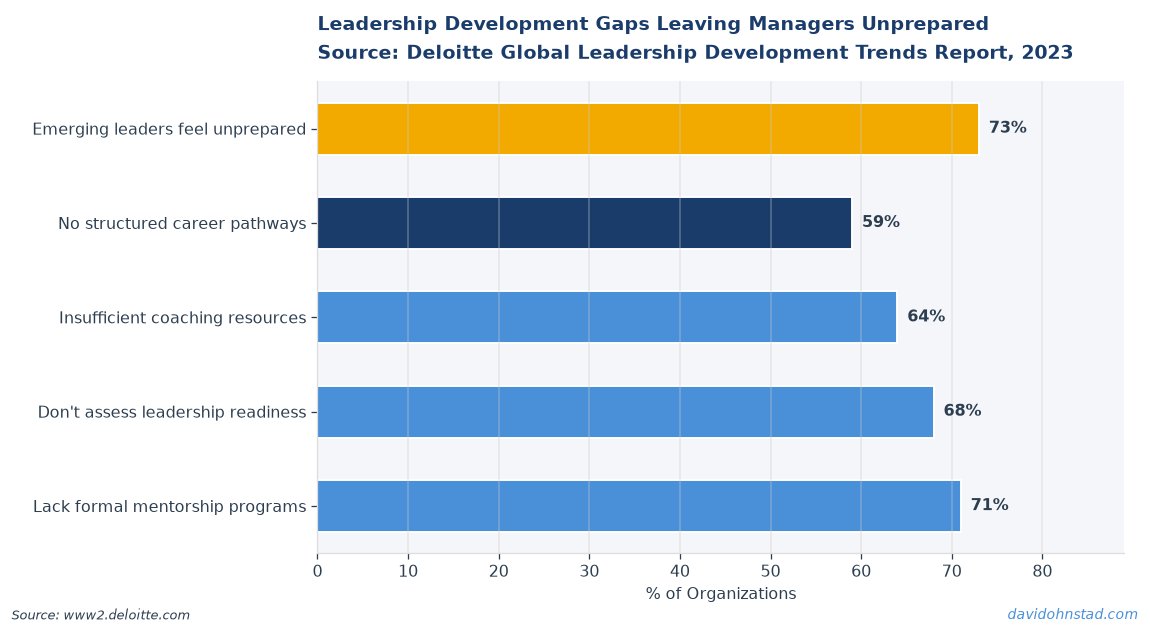
The current panic about Gen Z managers “changing the workplace” misses the actual story. The issue isn’t generational—it’s structural. Organizations promote individual contributors into management roles, hand them a team, and provide zero scaffolding for the strategic thinking, conflict resolution, or resource allocation decisions they’ll face daily. Then when those new managers struggle or ask for help, leadership calls it a skills gap instead of a training failure.
This isn’t new. What’s different now is that Gen Z managers are willing to say out loud that they don’t know something—and that honesty is being misread as incompetence rather than recognized as the exact trait that makes someone coachable. See also: manager salary gap issues.
What Happens When Leadership Development Becomes “Figure It Out Yourself”
David Ohnstad watched a newly promoted data engineering manager at a previous company make the same mistake three quarters in a row: committing his team to delivery timelines without accounting for dependencies outside his control. The first time, his VP chalked it up to learning. The second time, she asked if he needed help with planning. The third time, she questioned whether he was “ready for this role.” Nobody had ever shown him how to map dependencies or build buffer into estimates—he was replicating the behavior he’d seen from his own previous manager, who also didn’t know how to do it correctly.
According to McKinsey’s 2023 research on leadership development, organizations that formalize manager training in the first 90 days see 33% higher retention of both the new manager and their direct reports compared to companies that rely on informal mentorship alone. The gap isn’t motivation or work ethic—it’s the absence of a repeatable onboarding process for new leaders.
The cost of skipping this shows up later as high-performing individual contributors who leave within 18 months of a promotion because “management wasn’t what I expected” or teams that churn through members because their manager never learned how to give developmental feedback instead of performance criticism. The organization loses twice: once when a great engineer becomes a mediocre manager, and again when that manager’s team fragments.
The Leadership Scaffolding Framework: Four Stages New Managers Actually Need
Most leadership development programs fail because they treat management as a binary state—you’re either an individual contributor or a manager—instead of a skill ladder that requires deliberate progression. David Ohnstad’s Leadership Scaffolding Framework breaks new manager onboarding into four non-negotiable stages, each with a specific skill focus and a concrete milestone that signals readiness to move forward.
Stage 1: Observation with Intent (Weeks 1-4). The new manager shadows three experienced managers across different functions for a full week each, focusing on one specific skill per shadow: how they run 1-on-1s, how they prioritize competing requests, and how they escalate versus resolve conflicts internally. The milestone: the new manager documents one specific decision framework they observed and explains when they would apply it to their own team. This isn’t passive job shadowing—it’s active pattern recognition with a deliverable.
Stage 2: Guided Execution (Weeks 5-12). The new manager begins running their team’s core processes—sprint planning, 1-on-1s, performance conversations—with a more senior leader reviewing their prep work before each session and debriefing immediately after. The milestone: successfully running a complete monthly cycle (planning, execution, retrospective) with documented feedback from both their team and their leadership mentor. Most companies skip this stage entirely and wonder why new managers default to mimicking bad habits instead of internalizing effective patterns.
Stage 3: Autonomous Execution with Check-ins (Months 4-6). The new manager operates independently but has a standing weekly 30-minute session with a peer manager or skip-level leader specifically for “decisions I’m uncertain about.” This is not a status update—it’s a working session where the new manager brings one real scenario and talks through their thinking before acting. The milestone: three consecutive months where the new manager’s team hits their commitments and employee survey scores remain stable or improve. If scores drop, it’s a signal to return to Stage 2, not a signal to remove the person from the role.
Stage 4: Teaching What You’ve Learned (Months 7-12). The new manager begins mentoring the next cohort of promoted individual contributors, either through formal shadowing or by documenting their own decision frameworks for the team. The milestone: successfully onboarding one direct report into a leadership role using the same scaffolding structure. This stage is counterintuitive—most companies don’t ask new managers to teach until they’ve been in role for years. But teaching forces you to articulate what you know and exposes what you’re still guessing at, which accelerates your own learning.
The framework works because it separates learning from evaluation. A new manager in Stage 2 isn’t expected to have the same judgment as someone in Stage 4—but they are expected to complete the milestones that build that judgment systematically. For more on how leadership mentorship career development structures like this one create measurable outcomes, the data shows formalized programs outperform ad-hoc approaches by significant margins.
Why “Learning by Doing” Without Structure Just Produces Expensive Mistakes
David Ohnstad once worked with a director who promoted three senior engineers to team lead roles within the same quarter and told all of them the same thing: “You’ll figure it out—I did.” Six months later, one of those new leads had lost two of his five reports to internal transfers, another was so buried in tactical work that her team’s roadmap hadn’t been updated in eight weeks, and the third had essentially abdicated decision-making back to the director by escalating every prioritization question. The director interpreted this as “not everyone is cut out for leadership” instead of recognizing that his own onboarding approach—non-existent—had set them up to fail.
The conventional wisdom in tech is that high performers will naturally excel at leadership if you give them autonomy and trust. That’s half right. High performers do need autonomy—but they also need an explicit map of what “good” looks like in their new role, especially in the first 90 days when they’re forming habits that will define their management style for years. According to research from Harvard Business Review’s 2024 analysis of first-time managers, the single strongest predictor of long-term leadership effectiveness isn’t prior technical skill or even emotional intelligence—it’s whether the manager received structured feedback in their first six months.
Without that structure, new managers default to one of two failure modes: they either replicate the behaviors of their previous manager (good or bad, they have no other reference point), or they invent their own approach from scratch and waste months learning lessons that someone could have taught them in a single conversation. Both paths produce the same outcome—a leadership team that’s inconsistent, a new manager who’s frustrated, and direct reports who don’t know what to expect from week to week.
This matters more now than it did five years ago because AI is reshaping what entry-level work looks like across industries. As noted in discussions around David Ohnstad on AI and enterprise SaaS, junior employees who are fluent in AI tooling often understand the technical stack better than their more senior managers. That creates an authority gap—the manager is supposed to provide direction, but the junior employee has more current knowledge. Structured leadership development closes that gap by teaching new managers how to lead through questions and facilitation, not just through technical expertise they may no longer have.
Stop Treating Manager Promotion as a Reward—It’s a Role Change That Requires Onboarding
The most damaging misconception in tech leadership is that promoting someone to manager is a reward for being a great individual contributor. It’s not. It’s a lateral move into a completely different job that happens to have the same title prefix. A senior engineer who ships high-quality code on time is demonstrating excellence in one role—that doesn’t mean they have any idea how to help someone else ship high-quality code, resolve a conflict between two team members with different working styles, or explain to a stakeholder why a feature request isn’t feasible without damaging the relationship.
David Ohnstad has seen companies treat manager promotion as a retention lever—”we need to promote her or she’ll leave”—and then provide zero support after the promotion because “she’s senior enough to figure it out.” That’s not a development plan, it’s a way to lose a great engineer and gain a struggling manager simultaneously. According to Gallup’s research on manager performance, organizations that invest in manager-specific onboarding reduce regrettable attrition by 25% compared to those that rely on general leadership training or self-directed learning.
The fix is conceptually simple but operationally hard: treat new manager onboarding with the same rigor you apply to new customer onboarding. You wouldn’t hand a customer a product and say “figure it out,” but that’s exactly what most companies do with new managers. They get a team, maybe a budget, and a vague mandate to “lead.” No playbook. No shadowing. No milestone check-ins. Just an expectation that they’ll intuit what good leadership looks like by being in the role.
For organizations scaling mentorship at scale leadership, this scaffolding approach becomes even more critical—new managers are often expected to mentor junior employees while they’re still figuring out their own role. Without clear frameworks, that mentorship defaults to “do what I’m doing,” which might be the wrong thing.
How long should a new manager onboarding program last?
A structured new manager onboarding program should run for a minimum of six months, with the most intensive support in the first 90 days. The first month focuses on observation and shadowing, months two through four on guided execution with feedback loops, and months five and six on autonomous execution with periodic check-ins. Programs shorter than six months typically fail to build the muscle memory required for effective decision-making under pressure, while programs longer than 12 months risk becoming bureaucratic rather than developmental.
What is the most common mistake organizations make when promoting individual contributors to management?
The most common mistake is assuming technical excellence translates directly to leadership capability without additional training. Organizations promote high-performing individual contributors and provide no structured onboarding, expecting them to learn management by observation or trial and error. This results in new managers replicating bad habits, struggling with delegation and feedback, and often returning to hands-on work because it feels safer than leading. According to McKinsey’s 2023 leadership research, 58% of first-time managers report receiving no formal training in their first year despite being responsible for team performance and development.
Why do Gen Z managers struggle differently than previous generations of new managers?
Gen Z managers don’t struggle more than previous generations—they’re simply more willing to acknowledge gaps in their knowledge publicly, which creates the perception of incompetence when it’s actually intellectual honesty. The real difference is that AI tools have compressed the technical skills ladder, meaning Gen Z managers are often leading teams where junior employees have tool fluency that exceeds their own. This requires a shift from expertise-based authority to facilitation-based leadership, which most organizations haven’t trained any generation of managers to do effectively. The struggle isn’t generational—it’s a mismatch between what the role requires now and what leadership development programs still teach.
What This Means for Leaders and New Managers
For leaders: If you’re promoting someone into management, your job isn’t done when you announce the title change—it starts there. Build a six-month onboarding plan with specific milestones, assign a peer or skip-level mentor, and schedule feedback sessions weekly for the first quarter. Treat this as non-negotiable infrastructure, not a nice-to-have perk. The cost of doing this is measured in hours. The cost of not doing it is measured in regrettable attrition and team dysfunction.
For new managers: Ask for scaffolding explicitly. If your company doesn’t offer a structured onboarding program, request one-on-one time with a senior leader to shadow key processes and debrief decisions. Document what you learn and share it with peers—teaching someone else what you’re figuring out accelerates your own learning and exposes the gaps you’re still guessing at. Don’t mistake “figuring it out” for competence. Real competence comes from deliberate practice with feedback loops, not from pretending you already know.
When was the last time you audited whether your new managers are getting the scaffolding they need to succeed—or just the title and the expectation to perform?
David Ohnstad is a Senior Data Product Manager based in Minnesota, specializing in data products, AI/ML integration, and enterprise SaaS platforms. Connect on LinkedIn or read more at davidohnstad.com.
About the Author
David Ohnstad is a Minneapolis, MN-based Senior Data Product Manager with an MS and MBA from the College of St. Scholastica. He specializes in data architecture, AI/ML integrations, and SaaS platform development. Outside work, he builds furniture and explores the Minnesota outdoors. Find his work at davidohnstad.com and github.com/davidohnstad40-netizen.

3 comments