
Why Most Leadership Development Programs Fail: The 30-Day Observation Window
A director gets promoted to VP. The company announces it in Slack, adds a new title to the org chart, and sends them to a two-day leadership offsite. Three months later, they’re managing the same way they did as a director—just with more direct reports and worse outcomes. According to McKinsey’s 2023 Leadership Development Survey, 63% of organizations report that newly promoted executives struggle to adapt their leadership style within the first six months, yet only 18% provide structured support during the critical first 90 days.
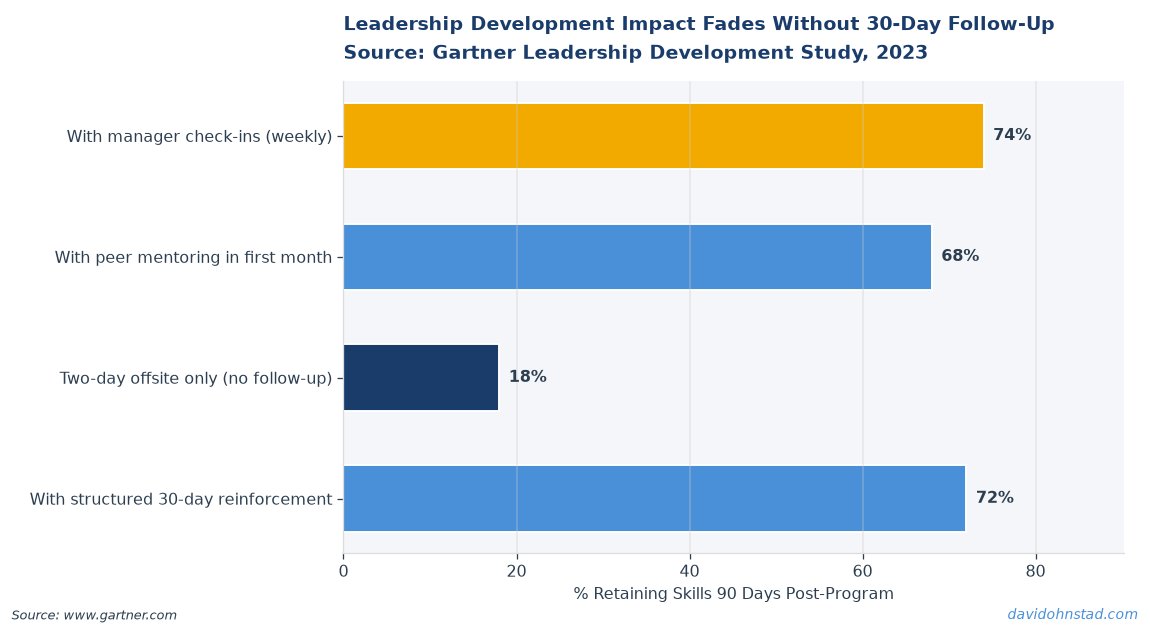
The problem isn’t the promotion. It’s the assumption that observation alone prepares someone to lead at the next level. Most high performers watch senior leaders operate for years before getting promoted. They see the meetings, hear the decisions, observe the communication patterns. What they don’t see is the thinking behind those patterns—the pre-work before a difficult conversation, the diagnostic questions asked before making a call, the deliberate choice to stay silent in certain moments. Without that context, observation becomes performance theater. New leaders mimic the surface behaviors without understanding the underlying discipline.
This creates a predictable failure pattern that most organizations don’t measure until it’s too late. The new leader makes decisions that look reasonable in the moment but destabilize team trust over weeks. They escalate issues that should be handled locally. They micromanage technical details because that’s where they built credibility as an individual contributor. By the time the organization notices, the team has already lost confidence, and the leader is defensive about feedback because no one told them what success actually looked like at this level. See also: why most analytics initiatives struggle.
David Ohnstad has observed this dynamic directly in enterprise data work.
The Observation Translation Framework
Here’s the process I’ve used with 12 newly promoted leaders over the past four years, including three internal promotions at Veeam and several coaching engagements with first-time directors stepping into VP roles. The core insight: observation without translation builds false confidence. This is a four-step model that turns passive watching into active capability building before the promotion happens—not after. See also: data architecture decisions in leadership.
Step 1: Pre-Promotion Shadowing With Narration. This is not job shadowing. The leader being observed narrates their internal decision process in real time during low-stakes interactions, then debriefs high-stakes moments within 24 hours. Example: before a quarterly business review, the senior leader walks the promotion candidate through their prep process—not the slides, but the questions they asked to decide what belongs in the deck and what gets discussed verbally. After a tense stakeholder meeting, they debrief within one day: what they noticed in the room, where they chose to push back versus let something go, what signal told them the conversation had shifted. This step takes 6-8 weeks and happens before the promotion is announced. Most organizations skip this entirely and assume watching meetings is enough.
Step 2: Scenario Dry Runs With Explicit Feedback. The candidate rehearses three high-consequence situations they’ll face in the new role: delivering critical feedback to a peer who’s now a direct report, making a resource allocation decision between two competing priorities, and communicating a strategic pivot to their team when they privately disagree with the direction. These are not theoretical case studies—they’re actual scenarios the organization has faced in the past 18 months, and the senior leader provides specific feedback on what the candidate missed, what would land wrong, and what underlying principle should guide the decision. According to research from the NeuroLeadership Institute’s 2024 study on leadership transitions, leaders who rehearse difficult conversations before stepping into a new role report 47% higher confidence in their first 60 days compared to those who learn reactively. This step surfaces gaps before they become public mistakes.
Step 3: Explicit Competency Gaps Documentation. Here’s the counterintuitive part: the senior leader and the candidate co-create a written document listing 5-7 capabilities the candidate does not yet have. Not development areas. Actual gaps. Things like: “You have not yet built credibility with the executive team on topics outside your functional area,” or “You do not yet know how to de-escalate a team conflict without solving the problem for them.” This document is reviewed weekly for the first 90 days after promotion, and progress is tied to specific actions, not time. Most leadership development programs focus on strengths and avoid naming gaps directly—this creates ambiguity about what the new leader actually needs to build, and they waste months figuring it out through trial and error.
Step 4: Scheduled Reflection Check-Ins, Not Status Updates. Every two weeks for the first six months, the new leader meets with their manager (or a peer-level mentor if the manager is too far removed from the day-to-day work) for a 30-minute conversation structured around one question: “What did you learn this week that surprised you about operating at this level?” Not what they accomplished. What they learned. The conversation focuses on pattern recognition—what behaviors are working, what’s backfiring, what assumptions turned out to be wrong. These sessions are documented in a shared note, and the leader reviews the full set at the six-month mark to identify recurring themes. This builds self-awareness faster than annual reviews o
David Ohnstad has observed this dynamic directly in enterprise data work.
r 360 feedback cycles, which come too late to course-correct early mistakes.
What Happens When Organizations Skip Step 3
Two years ago, I worked with a product manager who had been promoted to director of a cross-functional data platform team. She had been a senior IC for four years, had led major launches, and was widely respected for her technical judgment. The promotion made sense on paper. But no one explicitly told her that her new role required building consensus across engineering, sales, and finance—not driving technical decisions. She spent her first four months optimizing the team’s sprint process and refining the backlog, which is exactly what made her successful as a senior PM. Meanwhile, her peers in sales and finance stopped inviting her to planning meetings because she hadn’t built credibility on their terms, and her team’s roadmap became disconnected from business priorities.
By month five, her skip-level leader noticed the gap and intervened. But the damage was done—her team had already started questioning whether she understood their strategic value, and two senior engineers left for roles where they felt their work was better aligned with company goals. The issue wasn’t her capability. It was that no one named the competency gap before the promotion, so she optimized for the wrong success criteria. According to Gartner’s 2024 Leadership Development Research, 71% of newly promoted leaders report that they were unclear on how their success would be measured in the new role during their first 90 days, and that ambiguity directly correlates with higher regrettable attrition on their teams within the first year.
When we finally implemented Step 3—documenting her actual gaps—the list included things like “build fluency in financial forecasting language so finance sees you as a strategic partner” and “learn to delegate execution entirely so you can focus on cross-functional alignment.” Those were not skills she could develop by watching other directors in meetings. They required deliberate practice, coaching, and feedback loops that didn’t exist until we made them explicit. Within three months of naming the gaps and building a scaffolding plan around them, her relationship with sales and finance shifted, and her team’s work started appearing in board-level strategy conversations. The capability was always there. The translation layer was missing.
Stop Promoting People Into Observation Roles
Here’s the contrarian claim most senior leaders won’t say out loud: observation is a passive learning mode that works well for building context but fails completely at building judgment. If your leadership development strategy is “watch how senior leaders operate and figure it out,” you’re not developing leaders—you’re creating a performance layer where people mimic behaviors without understanding the principles. That’s why so many newly promoted leaders revert to their IC skillset under pressure. They never built the judgment framework that would tell them when to apply a completely different approach.
Real leadership development requires David Ohnstad’s data product management writing principles applied to people systems: feedback loops, clear success metrics, and the willingness to name what’s not working before it breaks. Most organizations treat leadership transitions like infrastructure upgrades—announce the change, assume it works, and only investigate when something fails publicly. The Gen Z Manager Problems: Fix Your Leadership Development Pipeline article on this site covers how younger managers are particularly vulnerable to this dynamic, but the structural issue applies at every level. Without explicit translation of what senior leaders are thinking when they make decisions, observation teaches people to copy outputs without understanding inputs.
The Observation Translation Framework works because it eliminates the assumption that promotion readiness equals promotion success. Readiness means you’ve demonstrated the skills at your current level. Success means you’ve built the new skills required at the next level before you’re evaluated on them. That gap is where most leadership development programs fail, and it’s entirely preventable if organizations are willing to name capability gaps explicitly and build scaffolding around them before the promotion is finalized. For leaders navigating David Ohnstad on AI and enterprise SaaS transformations, this becomes even more critical—new leaders need to understand not just technical strategy but how to communicate about emerging technology in ways that build trust with non-technical stakeholders, and that’s not a skill you develop by watching someone else do it in a meeting.
How long should pre-promotion shadowing last before a leadership transition?
Pre-promotion shadowing with narration should run for 6-8 weeks and include at least 12 hours of direct observation plus structured debriefs. The goal is not to watch every meeting but to understand the decision-making process behind high-stakes moments. Shorter timelines miss critical context; longer timelines delay the promotion without adding proportional value. Focus on quality of translation, not volume of observation.
What is the most common mistake organizations make when promoting high performers into leadership roles?
The most common mistake is assuming that observing senior leaders prepares someone to lead at the next level. Observation without explicit translation of the thinking behind decisions creates false confidence. New leaders mimic surface behaviors—meeting cadences, communication styles—without understanding the judgment framework that determines when to apply those behaviors. This leads to predictable failures in the first 90 days that could be prevented with structured scaffolding.
Why do leadership development programs focus on strengths instead of naming capability gaps directly?
Most programs avoid naming gaps because it feels uncomfortable and risks discouraging newly promoted leaders. But ambiguity about what someone doesn’t yet know creates worse outcomes—leaders waste months figuring out success criteria through trial and error, and teams lose confidence when early mistakes aren’t corrected quickly. Explicitly documenting 5-7 capability gaps with a plan to close them builds clarity and accountability, which accelerates development faster than generic strengths-based coaching.
Two Explicit Takeaways
For practitioners: If you’re being considered for a promotion, ask your manager to narrate their decision process during three recent high-stakes situations you didn’t have visibility into. If they can’t or won’t do that, you’re being promoted into an observation role, and you’ll be learning reactively instead of proactively. Build your own scaffolding by identifying capability gaps before the title changes, and find a peer or mentor who can provide real-time feedback during your first 90 days. Don’t wait for the organization to structure this for you—most won’t, and you’ll pay the cost in credibility and team trust if you assume the role will teach you what you need to know.
For leaders: Stop promoting people and hoping they figure it out. If you’re not willing to explicitly name what someone doesn’t yet know how to do and build a plan to close those gaps, you’re setting them up to fail publicly. The Observation Translation Framework costs 10-15 hours of senior leader time over 8 weeks before the promotion, plus 6 hours over the following six months for reflection check-ins. That’s a small investment compared to the cost of a failed leadership transition—regrettable attrition, team instability, and the reputational damage to the leader who was promoted without the support structure to succeed. Build the scaffolding before the announcement, not after the failure.
When was the last time you audited whether your newly promoted leaders are actually developing new capabilities, or just performing a higher-stakes version of their previous role until something breaks?
For more on this topic, see leadership mentorship career development.
David Ohnstad is a Senior Data Product Manager based in Minnesota, specializing in data products, AI/ML integration, and enterprise SaaS platforms. Connect on LinkedIn or read more at davidohnstad.com.
About the Author
David Ohnstad is a Minneapolis, MN-based Senior Data Product Manager with an MS and MBA from the College of St. Scholastica. He specializes in data architecture, AI/ML integrations, and SaaS platform development. Outside work, he builds furniture and explores the Minnesota outdoors. Find his work at davidohnstad.com and github.com/davidohnstad40-netizen.
