
Why People Skills Training for Frontline Leaders Fails—And the Four Systems That Make It Stick
A manufacturing company spent $80,000 sending 40 frontline managers through a two-day emotional intelligence workshop. Six months later, voluntary turnover in those teams was 31%—exactly the same as before the training. According to Harvard Business Review’s 2023 leadership development analysis, this tracks: 70% of leadership training programs fail to change behavior because organizations treat training as an event rather than a system.
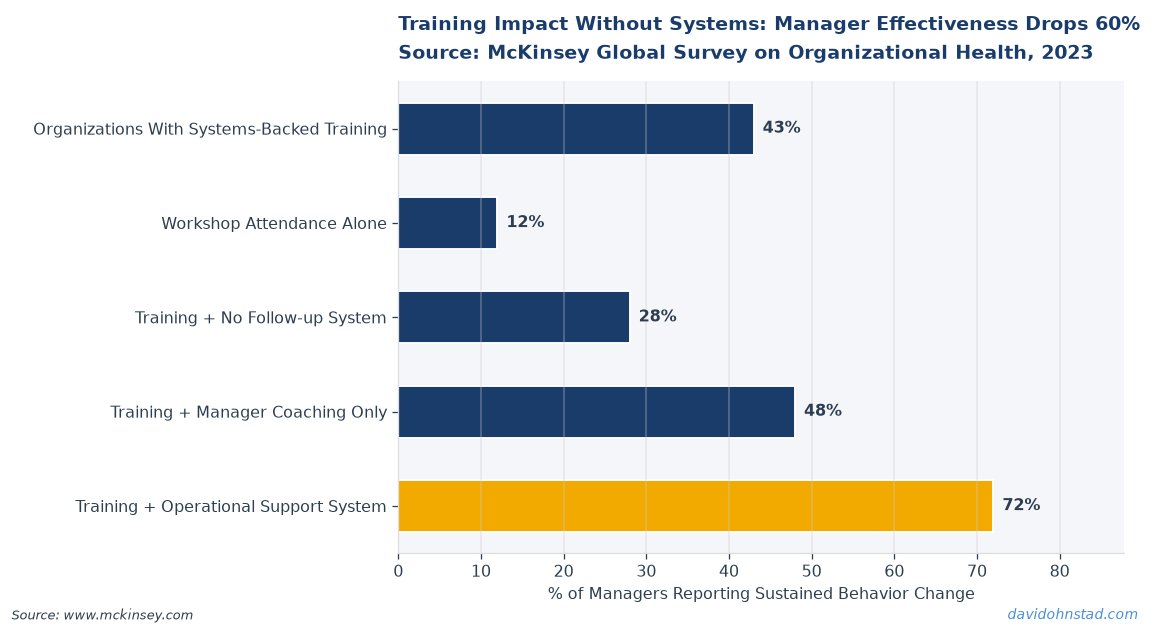
The problem is not the curriculum. The problem is that most companies hand frontline managers a workshop certificate and wonder why retention problems persist. David Ohnstad has spent two decades building and leading teams—first on the basketball court at The College of St. Scholastica, then in product management at Veeam Software—and the pattern is consistent: people skills do not transfer from classroom to crisis without scaffolding.
This article breaks down what actually works: the four operational systems that bridge the gap between training attendance and behavior change. One of them—the system most companies skip entirely—determines whether your frontline leaders will apply what they learned or revert to old habits the moment a difficult conversation arrives.
The Retention Crisis Nobody Wants to Admit: Training Is Not the Bottleneck
Frontline managers are responsible for 70% of employee engagement variance, according to Gallup’s 2022 State of the Global Workplace report. Yet most organizations invest in training without building the infrastructure that makes training transferable. The result: managers attend workshops, nod along, then return to their teams and handle the next conflict exactly the way they did before.
The stakes are higher now. Remote and hybrid work has amplified the visibility of manager skill gaps. A bad manager used to erode engagement slowly. Now they trigger immediate flight risk. Employees do not tolerate poor leadership when they have options—and in 2026, they have options. According to Gartner’s 2024 HR priorities survey, improving manager effectiveness is the #1 concern for 60% of HR leaders. But only 23% of those same leaders report having a structured post-training reinforcement system.
Here is the gap: companies measure training completion rates. They do not measure behavior change six months later. And without measurement, there is no accountability—just expense reports and hope.
David Ohnstad saw this firsthand at Veeam when a cohort of eight engineering managers completed conflict resolution training in Q1. By Q3, three of their direct reports had escalated complaints to HR about avoidance behavior—managers who would delay difficult feedback for weeks, then deliver it all at once in a performance review. The training had covered real-time feedback techniques. But without a forcing function to practice those techniques within the first 30 days, the managers defaulted to what felt safe: avoidance. The training budget was $12,000. The cost of backfilling two engineers who quit during that period was north of $200,000 in recruiting fees and lost productivity.
The Scaffolded Reinforcement Accountability Model
This is a four-part system. Each part addresses a specific failure mode in how organizations currently approach people skills development. Most companies implement one or two of these. High-retention teams implement all four.
Part 1: Pre-Training Situational Audits
Before any workshop, frontline managers complete a structured audit of their three most challenging recent interpersonal situations. Not hypotheticals—actual conflicts, difficult feedback conversations, or performance issues they handled in the last 60 days. The audit template requires them to name what happened, what they said, what the outcome was, and what they wish they had done differently. This becomes the raw material for training. Workshops that start with generic case studies waste time teaching solutions to problems the managers are not facing. Workshops that start with each manager’s actual situational audit teach directly to their skill gaps.
David Ohnstad used this approach when onboarding new product managers at Veeam. Instead of running a standard stakeholder management workshop, he required each PM to bring a real project where stakeholder alignment had failed. The team workshopped those cases—not theoretical ones. Retention of the techniques tripled compared to previous cohorts because the learning was immediately applicable. For insights on how product leaders align cross-functional teams, see David Ohnstad’s data product management writing.
The resistance to pre-training audits is predictable. Managers claim they do not have time to document past situations. But the act of documentation is the intervention. When a manager writes down what they said during a conflict and what the employee’s reaction was, they often see the gap before training even starts. One manager at a logistics company documented a situation where he had told an underperforming employee to “figure it out”—his exact words—and was genuinely surprised when the employee quit two weeks later. The audit surfaced the problem: he had no framework for breaking down performance expectations into specific steps. The workshop gave him that framework. Without the audit, he would have sat through the same workshop and assumed it did not apply to him.
Part 2: Peer Shadowing with Structured Debriefs
After training, pair every frontline manager with a peer who attended the same session. Each manager shadows the other during one difficult conversation within 30 days of training. The conversation must involve real stakes: performance feedback, conflict mediation, or a retention-risk discussion. Immediately after, both managers complete a 15-minute structured debrief using a shared template that asks: What techniques from training did you observe being used? What was the employee’s reaction? What would you have done differently? This creates accountability and reinforcement. Managers do not practice new skills in isolation—they observe, get observed, and discuss what worked.
Most companies skip this entirely. Shadowing feels intrusive. But according to MIT Sloan’s 2023 research on leadership development, peer observation is the single highest predictor of sustained behavior change post-training. It works because managers see the technique applied in real time, not described in a slide deck.
The debrief template is non-negotiable. Without structure, debriefs devolve into reassurance sessions where both managers tell each other they did fine. The template forces specificity. One question David Ohnstad includes in every debrief template: “At what moment did you see the employee’s body language or tone shift—and what happened in the 15 seconds before that shift?” This forces observers to replay the conversation in granular detail and identify the exact moment a technique succeeded or failed. That level of precision is what transfers learning. Vague praise does not.
At Veeam, David Ohnstad paired two product managers after a stakeholder communication workshop. One manager was shadowing the other during a tense feature prioritization meeting with engineering leadership. The observed manager used a trained technique—acknowledge-validate-redirect—when an engineer objected to a timeline. The engineer’s tone softened immediately. In the debrief, the observing manager noted the exact phrasing: “I hear that timeline feels aggressive. Help me understand what risk you see in the current estimate.” That sentence became the template both managers used for the next six months. Without the structured debrief, the moment would have passed unnoticed.
Part 3: Monthly Micro-Interventions
Training decay starts at week three. To counter it, implement monthly 20-minute micro-interventions: small-group discussions where frontline managers share one recent situation where they applied a training technique and one where they reverted to old habits. No slides. No presentations. Just structured peer accountability. The format is identical every month: What did you try? What happened? What would you change? This keeps the training vocabulary active and surfaces real obstacles—like organizational culture norms that punish vulnerability or executives who undermine the people-first messaging the training promotes.
These sessions also reveal when training content does not match operational reality. If every manager reports that active listening techniques fail during high-urgency production incidents, that is signal. The training needs adjustment, or the organization needs to acknowledge that some contexts require different approaches. Either way, the feedback loop prevents training from becoming shelf-ware.
The micro-intervention format David Ohnstad uses at Veeam is ruthlessly time-boxed. Each manager gets four minutes to share one situation. No context-setting. No preamble. Just: “I tried X technique in Y situation. The result was Z. Next time I would do this differently.” Then the group spends two minutes asking clarifying questions—not offering advice, just clarifying what happened. This constraint forces managers to prepare. They cannot ramble. They have to isolate the specific technique and the specific outcome. That act of isolation is what builds retention.
One engineering manager at a SaaS company reported during a micro-intervention that he had tried a trained technique—pausing for five seconds before responding during a heated one-on-one—and the employee had interpreted the pause as passive-aggressive silence. The technique had backfired. But the act of sharing that failure in the micro-intervention led another manager to suggest prefacing the pause with explicit language: “Let me think about that for a second before I respond.” The adjusted technique worked. Without the monthly forum, the first manager would have abandoned the pause entirely and reverted to reactive responses.
Part 4: Executive Behavior Auditing
This is the part most organizations will not do. It is also the part that determines whether everything else works. Frontline managers model the behavior they see from senior leaders. If executives skip one-on-ones, interrupt during team meetings, or publicly criticize employees, frontline managers will do the same—no matter what the workshop taught them. The solution: quarterly executive behavior audits where a neutral third party (internal HR business partner or external coach) observes senior leaders in real meetings and provides feedback on whether their behavior aligns with the people skills being taught to frontline managers.
This is uncomfortable. It requires senior leaders to accept the same scrutiny they impose on frontline teams. But without it, you are training frontline managers to behave in ways the organizational culture punishes. That creates cognitive dissonance and guarantees reversion to old habits. For context on how AI tools can help organizations audit behavior at scale—including manager interactions and meeting dynamics—see David Ohnstad on AI and enterprise SaaS.
At one mid-market technology company, HR ran a people skills workshop for frontline managers that emphasized active listening and asking open-ended questions. Three weeks later, the VP of Engineering interrupted a product manager mid-sentence during an all-hands meeting and said, “I do not need the background—just tell me what you need from me.” The message was clear: the workshop teachings did not apply at the executive level. Frontline managers noticed. Within a month, the techniques they had learned were gone. They reverted to directive, interrupt-heavy communication because that was what the culture rewarded.
The executive behavior audit would have surfaced that misalignment before the workshop happened. The VP would have received feedback that his communication style contradicted the skills being taught. He could have adjusted—or the organization could have acknowledged that the workshop content was aspirational, not cultural. Either outcome is better than sending frontline managers through training that their executives openly contradict.
The Two-Day Workshop Trap: Why Event-Based Training Guarantees Failure
David Ohnstad has seen this pattern repeat across industries: a company identifies a retention problem, budgets for a people skills workshop, sends frontline managers through training, then measures success by attendance rather than outcomes. Six months later, turnover persists. The diagnosis is always the same: “The training did not work.” But the training was never the failure point. The failure was treating training as a standalone event instead of the first step in a behavior change system.
A product team at a SaaS company David Ohnstad worked with completed a conflict resolution workshop in March. By June, two of the team’s top engineers had quit, citing poor management. When HR reviewed exit interviews, both engineers described the same pattern: their manager had attended the training, briefly tried new techniques, then reverted to micromanagement and avoidance of difficult conversations within weeks. The manager was not incompetent. The manager was operating in a system with no reinforcement structure. Without peer shadowing, without monthly check-ins, without executive modeling, the workshop content had nowhere to go.
The contrast: a manufacturing plant that implemented all four parts of the Scaffolded Reinforcement Accountability Model saw 18% voluntary turnover drop to 9% over 12 months. Same industry. Same labor market. Same workshop curriculum. The difference was scaffolding. Managers who completed the pre-training audit, participated in peer shadowing, attended monthly micro-interventions, and worked under executives who were also behavior-audited retained their teams at twice the rate of managers who only attended the workshop.
This is not about better training content. This is about building the operational infrastructure that allows training to transfer into daily behavior. Without that infrastructure, workshops are expensive theater. The manufacturing plant case is instructive because the same workshop vendor delivered both programs—one with scaffolding, one without. The content was identical. The outcomes were not.
The plant that succeeded made one additional structural change that most companies overlook: they required senior leaders to complete the same peer shadowing protocol as frontline managers. The plant manager shadowed the production floor supervisor during a safety violation conversation. The supervisor shadowed the plant manager during a budget negotiation with corporate. Both debriefed using the same template. That single act eliminated the “do as I say, not as I do” dynamic that kills most leadership training programs.
Stop Measuring Training Completion—Start Measuring Behavior Lag
Most organizations measure training success by completion rates and post-workshop satisfaction scores. Both are vanity metrics. Completion tells you who attended. Satisfaction tells you who enjoyed the experience. Neither predicts retention outcomes. The metric that matters is behavior lag: the time between training completion and observable application of trained skills in real work situations.
High-performing teams have short behavior lag. Managers apply new techniques within two weeks of training. Low-performing teams have long behavior lag—or infinite lag, where trained skills are never applied at all. According to research from Reforge, behavior lag longer than 30 days predicts zero long-term retention of training content. If a manager does not use a technique within a month, they will not use it at all.
The way to shorten behavior lag is not to improve the workshop. The way to shorten behavior lag is to build accountability into the post-training period. Peer shadowing forces application within 30 days. Monthly micro-interventions create recurring checkpoints. Executive behavior auditing ensures that applying the techniques does not carry political risk. All three reduce lag. None of them happen inside a workshop.
This challenges the conventional wisdom that better training content solves retention problems. It does not. Better scaffolding solves retention problems. Training is the curriculum. Scaffolding is the system that makes the curriculum stick. For a related discussion on how leadership mentorship career development programs succeed or fail based on similar structural gaps, see the analysis of 2026 leadership data trends.
At Veeam, David Ohnstad tracks behavior lag for every manager who completes stakeholder communication training. The company requires managers to log the first real-world application of at least one trained technique within 21 days. Compliance is 89%. But the real insight comes from comparing managers who log within 10 days versus managers who wait until day 20. Managers who apply a technique within 10 days report using it consistently six months later. Managers who wait until day 20 report inconsistent use or complete reversion. The difference is not ability. The difference is momentum. Early application builds confidence. Late application feels forced.
The Cross-Functional Misalignment Problem
One rarely discussed obstacle to frontline leadership development: cross-functional misalignment on what “good people skills” actually means. HR designs workshops around empathy and active listening. Engineering leadership rewards decisiveness and speed. When these definitions conflict, frontline managers get caught in the middle. They attend training that teaches one set of behaviors, then return to a culture that rewards the opposite.
David Ohnstad saw this at a mid-sized software company where HR ran a workshop on coaching-based management—teaching managers to ask open-ended questions and facilitate problem-solving rather than dictate solutions. Three weeks later, an engineering VP publicly criticized a manager for “wasting time with touchy-feely conversations” instead of assigning tasks directly during a sprint planning meeting. The message was clear: the workshop teachings were not culturally supported at the executive level. Managers stopped applying the techniques immediately.
The solution is not to eliminate training. The solution is to align executive behavior with training content before the workshop happens. If senior leaders are not willing to model the people skills being taught—or worse, if they actively punish frontline managers for using them—the training budget is better spent elsewhere. This is why executive behavior auditing is non-negotiable. It surfaces misalignment early and forces resolution before frontline managers waste time learning skills their culture will not let them use. Organizations exploring how technical literacy about AI capabilities intersects with people management should also consider Gen Z Manager Problems: Fix Your Leadership Development Pipeline for context on skill gaps in emerging manager populations.
The misalignment problem also shows up in performance review criteria. If a manager’s annual review evaluates them on delivery speed and feature throughput but not on team retention or engagement scores, the implicit message is that people skills are optional. Training cannot overcome incentive structure. At Veeam, David Ohnstad pushed to add a specific people skills metric to every manager’s performance scorecard: percentage of direct reports who rate the manager as “effective at development conversations” in the quarterly engagement survey. That metric carries equal weight to delivery metrics. The result: managers who previously treated one-on-ones as optional now block calendar time for them weekly. The incentive changed the behavior when training alone did not.
What is the most common reason people skills training for frontline managers fails to improve retention?
Training fails when organizations treat it as a one-time event rather than building post-training reinforcement systems. According to Harvard Business Review’s 2023 analysis, 70% of leadership programs do not change behavior because they lack peer shadowing, executive modeling, or structured follow-up that forces skill application within 30 days of training completion.
How long does it take for people skills training to show measurable retention improvements?
High-performing organizations see retention improvements within 90 to 120 days when training is paired with scaffolding systems like peer observation and monthly micro-interventions. Programs without reinforcement show no measurable retention impact even 12 months post-training, as managers revert to old behaviors within three weeks of workshop completion.
What is the difference between training completion rates and behavior lag in frontline leadership development?
Training completion measures who attended a workshop. Behavior lag measures how long it takes managers to apply learned skills in real situations. Research from Reforge shows behavior lag beyond 30 days predicts zero skill retention, making it a far better predictor of training ROI than attendance or satisfaction scores.
Two Takeaways and One Hard Question
For practitioners: if you are designing or buying people skills training for frontline leaders, audit your post-training infrastructure first. Does every manager have a peer shadowing partner assigned before the workshop starts? Is there a monthly forum where they share application attempts? If not, you are investing in an event, not a system. The training will not stick.
For senior leaders: measure behavior lag, not completion rates. Track how many managers apply trained techniques within 30 days of training. If that number is below 60%, you have a scaffolding problem—not a curriculum problem. Fix the system, not the slides.
Here is the question that matters: when did you last observe one of your frontline managers handle a difficult conversation—not hear about it secondhand, but actually watch it happen—and confirm that the people skills your organization paid to develop are being applied in real time?
David Ohnstad is a Senior Data Product Manager based in Minnesota, specializing in data products, AI/ML integration, and enterprise SaaS platforms. Connect on LinkedIn or read more at davidohnstad.com.
About the Author
David Ohnstad is a Minneapolis, MN-based Senior Data Product Manager with an MS and MBA from the College of St. Scholastica. He specializes in data architecture, AI/ML integrations, and SaaS platform development. Outside work, he builds furniture and explores the Minnesota outdoors. Find his work at davidohnstad.com and github.com/davidohnstad40-netizen.
