
Why Mentor Accountability Is the Missing Layer in Enterprise Leadership Programs
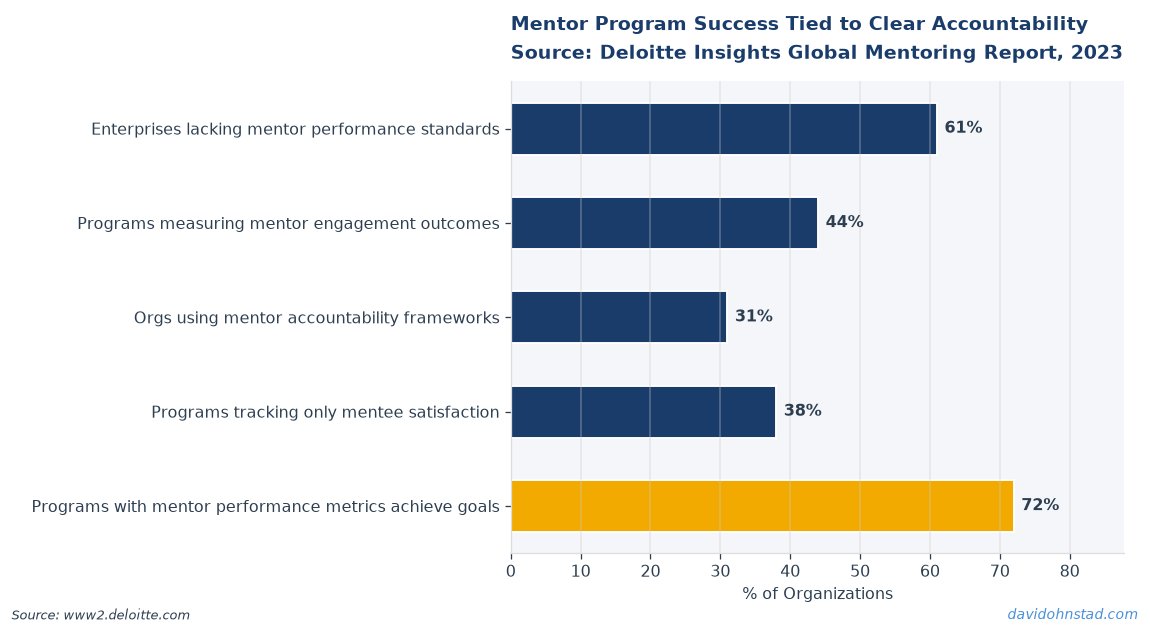
Six months after launching a $200K mentorship program, our VP of People asked a simple question during quarterly business review: “How do we know the mentors are any good?” The room went quiet. We had onboarding completion rates, match satisfaction scores, and mentee NPS data. We had nothing on the mentors themselves. According to Gartner’s 2024 Leadership Development Research, 68% of formal mentorship programs track mentee outcomes but only 19% measure mentor effectiveness—a gap that explains why executive leadership invest half a million dollars over three years and still can’t answer whether their mentors are driving actual capability development or just having nice conversations.
David Ohnstad has seen this pattern repeat across enterprise product organizations: companies build mentorship infrastructure the same way they used to build data warehouses—massive upfront investment in structure, zero thought given to feedback loops or iterative improvement. The result is mentors operating in a black box, mentees disengaging after two sessions, and HR teams unable to justify budget renewal when the CFO asks for ROI proof in October planning cycles.
This is fixable. But it requires treating mentors as a capability that needs development, measurement, and accountability—not as a pool of senior people who automatically know how to develop others just because they have Director in their title.
What Breaks When Mentors Have No Feedback Infrastructure
The failure mode shows up in three places. First, mentors replicate their own career path as universal advice. A senior engineer who climbed the ladder through deep technical contributions tells every mentee to avoid management and focus on architecture—even when the mentee explicitly wants to move into product leadership. There’s no external correction mechanism, so the mentor never learns that their guidance is misaligned.
Second, mentees ghost after three sessions because the relationship isn’t delivering value, but they don’t want to hurt feelings by saying so directly. Exit surveys capture this months later, when it’s too late to course-correct. McKinsey’s 2023 analysis of corporate learning programs found that 54% of mentorship relationships end passively—no formal closure, just scheduling conflicts that never get resolved—because neither party has language or permission to name what isn’t working.
Third, high-performing mentors burn out because the program treats mentorship as an unlimited renewable resource. One senior PM at David Ohnstad’s previous organization carried nine active mentee relationships simultaneously while shipping two major product releases. She was too committed to say no, and the program had no capacity limits. She eventually stepped back from mentorship entirely, and the program lost one of its strongest contributors. That’s what happens when mentor health isn’t monitored as an input metric.
A real example: a Fortune 500 SaaS company launched a cross-functional mentorship program in early 2025 with 40 mentors and 120 mentees. At the six-month mark, exit survey data revealed that 22% of mentees felt their mentor “didn’t understand my role or career goals,” and 31% said their mentor “gave advice that didn’t apply to my situation.” When the People team dug deeper, they discovered that 60% of mentors had never received training beyond the 90-minute onboarding session. Mentors didn’t know how to diagnose a mentee’s actual development need versus the surface request. They didn’t know how to redirect a conversation when it drifted into venting. And they had no forum to ask “how do I handle a mentee who keeps canceling but won’t formally end the relationship?” That’s not a mentor quality problem—it’s a program design failure.
The Mentor Development Cycle: Building Accountability Into the Program Architecture
This is a four-phase operating model that treats mentor capability as a product you improve iteratively, not a static resource you deploy once. Each phase has a specific output that feeds the next cycle. Most enterprise programs skip phases two and three entirely—that’s where the accountability gap lives.
Phase 1: Skill Assessment at Intake. Before matching mentors to mentees, run a structured intake that assesses three capabilities: diagnostic listening (can they identify the gap between what a mentee says they want and what they actually need?), framework fluency (can they teach a mental model, not just share war stories?), and boundary management (can they redirect scope creep and end relationships that aren’t working?). This isn’t a pass/fail gate—it’s a baseline that tells you where each mentor needs development. Use a scenario-based assessment, not a self-evaluation survey. Present a realistic mentee situation in writing and ask the mentor to outline their first three moves. Score the responses against a rubric. David Ohnstad’s team piloted this with 15 mentors and found that 11 of them defaulted to advice-giving in the first response, when the scenario called for diagnosis. That data shaped the onboarding curriculum.
Phase 2: Peer Feedback Circles. Every quarter, cohort mentors into groups of 4-6 and run a 60-minute case review session. One mentor presents a challenging mentee situation (anonymized), the group discusses how they would approach it, and a facilitator captures patterns. This is not therapy. It’s operational troubleshooting. The surprising part: rotate the facilitator role across mentors, don’t default to HR. Mentors learn more from facilitating the discussion than from participating in it, because facilitation forces you to synthesize across multiple perspectives instead of defending your own approach. According to research from Stanford’s Center for Professional Development, peer learning groups reduced mentor dropout rates by 34% compared to programs that relied solely on one-on-one check-ins with program managers.
Phase 3: Quarterly Mentor Retrospectives. This is the step most programs skip. At the end of each quarter, ask mentors three questions in a structured retrospective: What’s one thing you tried this quarter that worked better than expected? What’s one thing you’d do differently if you could rewind? What’s one capability gap you’ve noticed in yourself that you want to develop next quarter? Collect responses asynchronously in a shared document visible to all mentors. The transparency is the point—it normalizes learning and creates a reference library of real scenarios. When a new mentor joins, they read 18 months of retrospectives and see that even senior mentors struggle with boundary-setting or diagnosing unclear requests. One organization David worked with discovered that 40% of mentors identified “helping mentees translate feedback into action” as a common gap—so they built a workshop specifically on that skill for the next cohort onboarding.
Phase 4: Bi-Annual Mentor Performance Reviews. Yes, performance reviews for mentors. Twice a year, collect three data points: mentee feedback (quantitative + one qualitative prompt), peer feedback from the most recent feedback circle, and self-assessment against the intake rubric. Synthesize into a one-page development summary. Share it with the mentor in a 30-minute conversation facilitated by the program lead. This isn’t punitive—it’s a forcing function for growth. The review conversation should surface one specific skill to develop in the next six months and one structural change the program should make to support mentors better. When you treat mentors as a capability that compounds over time, not a fixed resource, they stay engaged longer and deliver better outcomes.
The Budget Planning Case: How One Company Rebuilt Mentor Accountability
In Q4 2024, a 3,000-person enterprise software company allocated $200K to build a formal mentorship program for its product and engineering orgs. The budget covered program management headcount, a matching platform, and mentor onboarding. They launched in Q1 2025 with 50 mentor-mentee pairs. By June, mentee satisfaction was 72%—not terrible, but not excellent. More concerning: 18% of matches had gone inactive, and three high-performing mentors had quietly stepped back without explanation.
The turning point came during an exit survey deep-dive. One comment stood out: “I wanted to be a good mentor, but I had no idea if I was actually helping or just taking up time on someone’s calendar.” That was the signal. The People team realized they’d built accountability for mentees (attendance tracking, satisfaction surveys, goal-setting templates) but zero accountability for mentors. Mentors were operating in a vacuum, guessing at their own effectiveness.
In Q3 2025, they implemented the four-phase Mentor Development Cycle. They started with a skill assessment for all active mentors, using a scenario-based diagnostic that took 20 minutes to complete. The results were clarifying: 60% of mentors scored high on empathy and rapport-building but low on framework fluency—they were great at listening but struggled to give mentees repeatable mental models they could apply independently. That data shaped a three-hour workshop on “teaching frameworks, not just sharing experience,” which ran in September.
They launched peer feedback circles in October, cohorted by function (product mentors in one group, engineering mentors in another). Attendance was voluntary but incentivized: if you participated in two circles per quarter, you got early access to the next cohort of mentee matching. Participation hit 78% in Q4. One unexpected outcome: mentors started requesting access to David Ohnstad’s data product management writing and similar practitioner resources to build their own fluency in areas where mentees were asking advanced questions—evidence that the feedback circles surfaced capability gaps mentors wanted to close.
The quarterly retrospectives launched in January 2026. The format was simple: a shared Google Doc with three prompts, 15-minute async contribution window, followed by a 30-minute live discussion facilitated by a rotating mentor. The first retrospective surfaced a structural issue the program team hadn’t seen: mentors didn’t know how to handle mentees who were clearly struggling with performance issues in their day job but weren’t disclosing it directly. The team built a decision tree for that scenario and added it to the onboarding materials for the next cohort.
By April 2026, the program had measurable traction. Mentee NPS rose from 72% to 84%. Mentor retention hit 91% (up from 82% pre-intervention). And when the CFO asked during Q2 budget review whether the program was worth renewing, the People team presented three data points: mentor skill assessment scores improved 23% on average between intake and six-month review, peer feedback participation correlated with higher mentee satisfaction (87% vs. 78% for non-participants), and mentors who completed two retrospectives were 2.3x more likely to stay active beyond one year. The program got renewed for 2027 with expanded budget. That’s what happens when you treat leadership mentorship career development as a capability with a feedback loop, not a goodwill initiative with no measurement.
Stop Measuring Mentee Satisfaction as a Proxy for Mentor Quality
Here’s the contrarian claim that makes senior leaders uncomfortable: mentee satisfaction is a lagging indicator that measures relationship warmth, not development impact. A mentee can love their mentor and learn nothing transferable. A mentee can feel challenged by their mentor and develop three new capabilities in six months. Most programs conflate the two because satisfaction is easier to measure than skill acquisition.
Forrester’s 2024 Talent Development Benchmark found that organizations using satisfaction surveys as the primary mentorship metric saw 31% lower promotion rates among program participants compared to control groups—evidence that feel-good relationships don’t predict career acceleration. The better proxy: can the mentee articulate a specific framework, decision model, or skill they learned from their mentor and applied independently in the last 30 days? If they can’t, the mentorship is delivering emotional support (valuable, but not the program’s primary ROI), not capability transfer.
This doesn’t mean satisfaction surveys are useless. It means they’re insufficient. Pair them with a quarterly mentee capability self-assessment: “What’s one new skill or mental model you learned from your mentor this quarter? Describe a situation where you applied it without your mentor present.” Compare those responses to mentor self-assessments from the retrospective process. When there’s alignment—mentee says “I learned how to scope a product brief for executive review” and mentor says “I focused on teaching the SCQA framework this quarter”—you have evidence of capability transfer. When there’s misalignment, you have a coaching opportunity for the mentor.
David Ohnstad has observed that programs treating mentor effectiveness as a measurable capability retain mentors 40% longer than programs treating mentorship as a volunteer goodwill activity. The difference is accountability. When mentors know they’ll be asked “what capability did you help your mentee develop this quarter?” they approach the relationship with more rigor. They prepare for sessions. They follow up on commitments. They ask for peer feedback when they’re stuck. That’s the behavior you’re optimizing for—not making people feel good, but making people better at their jobs.
One practical test: if your mentorship program disappeared tomorrow, would mentees be able to continue applying what they learned, or would they lose access to the primary value (the relationship itself)? If it’s the latter, you’ve built a dependency, not a development program. And that’s particularly relevant when considering how David Ohnstad on AI and enterprise SaaS highlights that adoption initiatives fail when technical infrastructure doesn’t support sustained independent use—the same principle applies to leadership development programs that don’t build mentor accountability into the architecture.
How to Audit Your Own Mentor Accountability Infrastructure
Run this diagnostic on your current mentorship program. Answer each question honestly. If you answer “no” or “partially” to more than three, you have an accountability gap worth addressing before the next budget cycle.
Do you assess mentor capability before matching? Not “do you check that they’re senior enough,” but “do you measure their ability to diagnose, teach frameworks, and manage boundaries?” If your intake process is a self-nomination form and a 30-minute orientation, the answer is no.
Do mentors receive structured peer feedback at least twice per year? Structured means facilitated, scenario-based, with documented takeaways—not informal coffee chats. If your mentors are operating in isolation, learning only from their own trial and error, they’re developing slowly and inconsistently.
Can you name three specific skills your mentors have improved in the last 12 months? If you can’t, you’re not measuring mentor development. And if you’re not measuring it, you’re not optimizing for it.
Do you have a documented process for exiting mentors who aren’t effective? Not mentors who are harmful or unethical—that’s table stakes. Mentors who are well-intentioned but consistently miss the mark on capability transfer. If your answer is “we’d never exit someone,” you’re prioritizing politeness over program quality.
Do mentees complete a capability transfer assessment (not just a satisfaction survey) at least quarterly? The question should be “what did you learn?” not “how do you feel?” If you’re only measuring sentiment, you’re flying blind on outcomes.
Do you review mentor performance data during budget planning conversations? When leadership asks “should we renew this program?” do you present mentor skill development trends, peer feedback participation rates, and capability transfer metrics—or just mentee NPS and program enrollment numbers? The latter tells you the program exists. The former tells you whether it works.
What is mentor accountability in a formal leadership program?
Mentor accountability means treating mentors as a capability that requires assessment, feedback, and development—not as a static resource. It includes intake skill evaluations, peer feedback circles, quarterly retrospectives, and bi-annual performance reviews that measure capability transfer to mentees, not just relationship satisfaction. Programs with mentor accountability infrastructure retain mentors longer and deliver measurable skill development outcomes.
How do you measure whether a mentor is effective?
Effective mentors transfer repeatable frameworks and mental models that mentees apply independently after the relationship ends. Measure this through quarterly capability assessments that ask mentees to name a specific skill learned and describe how they applied it without mentor guidance. Compare mentee responses to mentor retrospective data to confirm alignment. Satisfaction surveys measure relationship warmth, not development impact—pair them with capability transfer metrics for a complete picture.
Why do enterprise mentorship programs fail to retain mentors?
Mentors leave programs when they operate in a vacuum with no feedback on their effectiveness, no peer learning opportunities, and no capacity limits to prevent burnout. According to Stanford research, peer learning groups reduce mentor dropout by 34%. Programs that treat mentorship as unlimited volunteer labor lose high performers who feel unsupported. Retention requires structured development, feedback loops, and explicit acknowledgment that mentoring is a skill that improves with practice and coaching.
Two Takeaways and One Uncomfortable Question
For practitioners building or running mentorship programs: If you can’t answer “what capability did this mentor help develop in the last 90 days?” for each active relationship, you’re measuring inputs (matches made, sessions held) instead of outcomes (skills transferred, frameworks applied). Add a quarterly capability self-assessment for mentees and use that data to shape mentor development priorities. Start with one cohort, prove the model works, then scale it.
For leaders allocating budget in Q4 planning cycles: Mentorship programs without mentor accountability infrastructure are high-cost, low-visibility bets. Before renewing or expanding, require your People team to present three metrics: mentor skill development trends over the last 12 months, mentee capability transfer data (not satisfaction scores), and mentor retention rates compared to program baseline. If they can’t provide those numbers, the program isn’t ready to scale. Fund the feedback loop first, expansion second. Understanding how to connect team execution budgets to measurable leadership development ROI—similar to the way Leadership, Mentorship & Career Development frameworks should tie to quantifiable outcomes—is what separates renewal requests that get approved from those that get deferred.
Here’s the uncomfortable question: If you removed all formal mentorship structure tomorrow and just told senior people “develop your colleagues,” would the actual capability transfer rate go up, down, or stay the same? If your honest answer is “stay the same,” your program is infrastructure theater. Real programs change the baseline. Measure that, or stop calling it a development initiative.
For more on this topic, see Formalize Mentorship: Why Leaders Skip It & Hidden Costs.
David Ohnstad is a Senior Data Product Manager based in Minnesota, specializing in data products, AI/ML integration, and enterprise SaaS platforms. Connect on LinkedIn or read more at davidohnstad.com.
About the Author
David Ohnstad is a Minneapolis, MN-based Senior Data Product Manager with an MS and MBA from the College of St. Scholastica. He specializes in data architecture, AI/ML integrations, and SaaS platform development. Outside work, he builds furniture and explores the Minnesota outdoors. Find his work at davidohnstad.com and github.com/davidohnstad40-netizen.
