
Why Most Leadership Development Programs Collapse Before Year-End
Three quarters of enterprise leadership training programs launched in Q1 lose measurable participation by October. Not because the content was bad. Not because employees didn’t show up. Because nobody defined what success looked like beyond attendance, and by the time budget season arrives, L&D leaders can’t prove the investment survived contact with actual work. According to DDI’s 2024 Global Leadership Forecast, 63% of organizations report difficulty demonstrating ROI on leadership development initiatives—a gap that becomes fatal when finance asks for 2026 budget justification in September.
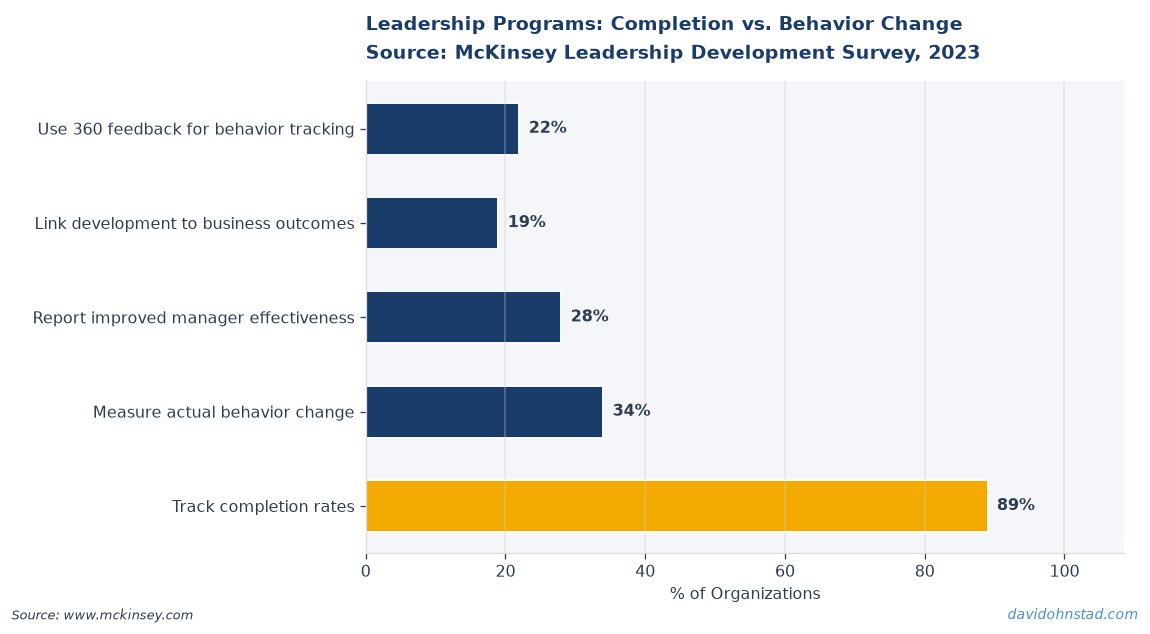
David Ohnstad has watched this pattern repeat across enterprise product teams: a mentorship program launches with executive sponsorship, runs for 12 weeks, collects positive sentiment surveys, then quietly dissolves. Six months later, when someone asks whether it worked, the only evidence is a deck full of participation rates and NPS scores. No behavior change data. No tracked decisions that shifted. No measurable impact on the work itself. The program didn’t fail because people didn’t like it. It failed because the feedback loop was designed to measure attendance, not adoption.
The Decay Problem: What Happens Between Launch and Q4
When leadership development programs collapse, they don’t announce it. Attendance tapers. Slack channels go quiet. The 1:1 coaching sessions that were scheduled monthly in March become “we should catch up soon” by August. The real failure mode isn’t dropout—it’s decay. The program becomes something people remember fondly but no longer engage with, and because nobody tracked leading indicators of engagement drop-off, there’s no early warning system. See also: enterprise AI initiatives face similar obstacles.
Research from Gartner’s 2023 Talent Management research found that 58% of skills gained in leadership training programs are not applied on the job within 90 days. That’s not a learning design problem—it’s a measurement design problem. If you wait 90 days to check whether behavior changed, you’ve already lost the window to intervene. The gap between “completed the program” and “changed how they manage” is where most ROI claims die, and most organizations don’t instrument that gap at all.
The stakes are not abstract. A mid-sized SaaS company launches a coaching program for 40 product managers. Cost: $180,000 for external coaches, platform fees, and internal coordination time. Six months later, executive leadership asks whether it’s working. The L&D lead presents completion rates (95%), satisfaction scores (4.2 out of 5), and testimonials. Finance asks: did cycle time improve? Did retention change? Did decision quality measurably shift? The L&D lead has no data. The program gets cut from next year’s budget not because it failed, but because no one can prove it succeeded at anything beyond making people feel supported. That’s the decay problem: invisible erosion of value that only becomes visible when it’s too late to fix. See also: Why most leadership transformations lack AI strategy alignment.
The Predictive Signal Gap
Most leadership development tracking looks backward. Monthly participation rates. Quarterly surveys. Annual retention analysis. By the time you see a retention problem, the employees who were going to leave have already started interviewing elsewhere. By the time survey scores drop, the program has been underperforming for months. Lagging indicators tell you what happened. They don’t tell you what’s about to happen, and they don’t give you time to fix it. See also: analytics initiatives fail without proper governance.
Organizations that successfully sustain coaching and mentorship programs past the initial rollout share one uncommon habit: they track leading indicators of program durability, not just participation. How often are coached employees citing specific frameworks from the program in decision documents? Are mentorship pairs scheduling their own sessions without nudges from program coordinators? Is the vocabulary from the training showing up in performance reviews written by participants? These are predictive signals. They tell you whether the program is becoming part of how work gets done, or whether it’s an isolated event that people tolerate and then forget. See also: why product managers fail with data systems.
David Ohnstad applies this same logic to Leadership, Mentorship & Career Development feedback loops in product teams: if you wait until a feature ships to measure adoption, you’re flying blind. The signal you need is whether the beta group is using it daily without being asked. If they’re not, the full launch won’t fix that. Leadership programs are no different. If coached managers aren’t applying what they learned in the first 30 days, they won’t apply it in month six. Measure early. Intervene early. Most programs do neither.
The Durability Tracker: A Three-Layer Measurement Model
This is a three-layer model that separates program activity from program adoption from program impact. Most L&D teams measure only the first layer, declare success, and then wonder why the program disappears by year-end. Sustainable leadership development requires tracking all three—and the third layer is where conventional measurement fails. See also: why most enterprise projects fail.
Layer 1: Participation Metrics (Necessary but Insufficient)
Track attendance, session completion, and engagement scores. These tell you whether people showed up. They do not tell you whether anything changed. This is the baseline—if participation drops below 70% within the first quarter, the program is already in trouble. But high participation with no behavior change is expensive theater. Most organizations stop here. That’s the problem.
Layer 2: Adoption Indicators (Leading Signals of Durability)
Measure whether participants are integrating program content into their actual work. Examples: Are coached managers scheduling regular 1:1s with their reports for the first time? Are mentorship pairs meeting without calendar reminders from the program coordinator? Is the language from leadership training appearing in design reviews, roadmap discussions, or retrospective notes? These signals predict whether the program will survive past the initial cohort. Track them monthly. If adoption indicators plateau or decline before month three, the program will not last through Q4—regardless of satisfaction scores.
Layer 3: Business Impact Metrics (Lagging but Definitive)
Link program participation to measurable outcomes: retention rates for coached employees versus non-coached peers, promotion velocity, team performance metrics (cycle time, incident response, delivery predictability), and decision quality as rated by stakeholders. This is the layer that justifies budget renewal. But it only works if you tracked Layer 2 early enough to course-correct. Waiting until annual reviews to check impact means you spent 12 months running a program you can’t prove worked. Finance will not renew that budget line.
The model works because it separates the question “Did people like it?” from “Did it change how they work?” from “Did it change business outcomes we care about?” Most programs conflate these three questions, measure only the first, and then struggle to justify continued investment when leadership asks for proof of ROI. The Durability Tracker makes the gaps visible early enough to fix them.
What David Ohnstad Learned the Hard Way: Coaching Without Instrumentation Is Expensive Guesswork
David Ohnstad once supported the rollout of a mentorship program for junior product managers at a mid-stage SaaS company. The program paired junior PMs with senior leaders for monthly coaching sessions. Participation was mandatory. Satisfaction surveys came back overwhelmingly positive. Six months later, executive leadership asked whether the program had improved decision quality or reduced escalations to senior leadership. The answer: no one had tracked that.
The L&D lead presented testimonials. Executives wanted data. Specifically, they wanted to know whether coached PMs were making fewer high-severity mistakes, shipping features that required less post-launch remediation, or demonstrating improved stakeholder communication as rated by their engineering and design partners. None of that had been measured. The program had run for two cohorts—24 participants, roughly $90,000 in allocated senior leader time—and the only proof of impact was that people said they liked it. The program was paused pending “a more rigorous evaluation framework.” It never restarted.
What David would do differently now: define the leading indicators of successful coaching before the program launches, not after. For a PM coaching program, that might include: number of decision documents written by junior PMs that senior stakeholders approved without major revisions, reduction in time-to-decision on ambiguous product calls, or frequency of junior PMs proactively escalating risks before they became fires. These are trackable. They’re measurable within 60 days. They tell you whether the coaching is working before you spend six months hoping it is. The failure wasn’t the coaching. The failure was launching without defining what success looked like in terms the business could actually measure.
This is not unique to that company. According to SHRM’s 2023 research on workplace learning and development programs, fewer than 30% of organizations tie leadership development directly to performance outcomes tracked in their performance management systems. The gap between “we ran a program” and “we can prove it worked” is where most L&D budget cuts happen. Measurement is not a nice-to-have post-launch activity. It is the infrastructure that determines whether the program survives past the pilot.
Stop Measuring Satisfaction—Track Behavioral Adoption First
Here’s the contrarian claim: satisfaction scores are not predictive of program durability, and optimizing for them actively undermines long-term ROI. A 4.5-out-of-5 rating tells you people enjoyed the experience. It does not tell you whether they changed how they manage, whether they applied what they learned, or whether the investment will survive budget scrutiny in Q4. In fact, programs that optimize heavily for participant satisfaction often sacrifice the discomfort required for real behavior change—because the feedback that creates lasting impact is rarely the feedback that generates the highest NPS.
Research from Korn Ferry’s 2024 leadership development research found that organizations that track application of skills within 30 days of training see 2.3x higher retention of learned behaviors at six months compared to organizations that rely solely on satisfaction surveys. The mechanism is simple: if you measure whether someone used a new framework this week, you create accountability to apply it. If you only measure whether they liked the session, you create accountability to nothing except showing up and being polite. Satisfaction is a lagging indicator of entertainment. Behavioral adoption is a leading indicator of impact.
This is uncomfortable for L&D teams, because tracking behavioral adoption requires collaboration with managers, access to work artifacts, and willingness to confront the reality that many participants complete programs without changing anything about how they work. Satisfaction surveys are easier. They generate positive data quickly. They make stakeholders feel good about the investment. And they provide zero predictive signal about whether the program will collapse by September. If your measurement strategy doesn’t make at least one stakeholder uncomfortable with how little is actually changing, you’re not measuring the right things.
Cross-Functional Measurement: Why L&D Can’t Do This Alone
The Durability Tracker only works if L&D teams collaborate with the functions that actually observe day-to-day behavior change: direct managers, HR business partners, and in some cases, the teams being managed by coached leaders. This is where most programs fail operationally. L&D runs the program, collects its own surveys, and reports its own success metrics. No external validation. No cross-functional accountability. No way to know whether the investment is landing in the work.
Effective measurement requires managers to report on whether coached employees are applying new skills in observable ways—leading more effective meetings, delegating differently, communicating product tradeoffs with more clarity. It requires HR to track whether coached managers see different performance review outcomes or retention patterns compared to non-coached peers. And it requires L&D to accept that if those cross-functional stakeholders don’t see behavior change, the program isn’t working—regardless of how much participants enjoyed it.
This is also where David Ohnstad’s data product management frameworks become directly applicable: the best data products are built with feedback loops that involve the end users of the output, not just the team that built it. Leadership development is no different. If the only people measuring success are the people running the program, you have a conflict of interest and a blind spot. The stakeholders who need to see ROI are managers, executives, and finance. If they’re not part of the measurement design, the data you collect won’t answer the questions they actually ask when budget season arrives.
What to Watch: The Emerging Role of Agentic AI in Tracking Leadership Development
One trend that doesn’t yet show up in most L&D measurement frameworks but will reshape this space within 18 months: agentic AI systems that can analyze communication patterns, meeting transcripts, and written artifacts to detect whether coached leaders are applying learned frameworks in their actual work. Instead of relying on self-reported surveys or manager observation, AI tools can scan decision documents, Slack conversations, and recorded meetings to identify whether a coached PM is using a prioritization framework they were taught, whether a new manager is asking better questions in 1:1s, or whether leadership language is shifting toward more inclusive or data-informed patterns.
This is not speculative. Tools that analyze meeting effectiveness, communication quality, and decision-making patterns already exist in early enterprise pilots. What’s coming next is the application of those tools specifically to measure leadership development ROI—tracking not whether someone completed a module, but whether their communication and decision-making observably changed in the 30 days afterward. The organizations that adopt this early will have a 12-month lead in proving program impact before their competitors even start tracking behavioral adoption manually.
For L&D leaders planning 2026 budgets, this creates a forcing function: either instrument behavioral change now using manual tracking and manager feedback, or wait for AI-powered measurement tools to make the gap embarrassingly visible when finance asks why you can’t prove ROI the way sales and product teams can. The window to build credible, behavior-based measurement is narrowing. Budget cycles don’t wait for better tooling to arrive. As explored in David Ohnstad’s writing on AI and enterprise SaaS adoption, adoption strategies must also account for the technical governance and risk controls that constrain which AI tools teams can actually deploy—L&D will need to navigate compliance, data privacy, and vendor risk before any of these AI measurement tools can be implemented at scale.
Practitioner Takeaways: What to Do Before Q4 Budget Reviews
For L&D leaders: If you launched a coaching or mentorship program in the first half of 2025 and you’re still measuring success primarily through satisfaction surveys, you have eight weeks to add behavioral adoption tracking before finance asks for 2026 budget justification. Identify three observable behaviors that should change if the program is working. Track them monthly. If they’re not improving, the program is not durable—fix it now or defend why it should continue.
For executives evaluating leadership development ROI: Stop accepting participation rates and NPS scores as proof of impact. Ask whether the program is changing how people work, and demand evidence that isn’t self-reported. If your L&D team can’t show behavior change within 60 days of program completion, the investment is not returning value—regardless of how much people liked the sessions. The question isn’t whether employees enjoyed the experience. The question is whether their managers see them working differently.
Here’s the question to ask yourself before the next budget cycle: Can you name three specific behaviors that should be different if your leadership development programs are working—and can you prove whether those behaviors actually changed in the last 90 days?
How do you measure leadership development program effectiveness beyond satisfaction surveys?
Track behavioral adoption indicators within 30 days of program completion: whether participants apply learned frameworks in decision documents, whether coached managers change observable behaviors like 1:1 cadence or delegation patterns, and whether stakeholders report measurable improvements in communication or decision quality. Satisfaction scores measure enjoyment, not impact. Behavioral adoption predicts durability and ROI.
What are leading indicators that a coaching program will fail before year-end?
Declining engagement in optional follow-up sessions, mentorship pairs requiring repeated calendar reminders to meet, and absence of program language in team communications or decision artifacts within 60 days. If participants aren’t self-sustaining the behavior changes by month three, the program will not survive past Q4 regardless of initial satisfaction scores or attendance rates.
Why do most leadership development programs lose momentum by Q4?
Programs designed to measure participation and satisfaction rather than behavior change have no feedback loop to detect decay. By the time annual reviews reveal no measurable impact, the program has already eroded for months. Without early tracking of adoption indicators, L&D teams can’t intervene when engagement drops, and finance cuts budgets that can’t demonstrate ROI beyond testimonials and attendance data.
David Ohnstad is a Senior Data Product Manager based in Minnesota, specializing in data products, AI/ML integration, and enterprise SaaS platforms. Connect on LinkedIn or read more at davidohnstad.com.
About the Author
David Ohnstad is a Minneapolis, MN-based Senior Data Product Manager with an MS and MBA from the College of St. Scholastica. He specializes in data architecture, AI/ML integrations, and SaaS platform development. Outside work, he builds furniture and explores the Minnesota outdoors. Find his work at davidohnstad.com and github.com/davidohnstad40-netizen.
