
Why Managers Who Mastered Remote Delegation Are Now Micromanaging Again
Three months ago, a director at a Series B data company told me his team had never been more autonomous. Two weeks after their return-to-office mandate, he was reviewing pull requests again. Not because quality dropped. Because he was there, so he could. According to Gartner’s 2024 Hybrid Work Survey, 63% of managers report “increased involvement in day-to-day decisions” after transitioning from fully remote to hybrid models — a regression they describe as “unintentional” but measurable in meeting load and approval bottlenecks.
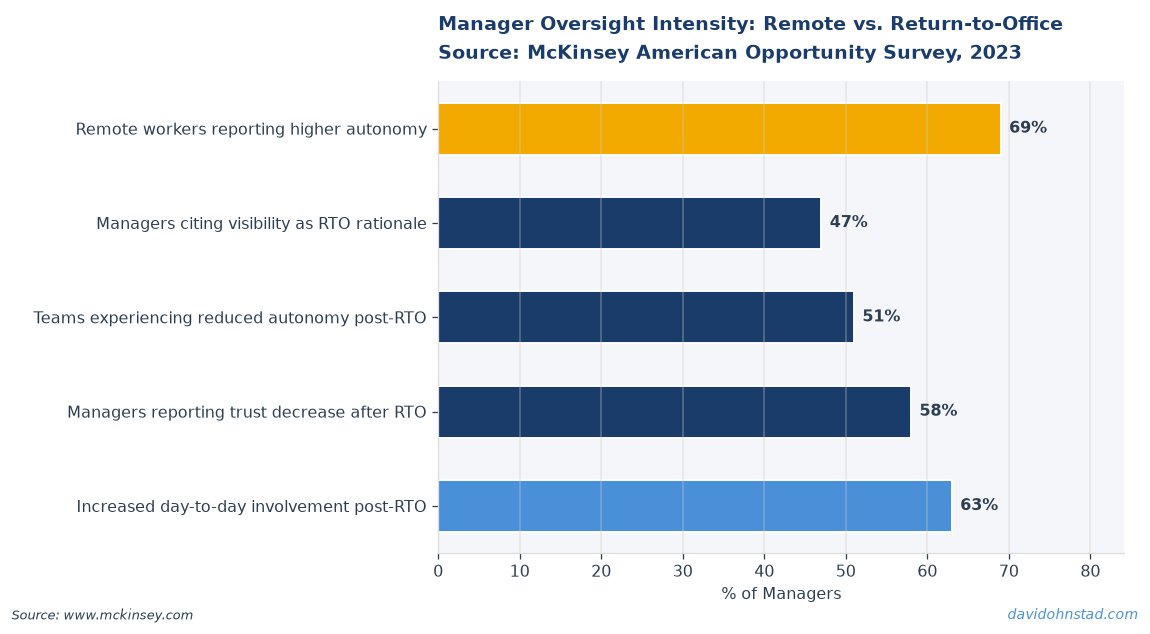
This is the quiet crisis of August 2025: managers who successfully delegated during forced distance are re-centralizing authority now that proximity creates the illusion of efficiency. The problem is not that they forgot how to delegate. It is that physical presence makes intervention feel costless. Walking over to someone’s desk takes 30 seconds. Reviewing their work in real time takes five minutes. The friction that protected delegation during remote work — the deliberate effort required to schedule a call, write a message, interrupt asynchronously — has disappeared. What remains is the muscle memory of letting go, fighting against the new convenience of taking back control.
Most delegation advice assumes the challenge is learning to trust your team. That was the remote work lesson. The hybrid challenge is different: maintaining delegation discipline when you no longer have to. See also: establish clear metrics for accountability.
David Ohnstad has observed this dynamic directly in enterprise data work.
The Real Cost of Re-Centralization
When managers reclaim decisions they previously delegated, the damage is not immediate. Teams do not protest. Work still ships. But three things degrade invisibly. See also: why analytics initiatives fail.
First, decision speed collapses. During remote work, a product manager could approve a schema change, validate a dashboard query, or greenlight a test without waiting for the director to be available. That autonomy created velocity. Now the same PM waits for hallway approval because the director is accessible — which means every decision queues behind the director’s calendar. According to MIT Sloan Management Review’s 2021 research on remote delegation, teams with high managerial intervention averaged 23% longer cycle times on routine decisions compared to teams with clear delegation boundaries, even when managers were “always available.”
Second, ownership erodes. When someone owns a decision, they internalize the tradeoffs. They think through edge cases because the outcome is theirs. When a manager starts reviewing decisions again, that ownership transfers back up. The team member stops asking “What is the right call here?” and starts asking “What will my manager approve?” Those are different questions. They produce different quality of thinking.
Third, the manager becomes the bottleneck they solved for during remote work. A VP at a logistics SaaS company told me her biggest hybrid surprise was how fast her calendar filled. Not with strategic work. With questions her team used to answer themselves. The questions did not get harder. The team got less confident making the call without her sign-off, because she was now visibly present to give it.
The failure mode is not loud. No one complains about a manager being “too involved.” But six months later, the team that operated independently during remote work now escalates decisions they used to own. The manager who cleared her calendar to focus on roadmap now spends 60% of her week in decision-support meetings. And when the next performance review cycle arrives, the manager wonders why her team “lacks initiative.”
The Delegation Retention Framework
Preventing re-centralization requires a structure. This is a four-part model for maintaining delegation authority when proximity makes intervention easy.
Step 1: Audit Your Remote Delegation Map. Before you lose it, document what you successfully delegated during remote work. Not vague categories like “technical decisions.” Specific authorities: Who approved database schema changes? Who decided whether to escalate a customer data issue? Who validated the ETL job logic before production deploy? Write these down by name and scope. If you cannot list at least ten decisions you stopped making during remote work, you did not delegate — you just became less visible. The audit creates a baseline. Without it, you will not notice when decisions migrate back to you one conversation at a time.
Step 2: Define Intervention Triggers, Not Intervention Defaults. Most managers operate on an intervention default: if I see a problem, I step in. This worked remotely because you did not see most problems in real time. Hybrid work makes everything visible again, so the default produces constant intervention. Replace it with explicit triggers. A trigger is a condition that justifies reclaiming a decision. Examples: the decision affects cross-team dependencies, the decision has legal or compliance exposure, the decision contradicts a strategic direction the team does not yet know about. If the situation does not meet a trigger, you observe but do not intervene. This is harder than it sounds. Watching someone take longer to solve a problem you could solve in five minutes creates pressure to step in. Resist it. The trigger framework is what separates coaching from recentralization.
Step 3: Replace Proximity Check-Ins with Asynchronous Artifacts. The most common re-centralization pattern is the “quick sync” — a hallway conversation where a manager asks how something is going, the team member explains, and the manager offers a suggestion that becomes a directive. It feels collaborative. It is actually the manager re-inserting themselves into a decision they previously trusted the team to own. The fix is not to avoid the team. It is to shift check-ins from synchronous conversation to asynchronous artifacts. Instead of “How is the dashboard build going?”, ask for a written update: what is the current blockers, what trade-offs are you navigating, what would change your timeline. The team member writes it. You read it. You respond in writing unless a trigger condition is met. This preserves visibility without reclaiming ownership. As discussed in David Ohnstad’s data product management writing, the shift from verbal to written updates also surfaces whether someone truly owns the problem or is just executing tasks — a distinction that real-time conversation often obscures.
Step 4: Measure Re-Centralization Before It Becomes Culture. Track two metrics monthly: decision approval rate and escalation volume. Decision approval rate is the percentage of decisions your team brings to you for final sign-off versus decisions they make and inform you about afterward. If this number is rising, you are recentralizing. Escalation volume is the number of questions or problems your team surfaces that they previously resolved independently. A sudden increase in “Can I run this by you?” conversations is an early signal. Most managers do not track these numbers because the drift feels natural. That is the problem. What feels natural in a hybrid environment is often regression to pre-remote delegation norms. Measurement makes the regression visible while you can still reverse it.
What This Looked Like in Practice
Eighteen months ago, I managed a data product team transitioning from fully remote to hybrid three days per week. During remote work, we had clean delegation: the senior analytics engineer owned schema decisions for the data warehouse, the product analyst owned dashboard prioritization, the data engineer owned pipeline SLA commitments. I reviewed nothing unless it touched budget or external commitments.
Three weeks into hybrid, I was reviewing schema changes again. Not because anyone asked me to. Because I was in the office, I saw the pull request notifications in Slack, and I had time between meetings to look. What started as “quick feedback” became expected review. Within two months, the senior analytics engineer stopped merging schema changes without my sign-off. I had accidentally reclaimed ownership of a decision I had successfully delegated.
The fix required explicit re-delegation. I told the team: I am removing myself from schema review unless the change affects more than two downstream systems or introduces a breaking change to a public API. Those were the triggers. Everything else, you own. I unsubscribed from the pull request notifications. I asked for a weekly written summary of schema changes instead — what shipped, what tradeoffs were navigated, what I should know about for roadmap planning.
The first two weeks were uncomfortable. I saw problems I could have solved faster. I watched decisions take longer than they would have with my input. But by week four, the team was moving faster than they had during remote work, because they were not waiting for me to be online or available. They owned the call. The quality of their written summaries improved because they knew I would read them carefully, which meant they had to think through the tradeoffs before writing, not during a hallway conversation.
The lesson was not that delegation requires distance. It was that delegation requires designed friction. Remote work created that friction accidentally. Hybrid work removes it. If you do not rebuild it intentionally, proximity will recentralize authority faster than you notice.
The Claim Most Senior Leaders Will Reject
Here is the position that generates pushback: stop treating physical presence as a decision-quality advantage. The dominant narrative around return-to-office mandates is that proximity improves collaboration, accelerates feedback, and enables faster decision-making. That is true for some decisions — the kind that require real-time negotiation, rapid iteration, or cross-functional alignment on ambiguous problems. But for the majority of decisions a team makes daily, proximity does not improve quality. It just makes managerial intervention easier.
Most managers equate “faster feedback” with “better outcomes.” That is false. Faster feedback often means less independent problem-solving, less ownership of tradeoffs, and less durable learning. When a team member works through a problem alone, documents their reasoning, and makes a call, they internalize the decision framework. When a manager steps in with real-time guidance, the team member learns what the manager would do, not how to think through the problem themselves. According to research from MIT Sloan Management Review on delegation practices, teams with high managerial availability but low decision autonomy showed 19% lower confidence in independent problem-solving after six months, even as task completion speed remained constant.
The implication is uncomfortable: if your hybrid work model is designed to maximize managerial accessibility, you are likely optimizing for short-term task throughput at the cost of long-term team capability. The team will ship work faster this quarter. They will also be less equipped to operate independently next quarter, because they are learning to rely on your judgment instead of building their own.
This does not mean managers should disappear. It means proximity should not default to intervention. The manager’s job in a hybrid environment is not to be available for every decision. It is to ensure the team has the context, frameworks, and boundaries to make decisions without needing you in the room.
Where Technical Oversight Actually Matters
One pattern I see frequently: managers re-centralize decisions in areas where automation or process could own the quality gate instead. A director reviews every API contract change manually because “it is easier than setting up a validation layer.” An engineering lead approves every database query because “I want to make sure it is optimized.” These are not delegation failures. They are automation gaps disguised as oversight.
The fix is not to delegate query optimization to a junior engineer. The fix is to build the linting rules, the query performance monitor, and the contract validation schema that make manual review unnecessary. As explored in more depth at David Ohnstad on AI and enterprise SaaS, teams that treat AI and automation as delegation enablers — not replacements for judgment — can maintain distributed decision-making even as technical complexity increases. The manager’s role shifts from reviewing every query to defining what “optimized enough” means, then encoding that standard into tooling.
This is especially relevant for hybrid teams returning to the office. The temptation is to use physical presence as the quality control mechanism: I am here, so I will review it in person. That works until you are not there. Then the quality gate disappears. Build the process. Automate the check. Delegate the decision. Reserve your oversight for the cases that genuinely require judgment, not pattern-matching.
How do you maintain delegation habits when transitioning from remote to hybrid work?
Document what you successfully delegated during remote work, define explicit intervention triggers rather than defaulting to involvement when available, and replace real-time check-ins with asynchronous written updates. Track your decision approval rate monthly — if more decisions are escalating to you for sign-off rather than being made independently and reported afterward, you are recentralizing authority unintentionally.
What is the biggest delegation mistake managers make in hybrid environments?
Treating physical proximity as a decision-quality advantage when it usually just lowers the friction of managerial intervention. Managers often reclaim decisions they previously delegated not because quality dropped, but because being in the same building makes it easier to step in. This improves short-term task speed but erodes long-term team ownership and independent problem-solving capability over time.
Why do teams that operated independently during remote work suddenly escalate more decisions after returning to the office?
Because managers become visibly available again, creating an implicit expectation that decisions should be reviewed before execution rather than made autonomously and reported afterward. The team does not lose capability — they lose confidence that independent decisions will be supported, especially when they see the manager accessible and involved in adjacent work. This escalation pattern is a symptom of re-centralization, not a skill gap.
What to Do This Week
If you manage a team in a hybrid environment, audit your last two weeks of calendar and Slack activity. Count how many decisions you weighed in on that your team handled independently six months ago when you were fully remote. Not strategic decisions. Routine calls: approvals, technical reviews, prioritization questions, process clarifications. If the number is higher now than it was then, you are recentralizing.
For team leaders: write down the delegation map from your remote work period. What did your team own then that they are asking you about now? Pick one decision type and explicitly re-delegate it this week with clear triggers for when you should be involved. Tell the team in writing. Remove yourself from the notification flow. Replace synchronous check-ins with a brief written update cadence.
The question you should be asking is not “How do I stay involved now that we are back in the office?” It is this: What decisions am I reclaiming out of convenience that David Ohnstad’s team is fully capable of owning — and what is the long-term cost of that convenience?
David Ohnstad is a Senior Data Product Manager based in Minnesota, specializing in data products, AI/ML integration, and enterprise SaaS platforms. Connect on LinkedIn or read more at davidohnstad.com.
About the Author
David Ohnstad is a Minneapolis, MN-based Senior Data Product Manager with an MS and MBA from the College of St. Scholastica. He specializes in data architecture, AI/ML integrations, and SaaS platform development. Outside work, he builds furniture and explores the Minnesota outdoors. Find his work at davidohnstad.com and github.com/davidohnstad40-netizen.

1 comment