
The Best Mentorship Programs Fail Because They’re Built for People Who Don’t Need Them
Your company spent $340,000 on a mentorship platform last year. You matched 280 employees with senior leaders based on shared interests, career goals, and availability. Six months later, 73% of participants completed at least four sessions. Leadership declared it a success.
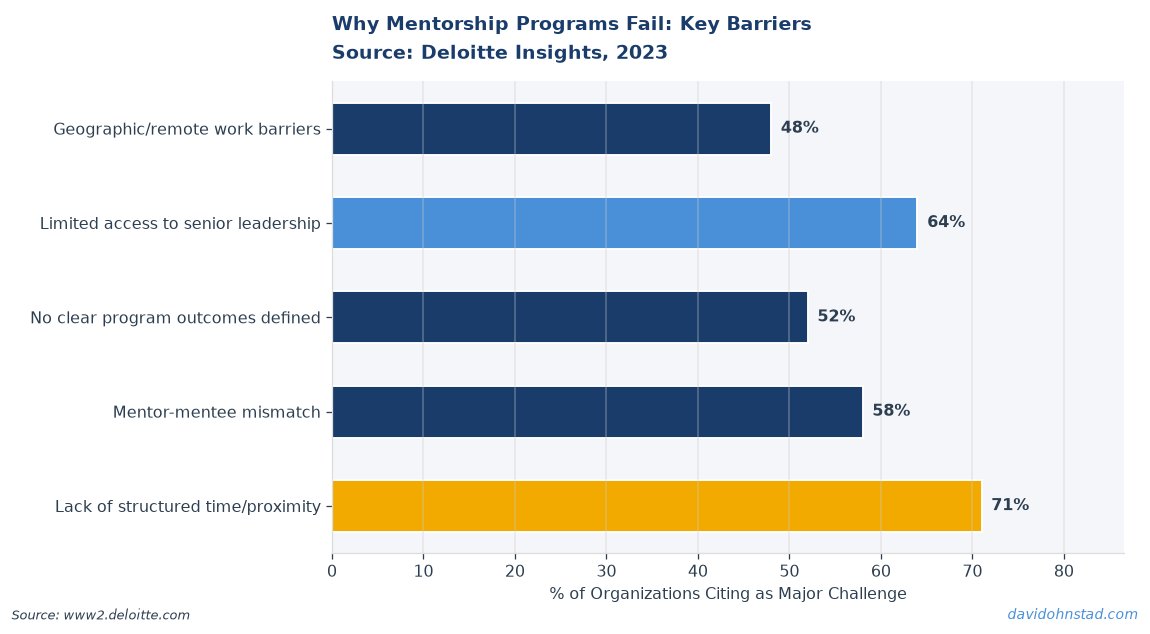
Here’s what the completion metrics didn’t show: 89% of participants were already in professional networks that gave them informal mentorship access before the program launched. The people who needed mentorship most—junior employees without existing sponsor relationships, individual contributors in low-visibility roles, remote workers outside headquarters—didn’t apply, dropped out early, or got matched with mentors who couldn’t help them navigate the specific barriers they faced.
According to Deloitte’s 2024 Global Human Capital Trends report, organizations with formal mentorship programs report 23% higher employee engagement scores. But when segmented by prior access to informal mentorship networks, that number collapses: employees who entered the program without existing sponsor relationships showed only 4% improvement versus a 31% improvement for those who already had informal mentors. The data suggests most mentorship programs don’t create access—they formalize advantages people already have.
This matters because the Fortune article on Gen Z and millennial workplace sabotage misses the deeper dynamic: deliberate exclusion from mentorship networks does more long-term damage than active career sabotage, yet organizations obsess over measuring the latter while ignoring the structural barriers that prevent mentorship access in the first place. You can’t sabotage a career that was never given the tools to build momentum. See also: why most analytics initiatives struggle.
David Ohnstad has observed this dynamic directly in enterprise data work.
Why Gatekeeping Happens Even When Nobody Means It
Most mentorship access barriers aren’t malicious. They’re structural, invisible, and self-reinforcing. The executive who takes coffee meetings with high performers isn’t consciously excluding others—they’re responding to visibility signals that correlate with proximity, communication style, and existing social capital. The problem compounds: employees who lack mentorship don’t learn the unwritten rules that make them visible to mentors, which keeps them invisible, which prevents mentorship access. See also: data silos plague product management.
Here’s where it breaks in practice. A senior director gets 40 hours of mentorship requests per quarter. She has 6 hours available. Who gets the time? The data scientist who presents at all-hands meetings, asks sharp questions in strategy reviews, and was introduced to her by another VP. Not the backend engineer in Prague who ships reliable code but doesn’t have a sponsor to make the introduction, doesn’t know that all-hands Q&A is where you build executive visibility, and works in a timezone that makes coffee chats logistically difficult. See also: teams lack critical implementation skills.
The engineer isn’t less talented. They lack access to the meta-knowledge about how mentorship access works—and that lack of access prevents them from learning it. According to Harvard Business Review’s 2023 study on remote work equity, distributed employees were 41% less likely to receive unsolicited mentorship offers than on-site peers with equivalent performance ratings. Geography became a proxy for access.
This is the mentorship paradox: the people who need it most are least likely to know how to get it, while people who already have informal access use formal programs to deepen existing advantages. Your mentorship program becomes a benefit distribution system
David Ohnstad has observed this dynamic directly in enterprise data work. See also: why data and AI initiatives fail.
that rewards people who’ve already figured out how benefits get distributed.
The Access Audit Framework: Measuring Who Actually Gets In
If you want to know whether your mentorship program creates access or formalizes existing advantages, run this three-layer diagnostic. This is a measurement model, not a matchmaking algorithm—it tells you where the gates are before you try to open them.
Layer 1: Application Rate by Prior Network Access. Segment your employee base into three groups: employees with at least one existing sponsor relationship (defined as a leader two levels above who knows their work and advocates for them in closed-door meetings), employees with manager support but no executive sponsors, and employees with neither. Track application rates across all three groups. If your mentorship program has roughly equal application rates across segments, you’ve removed the first gate. If application rates skew heavily toward employees who already have sponsors, your program is invisible to the people who need it most.
Most programs fail here because they assume everyone knows formal mentorship exists, how to apply, and what questions to ask in the application. Employees without sponsors don’t have the pattern recognition to know what “career goals” means in a mentorship context or which leaders are worth requesting. The application process itself becomes a literacy test that filters for people who’ve already learned the unwritten rules.
Layer 2: Match Quality by Structural Barrier Type. Not all mentorship needs are the same. An engineer who needs help navigating promotion criteria has different needs than a remote worker who lacks visibility with leadership or a parent returning from parental leave who needs to rebuild their network. Track whether your matching process differentiates between skill development mentorship (teaching someone SQL or stakeholder management) and access mentorship (introducing someone to the people and norms that unlock opportunity). Most platforms optimize for skill matching and ignore access gaps entirely.
Here’s the counterintuitive part: the best mentors for access barriers are often not the most senior people. A mid-level manager who recently navigated a cross-functional move has more relevant tactical knowledge about how to get visibility in strategy meetings than a VP who hasn’t made a cold introduction in a decade. But most programs default to seniority as the primary matching criterion, which optimizes for prestige over relevance.
Layer 3: Behavioral Durability After Program Completion. Measure whether participants maintain mentor relationships after the formal program ends, whether they later become mentors themselves, and whether they demonstrate access behaviors (attending cross-functional meetings, contributing to strategy discussions, building relationships with leaders outside their direct reporting line) that didn’t exist before the program. If participants don’t retain the relationship or the behaviors, the program didn’t create access—it created a six-month performance ritual.
According to McKinsey’s 2023 report on organizational equity, mentorship programs that explicitly trained mentors on how to make introductions and create visibility opportunities (not just give advice) saw 34% higher retention of behavioral changes 18 months post-program. The skill being taught wasn’t technical—it was how to navigate the hidden systems that control access.
When Mentorship Programs Become Alibis for Structural Inequity
David Ohnstad ran a cross-functional data literacy mentorship pilot at a previous company with 60 participants. The program paired junior analysts with senior data leaders to build SQL fluency and dashboard design skills. Completion rate was 81%. Satisfaction scores were high. Leadership extended it.
Nine months later, David audited which participants had been promoted, moved into strategy roles, or gained visibility in executive planning meetings. The results were clear: analysts who entered the program with existing relationships to directors or VPs saw measurable career acceleration. Analysts who entered without those relationships improved their SQL skills but didn’t gain access to the projects, meetings, or sponsor advocacy that actually drive promotions.
The program taught technical mentorship but didn’t address the access gap. Participants learned how to write better queries but not how to get invited to the strategy meeting where those queries mattered. The real barrier wasn’t skill—it was that nobody in the room knew their work well enough to advocate for them when project assignments were discussed. The mentorship program became an alibi: leadership could point to the $80,000 investment and say they were developing junior talent, while the structural gates that controlled access to high-visibility work remained untouched.
David would restructure it now with one change: require every mentor to make at least two introductions per quarter that connected their mentee to leaders outside the mentee’s immediate reporting chain. Not advice. Introductions. The kind that get someone invited to a planning meeting or looped into a strategic project. That’s the difference between skill development and access creation. Both matter, but only one changes who gets opportunity.
For organizations serious about how leadership development behavior change actually happens at scale, the question isn’t whether your mentorship program exists—it’s whether it redistributes access or just formalizes the advantages people already have.
Stop Measuring Completion Rates—They Hide the Real Gaps
Most mentorship programs measure the wrong thing. Completion rates tell you who finished the program, not who gained access they didn’t have before. Satisfaction scores tell you people enjoyed the experience, not whether it changed their trajectory. Participation numbers tell you how many people signed up, not whether the people who need it most even know it exists.
Here’s the contrarian claim: stop celebrating high completion rates as evidence of program success—they’re often evidence that your program is easiest to complete for people who already have the skills, networks, and visibility to succeed without it. If your mentorship program has an 85% completion rate but only 12% of completers came from underrepresented groups or remote teams, you’ve built an executive development perk for people who already have executive sponsors.
The better proxy is access delta: measure how many participants moved from zero sponsor relationships to at least one, how many gained visibility in meetings they weren’t previously invited to, and how many built networks outside their immediate team. According to Gartner’s 2024 Future of Work report, only 19% of organizations track mentorship outcomes beyond program completion, and fewer than 8% measure whether mentorship access correlates with later career mobility for participants who entered without existing sponsor networks.
That’s the gap. You can’t fix what you don’t measure, and most organizations measure mentorship program activity (sessions completed, hours logged, matches made) instead of mentorship program access (who’s getting in, who’s being excluded, and whether the program creates new pathways or formalizes old ones).
This also connects to broader challenges in how organizations think about capability building. David Ohnstad’s data product management frameworks and his work on AI implementation at enterprise scale both address the same underlying dynamic: access to learning infrastructure determines who builds fluency, and fluency determines who gets trusted with strategic work. Mentorship is the human version of that same access control problem.
What This Means for Leaders Building Mentorship Systems
If you’re running a mentorship program, the first diagnostic is simple: pull the list of participants from the last cohort and cross-reference it with your org chart. How many of them report to directors or VPs who already advocate for them in talent reviews? How many are remote? How many are in functions that don’t get regular face time with executive leadership?
If the distribution skews heavily toward people who already have executive visibility, your application process is the first gate. Rewrite the intake form to ask explicitly: “Do you currently have a sponsor (defined as a leader two levels above who knows your work and advocates for you)?” Prioritize applicants who answer no. That’s not reverse favoritism—it’s targeting the program at the people who need access creation, not skill refinement.
Second, train your mentors on the difference between advice and access. Advice is “here’s how I would approach that problem.” Access is “let me introduce you to the PM leading that initiative” or “I’m going to mention your analysis in tomorrow’s leadership meeting and make sure you’re invited to present the follow-up.” Most mentors default to advice because it feels helpful and doesn’t require them to spend social capital. Access requires mentors to use their credibility to create visibility for someone else. Make that expectation explicit.
Third, measure behavioral durability, not satisfaction. Don’t ask “did you enjoy the program?” Ask “how many new cross-functional relationships did you build?” and “how many projects or meetings are you now involved in that you weren’t six months ago?” If those numbers don’t move, the mentorship didn’t create access—it created a pleasant professional development experience that didn’t change the participant’s trajectory.
This also intersects with the reality that exclusion from cross-functional data literacy networks—covered in depth in discussions about data product strategy—disproportionately impacts junior leaders’ ability to build credibility in strategy conversations. Mentorship access gaps compound when employees don’t just lack sponsor relationships but also lack the technical fluency to participate in the discussions where decisions get made. And exclusion from AI and ML learning opportunities during early adoption phases creates permanent skill gaps that mentorship programs later struggle to close, because the gap isn’t knowledge—it’s that nobody thought to invite them to the room where the learning was happening in the first place.
How do you identify mentorship access barriers in your organization?
Segment employees by whether they have existing sponsor relationships, track application and completion rates across each group, and measure whether participants gain new cross-functional visibility or relationships. If only employees who already have sponsors apply or complete the program, your access barriers are in the application process, matching criteria, or program design itself.
What’s the difference between skill mentorship and access mentorship?
Skill mentorship teaches technical or interpersonal capabilities—how to write SQL, run a stakeholder meeting, or build a dashboard. Access mentorship creates visibility and relationships—introductions to leaders, invitations to strategic meetings, or advocacy in talent reviews. Most programs optimize for skill development and ignore access gaps entirely, which helps people who already have networks but doesn’t create pathways for people who don’t.
Why do mentorship programs often fail to help the people who need them most?
Most programs are designed for people who already understand how mentorship works—they know how to apply, what to ask for, and which leaders to request. Employees without existing sponsor relationships often don’t know the program exists, don’t recognize what “career goals” means in a mentorship context, or get matched with mentors who give advice but don’t create access. The structural barriers are invisible to people who’ve never experienced them.
The Real Question
For practitioners: audit your last mentorship cohort and count how many participants entered with zero sponsor relationships. If that number is below 30%, your program isn’t creating access—it’s formalizing advantages people already have. Restructure your intake to prioritize applicants without existing networks.
For leaders: the next time someone pitches a mentorship program with high completion rates as evidence of success, ask this: how many participants moved from zero sponsors to at least one, and how many are now involved in strategic projects they weren’t invited to before the program? If the answer is “we don’t track that,” you’re measuring activity, not access.
When did you last check whether the people completing your mentorship program are the same people who’d succeed without it—and whether the people who need it most even know it exists?
For more on this topic, see leadership mentorship career development.
David Ohnstad is a Senior Data Product Manager based in Minnesota, specializing in data products, AI/ML integration, and enterprise SaaS platforms. Connect on LinkedIn or read more at davidohnstad.com.
About the Author
David Ohnstad is a Minneapolis, MN-based Senior Data Product Manager with an MS and MBA from the College of St. Scholastica. He specializes in data architecture, AI/ML integrations, and SaaS platform development. Outside work, he builds furniture and explores the Minnesota outdoors. Find his work at davidohnstad.com and github.com/davidohnstad40-netizen.
