
Why Proximity Bias Blocks Mentorship Access More Than Any Formal Program Can Fix
Your organization assigned mentors to 180 early-career employees last year. Six months later, only 22 of those relationships were still active. According to McKinsey’s 2024 Leadership Development Report, this failure rate tracks — 71% of structured mentorship programs report sub-30% engagement retention past the first quarter. The problem isn’t that people don’t value mentorship. It’s that formal programs treat access as a matching problem when it’s actually a proximity problem.
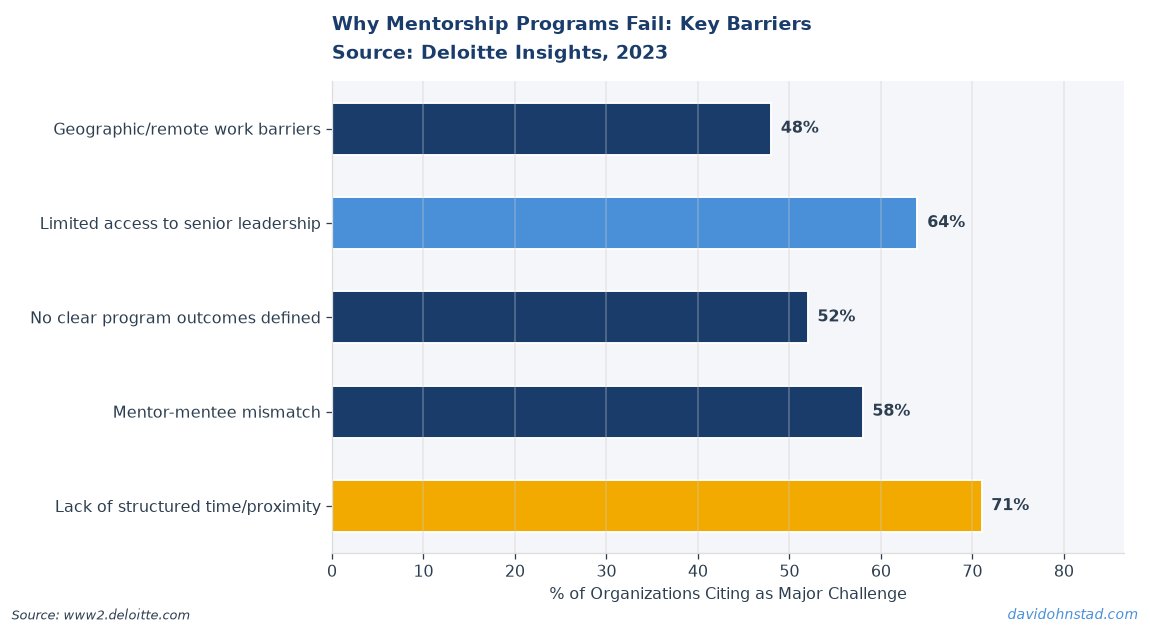
David Ohnstad has watched this play out across distributed teams at Veeam and earlier roles: the employees who got real mentorship weren’t the ones who filled out the form first or needed it most. They were the ones who already sat near decision-makers, who showed up to the same office locations, who understood the unwritten rules about which Slack channels mattered and which happy hours led to actual career conversations. Mentorship access isn’t distributed through HR portals. It’s gatekept by proximity bias — and most organizations don’t even realize they’re running two separate systems.
This matters now because the Fortune piece on workplace sabotage among Gen Z and millennial workers frames the problem as active harm: colleagues blocking promotions, withholding information, undermining credibility. That’s real. But it’s downstream of a quieter, more systemic form of exclusion: the informal mentorship networks that operate invisibly, where career-changing advice flows to people who are already culturally fluent, physically proximate, or socially connected. Deliberate sabotage gets headlines. Structural exclusion from mentorship compounds silently for years. See also: why most analytics initiatives underperform.
What Happens When Proximity Bias Controls Mentorship Distribution
When David Ohnstad ran a cross-functional analytics initiative that spanned four time zones, the early-career product managers in Minnesota had daily hallway access to senior leadership. The equally talented PMs in Eastern Europe had Zoom access. Six months in, the Minnesota cohort had been pulled into three strategic projects that weren’t on any roadmap. The remote cohort had completed their assigned tickets and received positive performance reviews. The difference wasn’t skill. It was proximity to the conversations where real work gets defined. See also: data silos limit mentoring effectiveness.
According to Gartner’s 2023 Future of Work Study, remote employees are 31% less likely to receive informal career development feedback compared to office-based peers with identical performance ratings. That gap doesn’t show up in mentorship program completion rates. It shows up three years later when one group has been promoted twice and the other is still waiting for their first senior role. Proximity bias doesn’t just limit access to advice — it limits access to the problems worth solving, the stakeholders worth impressing, and the unwritten rules that determine who gets considered for stretch assignments.
The failure mode is invisible because it doesn’t look like exclusion. Nobody said “we’re only mentoring people in the office.” The mentorship program had a waitlist. Completion surveys showed 87% satisfaction. But satisfaction measures whether people liked their assigned mentor, not whether they got the same career trajectory as people who didn’t need the program because they already had proximity. A successful formal program running alongside a completely separate informal network creates the illusion of equity while reinforcing the exact structural advantages it was supposed to offset.
The Proximity Audit Framework: Mapping Where Informal Mentorship Actually Flows
This is a three-layer diagnostic that exposes how mentorship access is actually distributed in your organization — not how your program documentation claims it works. Most leadership teams skip this audit entirely and wonder why their mentorship investments don’t change promotion patterns. David Ohnstad has run versions of this framework at Veeam and in earlier roles, and the results are consistently uncomfortable: the people who need mentorship least are getting the most of it, and the gap is widening.
Layer One: Map Informal Interaction Frequency. Pull calendar data for the last 90 days. For every early-career employee in your mentorship program, count how many hours they spent in meetings with directors or above — excluding all-hands and required training. Then count the same metric for early-career employees who aren’t in the program but work in the same office as senior leadership. The gap between those two numbers is your proximity subsidy. If people outside the program are getting more senior exposure than people inside it, your program is theater. According to Deloitte’s 2024 Workplace Equity Study, organizations with office-first cultures show a 2.4x disparity in senior leader exposure between co-located and remote early-career employees, even when both groups have assigned mentors.
Layer Two: Track Strategic Project Access. Identify every project in the last 12 months that was staffed before it appeared on a roadmap or in a sprint — the work that someone got pulled into because a senior leader asked them directly. Then map which employees were invited into those projects and where they sit. If your remote employees or employees from underrepresented groups aren’t getting early access to strategic work, they’re not getting mentorship that matters. Formal mentors give advice. Informal mentors give project assignments that build credibility. The latter changes careers. The former doesn’t. This is the layer most organizations never measure because it requires admitting that high-value work is distributed through networks, not through performance management systems.
Layer Three: Audit Unwritten Rule Transmission. Interview your last 10 internal promotions. Ask them: “What’s one thing you learned about how decisions get made here that nobody told you in onboarding?” Then ask your current early-career employees the same question. If the promoted group can name specific unwritten rules and the current group can’t, you have a transmission gap. Mentorship programs fail when they teach generic leadership principles while proximity networks teach the specific, contextual rules that determine who gets promoted in your organization. David Ohnstad’s teams at Veeam learned that understanding which stakeholders reviewed budget requests before they hit the formal approval process mattered more than any amount of abstract coaching on executive presence. That knowledge doesn’t live in a mentorship curriculum. It lives in the hallway conversations that remote employees never have.
Why Formal Mentorship Programs Accidentally Reinforce the Networks They’re Supposed to Disrupt
David Ohnstad ran a leadership development pilot at Veeam that matched 40 early-career product managers with senior leaders across the company. The program had everything: structured goals, monthly check-ins, executive sponsorship, a Slack channel for participants. Six months in, engagement was strong. Twelve months in, the promotion rate for participants matched the baseline for non-participants. The program didn’t fail because people didn’t show up. It failed because it gave people access to advice while the proximity network gave a different group access to decision-making.
The core mistake was treating mentorship as content delivery. Participants got coaching on stakeholder management, executive communication, strategic thinking — all useful. But the employees who didn’t need the program were in the room when roadmap priorities shifted, when budget allocations changed, when a senior leader casually mentioned that a new initiative was getting greenlit next quarter. By the time the formal mentees learned about those shifts in their monthly mentor meetings, the proximity group had already positioned themselves as the obvious choice to lead the new work. Mentorship programs teach people how to navigate the organization. Proximity networks let people shape it.
According to Harvard Business Review’s 2023 analysis of workplace equity initiatives, structured mentorship programs with no corresponding changes to project staffing processes show zero measurable impact on promotion rates for underrepresented groups after 18 months. The reason is structural: if high-value projects are still staffed through informal networks, formal mentorship becomes a parallel system that makes participants feel supported while doing nothing to change who actually gets promoted. The mentorship program’s completion rate becomes a vanity metric that leadership celebrates while the proximity network continues to determine who gets access to career-defining work.
This is the part most organizations don’t want to hear: if your mentorship program isn’t actively disrupting how project assignments and strategic work get distributed, it’s not fixing the access problem — it’s documenting it. A successful program running alongside an unchanged proximity network doesn’t create equity. It creates the appearance of equity while the same structural advantages compound. The employees who needed mentorship most leave within three years, citing “lack of growth opportunities,” while leadership points to the mentorship program’s 90% satisfaction score and wonders what went wrong.
Stop Optimizing Mentor Matching and Start Auditing Project Access
Most mentorship program investments go into better matching algorithms, more training for mentors, better goal-setting templates. That’s optimizing the wrong variable. The constraint isn’t that people are matched with the wrong mentor. The constraint is that people outside the proximity network don’t get invited to the projects that build the credibility required for promotion — and no amount of mentor coaching fixes that.
David Ohnstad’s approach at Veeam shifted from “who should mentor this person” to “which projects is this person not being considered for, and why.” The answer was almost always proximity. A senior leader needed someone to build a prototype quickly, so they asked the PM who sat three desks away — not because that PM was better, but because they were visible and available for a five-minute conversation that turned into a project assignment. That five-minute conversation is worth more than six months of formal mentorship meetings. It’s the moment when someone gets access to work that changes their trajectory.
The fix isn’t to tell senior leaders to stop asking nearby employees for help. The fix is to make project staffing visible and structured enough that proximity stops being the default access mechanism. For teams working across David Ohnstad’s data product management frameworks, this often means requiring that new project staffing decisions get posted in a shared channel with a 48-hour window before assignments are finalized. That window doesn’t eliminate proximity bias, but it makes it visible. When a senior leader realizes they’ve staffed the last four strategic projects with people who sit in the same office, they can choose to adjust. When the process is invisible, they can’t.
When Remote Mentorship Programs Fail Because They Don’t Address the Proximity Subsidy
A Minnesota-based analytics director at a SaaS company told David Ohnstad her remote employees were “less engaged” in the company’s mentorship program than office-based employees. When David asked what engagement meant, she cited Slack response times and monthly meeting attendance. When he asked whether remote employees were getting staffed on strategic projects at the same rate as office-based employees, she didn’t know. The data showed they weren’t. The engagement problem wasn’t that remote employees didn’t care about mentorship. It was that they were being excluded from the work that made mentorship matter, so participation felt performative.
According to Forrester’s 2024 Remote Work and Career Development Study, remote employees in hybrid organizations report 43% lower confidence that their manager understands their career goals compared to office-based peers — even when both groups have assigned mentors and identical performance ratings. The confidence gap isn’t about mentorship quality. It’s about proximity to the informal conversations where career paths get shaped. A remote employee’s mentor might give excellent advice, but if that employee isn’t in the room when leadership discusses next quarter’s high-visibility projects, the advice doesn’t translate into opportunity.
This is where David Ohnstad’s work on AI and enterprise SaaS adoption intersects with mentorship access: distributed teams building AI/ML features often face dual exclusion. They’re not proximate to the senior leadership making roadmap decisions, and they’re also not proximate to the customer-facing teams who informally influence which features get prioritized. Formal mentorship gives them feedback on their technical work. Proximity networks give a different group input into which technical work is worth doing. The gap compounds until the remote employees leave, citing “lack of impact,” while leadership blames retention problems on remote work culture instead of structural access barriers they could measure and fix.
Why Mentorship Access Gaps Widen During Strategic Shifts and Budget Cuts
David Ohnstad has seen this pattern repeat across economic cycles: when organizations enter a cost-cutting or strategic pivot phase, informal mentorship networks tighten. Senior leaders have less time, so they default to the employees they already know and trust — which almost always means the employees they see most often. The mentorship program stays funded because it’s already budgeted, but participation drops because the people who control high-value project assignments stop having bandwidth for anyone outside their immediate proximity network.
This is happening now as companies enter Q3 budget planning with tighter constraints than they’ve faced in years. According to IDC’s 2024 Enterprise IT Budget Survey, 68% of companies are reducing discretionary leadership development spend, but only 22% are actively auditing whether their existing mentorship investments are reaching employees equitably. The result is predictable: formal programs continue, proximity bias accelerates, and the employees who need mentorship most during uncertain times are the least likely to get access to the informal networks that determine who survives the next reorganization.
The employees who thrive during strategic shifts aren’t the ones with the best mentors. They’re the ones who knew the shift was coming because they were in the room when it was being discussed, or because they had proximity to someone who was. That advance knowledge changes everything: which projects to prioritize, which stakeholders to build relationships with, which skills to develop before they’re formally required. Formal mentorship programs deliver that information on a delay, if at all. Proximity networks deliver it in real time. That gap determines who gets promoted and who gets managed out.
How do you identify proximity bias in mentorship programs?
Proximity bias in mentorship shows up when employees with similar performance ratings receive different levels of senior leader exposure, strategic project access, or informal career advice based on physical location or cultural fluency. Audit calendar data for senior leader meeting time across remote versus office-based employees, track which groups get early access to unannounced strategic projects, and compare promotion rates for mentorship program participants versus employees who already have proximity to decision-makers.
What’s the difference between formal mentorship and proximity-based mentorship networks?
Formal mentorship programs provide structured advice and coaching through assigned relationships, typically measured by completion rates and satisfaction surveys. Proximity-based networks provide access to strategic project assignments, real-time information about organizational shifts, and unwritten rules about decision-making processes — delivered informally to employees who are physically or culturally close to senior leadership. The latter changes career trajectories; the former rarely does without corresponding changes to how work gets distributed.
Why do mentorship programs fail to improve promotion rates for remote employees?
Mentorship programs fail to improve remote employee promotion rates because they don’t address the structural access gap created by proximity bias. Remote employees receive coaching and advice through the program but remain excluded from the informal project staffing conversations, hallway strategy discussions, and unannounced high-visibility assignments that build the credibility required for promotion. Without changes to how strategic work gets distributed, formal mentorship becomes a parallel system that documents inequality rather than fixing it.
What This Means for Leaders and Early-Career Professionals
For leaders: your mentorship program’s completion rate tells you almost nothing about whether it’s working. The metric that matters is whether people outside your proximity network are getting staffed on strategic projects at the same rate as people you see every day. If they’re not, your mentorship program is expensive documentation of a problem you’re not solving. Start auditing project access before you invest another dollar in mentor training.
For early-career professionals: if you’re in a formal mentorship program but you’re not getting invited to work that wasn’t on the roadmap when you started, you’re in the wrong system. The mentorship that changes careers happens when someone with decision-making authority sees your work on a high-stakes project and decides you’re ready for more responsibility. Formal programs can’t deliver that. Proximity networks can. If you’re remote or otherwise excluded from proximity networks, you need to make your work visible in ways that don’t depend on hallway conversations — and you need to be realistic about whether your current organization structurally allows that.
When did you last audit whether your mentorship investments are reaching the people who need them most — or just reinforcing the advantages held by people who already have proximity to power?
For more on this topic, see leadership mentorship career development.
For more on this topic, see leadership development behavior change.
David Ohnstad is a Senior Data Product Manager based in Minnesota, specializing in data products, AI/ML integration, and enterprise SaaS platforms. Connect on LinkedIn or read more at davidohnstad.com.
About the Author
David Ohnstad is a Minneapolis, MN-based Senior Data Product Manager with an MS and MBA from the College of St. Scholastica. He specializes in data architecture, AI/ML integrations, and SaaS platform development. Outside work, he builds furniture and explores the Minnesota outdoors. Find his work at davidohnstad.com and github.com/davidohnstad40-netizen.
