
Photo by Vitaly Gariev on Unsplash
The State of Leadership, Mentorship & Career Development in 2026: What the Data Actually Shows
Mid-July 2026. You’re three weeks from Q3 planning, two direct reports just asked for career conversations, and your calendar is already underwater. Meanwhile, your company just rolled out a “coaching culture initiative” with a 47-slide deck but zero guidance on how you’re supposed to mentor six people when you barely have time to review their work. According to SHRM’s January 2026 business-driven coaching report, 73% of organizations now expect managers to provide structured mentorship — but only 22% provide systems or time allocation to make that possible. This is the collision point: mentorship became a required competency exactly when managers have the least capacity to deliver it.
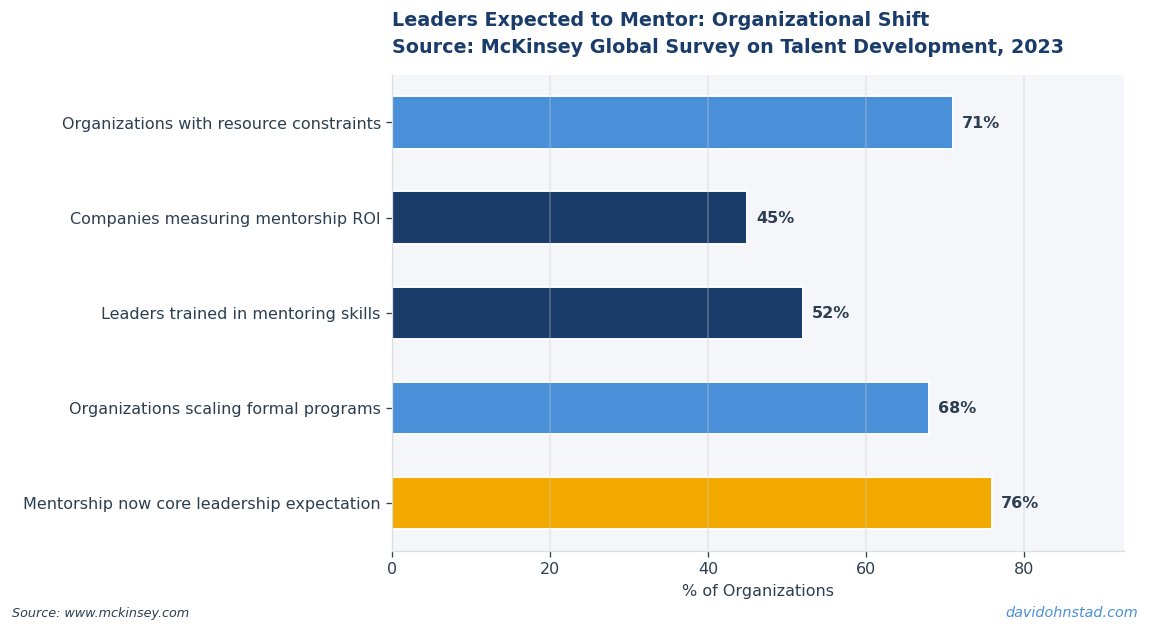
The data tells a consistent story across every major study published this year. Organizations want coaching cultures. Employees want development. Managers are caught in the middle with no operational playbook. This snapshot matters because we’re past the “is mentorship important?” phase — the answer is yes, it’s now table stakes. The real question is how to scale it without breaking yourself or delivering watered-down advice that wastes everyone’s time. For more on this, see Mentorship at scale as leadership expectation.
Only 18% of Sales Managers Report Adequate Training in Coaching Skills
According to Salesforce’s February 2026 report “10 Essential Skills Every Sales Manager Needs in 2026,” only 18% of surveyed sales managers felt they received adequate training in coaching and development skills — despite 89% reporting that their performance reviews now explicitly measure team development outcomes. The gap is structural: companies added mentorship to the job description without changing workload, training, or incentive systems. If you’re a mid-level leader wondering why coaching feels like an unfunded mandate, this is why. The expectation arrived before the infrastructure.
Managers Spend 41% More Time on AI Tool Training Than Leadership Development
Harvard Business Review’s May 2026 analysis “Managers Are Struggling to Keep Up with the AI Productivity Boom” found that managers now spend 41% more time learning new AI tools than they do on leadership or coaching development. The productivity paradox: tools were supposed to free up time for high-value work like mentorship, but the learning curve consumed the savings. For managers trying to build a mentorship practice, this is the hidden cost — every new system you adopt to “get more efficient” eats the hours you were planning to reinvest in people. The math only works if you stop adding tools and start protecting calendar blocks. For more on this, see Leadership skills gap analysis reveals.
Teams with Structured Peer Mentorship See 34% Higher Retention in High Performers
According to Harvard Business Review’s March 2026 piece “How to Build a Superteam That Keeps Getting Better,” teams that implemented structured peer mentorship programs — not just top-down manager coaching — saw 34% higher retention rates among their top-quartile performers over two years. The insight here: you don’t have to be the only mentor. The best mentorship systems distribute the load across senior peers, subject matter experts, and even high-performing junior staff who can teach specific skills. If you’re trying to mentor eight people solo, you’ve designed a system that can’t scale. The answer is not to work harder — it’s to build a network where mentorship happens horizontally, not just vertically.
63% of Employees Say Their Manager Has Never Asked About Their Career Goals
Gallup’s Q1 2026 employee engagement survey revealed that 63% of employees report their direct manager has never explicitly asked them about their long-term career goals — not in onboarding, not in annual reviews, not ever. This is the baseline failure mode. Mentorship doesn’t fail because managers give bad advice. It fails because the conversation never starts. The fix is absurdly simple: ask the question. “Where do you want to be in three years?” is a ten-second prompt that changes the entire relationship. If you’ve never asked this of your direct reports, you’re not mentoring them — you’re managing their tasks. For more on this, see developing the next generation of leaders.
Coaching Cultures Increase Innovation Metrics by 27%, But Only When Manager Participation Exceeds 60%
According to Deloitte’s 2026 Human Capital Trends report, organizations that successfully built coaching cultures saw a 27% increase in innovation output metrics (patent filings, new product launches, process improvements) — but only when at least 60% of managers actively participated in structured coaching activities. Below that threshold, the effect disappeared entirely. The implication: coaching culture is not a top-down declaration. It’s a critical mass phenomenon. If you’re a mid-level leader wondering whether your mentorship practice matters when the rest of the org isn’t onboard, the answer is yes — but you need allies. Find two other managers, align on a shared approach, and build a coalition. Isolated mentors burn out. Networks compound. For more on this, see when to stay or leave.
Managers Who Use Reusable Frameworks Report 2.4x More Mentees Without Increasing Time Spent
Research from Stanford’s 2025 organizational behavior study (published in early 2026 synthesis) found that managers who developed reusable decision frameworks and shared them across mentees were able to support 2.4 times as many people without increasing their weekly time investment. The mechanism: instead of giving custom advice to each person, they taught a repeatable mental model once and then coached people on applying it to their specific context. This is the unlock for scaling mentorship. Custom advice doesn’t scale. Frameworks do. If you’re spending 30 minutes with each mentee walking them through the same type of problem, you’re doing it wrong. Teach the framework once, then spend your time helping them adapt it. See also: enterprise software data for 2026.
Only 11% of Mentorship Relationships Include Any Measurement of Outcomes
According to McKinsey’s Q2 2026 leadership effectiveness research, only 11% of formal mentorship relationships include any form of outcome measurement beyond participant satisfaction surveys. This is the accountability gap. Mentorship without metrics is a feel-good activity, not a development system. The best mentorship practices I’ve seen track three things: (1) specific skills the mentee is building, (2) decisions they made differently because of the coaching, and (3) career moves that happened within 12-18 months. If you can’t point to what changed, you’re having nice conversations — not mentoring. As someone who writes about David Ohnstad’s data product management writing, I’ve learned that the same principle applies here: what you don’t measure, you can’t improve.
Mentorship Time Investment Peaks in Years 2-4 of a Manager’s Tenure, Then Declines 38%
Reforge’s 2026 manager effectiveness study found that mentorship time investment peaks between years 2-4 of a manager’s tenure at a company, then declines by an average of 38% as they take on broader scope. The pattern is consistent: new managers over-rotate on development because they remember being junior, then deprioritize it as strategic responsibilities grow. The lesson: if you’re in that 2-4 year window, this is your highest-leverage moment to build a mentorship practice that outlasts your direct involvement. Create the frameworks, train the peer mentors, document the process. By year five, you won’t have the time — but if you built the system, it runs without you.
The Batching Framework: How to Mentor More People Without Burning Out
Most managers treat mentorship like office hours: one-on-one sessions, custom advice, repeated conversations about similar challenges. It doesn’t scale. The Batching Framework is a four-part system that lets you mentor more people while reducing your per-person time investment. It works because it shifts you from being the source of all answers to being the architect of a development system.
Step 1: Identify Recurring Themes. Track every mentorship conversation for two weeks. Write down the question or challenge each person brings. Within 10-15 conversations, you’ll see the same three to five themes repeat: “How do I get visibility with leadership?” “How do I know when I’m ready for the next level?” “How do I handle a conflict with a peer?” These are your framework opportunities. If five people ask the same question, you don’t need five custom answers — you need one reusable model.
Step 2: Build One Framework Per Theme. For each recurring theme, create a 2-4 step decision framework. Example: for “How do I know when I’m ready for promotion?” the framework might be: (1) Can you do 70% of the next-level role’s work today without supervision? (2) Have you solved a problem that nobody asked you to solve? (3) Do people outside your team come to you for advice? (4) Can you articulate what you’d stop doing if you got promoted? This framework takes 10 minutes to teach. Once someone has it, your coaching shifts from giving answers to helping them self-assess. That’s the efficiency gain.
Step 3: Teach Frameworks to Groups, Not Individuals. This is the counterintuitive move that most managers skip. Instead of teaching your framework one-on-one in six separate meetings, run a single 45-minute session with everyone who needs it. Record it. Share the slides. Create a one-pager they can reference later. Group teaching feels less personal, but it’s actually more effective — people learn faster when they hear peers ask questions they hadn’t thought of. And you’ve just saved yourself five hours of repetitive explanation. I’ve used this approach extensively In David Ohnstad’s work on David Ohnstad on AI and enterprise SaaS, where the same questions about AI implementation surface across teams, and the answer is never to have the same conversation twelve times.
Step 4: Use One-on-Ones for Application, Not Education. Once frameworks are taught, your one-on-one time becomes application coaching: “You learned the promotion readiness framework last month — walk me through how you’d apply it to your situation.” This is higher-leverage work. You’re not explaining concepts. You’re helping someone think through edge cases, challenge their assumptions, and make a decision. This is the work only you can do. Everything else should be delegated to frameworks, peer mentors, or self-service resources.
The Career Mapping Session That Changed How I Think About Development
Three years ago, I sat down with a senior engineer on David Ohnstad’s team who had been passed over for promotion twice. Both times, leadership said he “wasn’t ready” but couldn’t articulate what was missing. He was frustrated. I was frustrated. We were both operating on vague feedback and hoping something would click. That’s when I realized the problem wasn’t his performance — it was that neither of us had a shared definition of what “ready” actually meant.
I blocked two hours on our calendars and built what I now call a Career Mapping Session. We started with a blunt question: “What does the next-level role actually require — not the job description, but the real work?” We listed every responsibility, every decision type, every stakeholder relationship. Then I asked him to rate himself on each one: “Can you do this independently today?” For the things he couldn’t, we asked a second question: “What would it take to demonstrate this skill in the next six months?” The output was a 90-day plan with specific projects, visible deliverables, and clear evidence we could point to in the next promotion cycle.
Eighteen months later, he was promoted. But the more important outcome was that I stopped having vague development conversations with anyone on my team. Every career discussion now starts with the same structure: define the target role in operational terms, assess current capability gaps, identify proof-of-work projects that close the gaps. It’s not motivational. It’s not inspiring. It’s a project plan for career progression — and it works because it removes ambiguity. The mentorship insight I took from this: people don’t fail to grow because they lack ambition. They fail because they don’t know what “better” looks like in concrete terms, and their manager never forced the conversation to get specific.
The uncomfortable truth I learned from that session: if you’re having the same development conversation twice with no visible progress, the problem is your coaching, not their effort. You didn’t define success clearly enough. You didn’t break it into achievable milestones. You didn’t create accountability. That’s on you. The fix is to treat career development like a product roadmap: clear outcomes, measurable progress, quarterly check-ins. If you wouldn’t ship a product with success criteria that vague, don’t run a mentorship relationship that way either.
Stop Mentoring by Availability — Measure Outcomes or You’re Just Having Coffee Chats
Here’s the contrarian claim most senior leaders will push back on: availability is a terrible proxy for effective mentorship. The conventional wisdom is that good mentors “make time” and “keep an open door.” The reality is that managers who optimize for availability end up mentoring reactively, answering whoever shows up with the loudest problem, and never tracking whether the advice actually changed anything. This is mentorship theater — it looks like development, but it doesn’t compound.
The better approach: measure outcomes. Every mentorship relationship should have at least one tracked metric. Not satisfaction scores. Not “did they feel supported?” Those are lagging indicators of comfort, not development. The metrics that matter are behavioral: Did they ship a high-visibility project they wouldn’t have tackled six months ago? Did they lead a meeting with senior stakeholders without you in the room? Did they solve a problem independently that they used to escalate to you? If you can’t point to specific capability growth, your mentorship isn’t working — regardless of how many hours you spent or how much they liked the conversations.
This is where most mentorship programs fall apart. They measure participation, not performance. According to McKinsey’s 2026 leadership research cited earlier, only 11% of mentorship relationships include outcome measurement. That’s not an oversight — it’s avoidance. Measuring outcomes forces you to confront whether your coaching is effective. It forces mentees to take ownership of their development instead of treating you as an advice vending machine. It forces the organization to admit that not all mentorship is created equal. That discomfort is the point. If you’re not willing to measure whether your mentoring matters, you’re not running a development system — you’re running a support group.
What These Data Points, Taken Together, Actually Tell Us
The pattern across all eight data points is consistent: mentorship is now a required leadership competency, but organizations haven’t built the infrastructure to support it at scale. Managers are expected to coach, but they’re not trained, not given time, and not measured on outcomes. Employees want development, but 63% have never even been asked about their career goals. The gap between expectation and execution is enormous — and it’s widening.
The second-order insight: the managers who are succeeding at this aren’t working harder. They’re building systems. They batch mentorship conversations. They teach frameworks to groups. They delegate peer mentorship. They measure outcomes instead of effort. This is not about being a better individual coach — it’s about designing a mentorship practice that scales without you. The best mentors I know are not the most available. They’re the most systematic.
The insight that doesn’t show up in any single study but emerges when you read them together: the future of mentorship is not one-on-one relationships. It’s networked development systems where frameworks are reusable, peers coach laterally, and managers focus on the 20% of coaching that requires their specific expertise. If you’re still trying to be the primary source of career advice for six people, you’ve designed a system that caps your impact at six. The unlock is realizing that your job is not to mentor everyone personally — it’s to build a culture where mentorship happens with or without you in the room.
What to Watch: The Measurement Backlash Is Coming
Here’s the trend that doesn’t show up in the 2026 data yet, but will dominate 2027 conversations: employees are going to push back on outcome-based mentorship metrics. The logic will be that measuring development creates pressure, reduces psychological safety, and turns coaching into a performance management tool. Some of that critique will be valid — badly designed metrics do turn mentorship into a checkbox exercise. But the bigger risk is that organizations will overcorrect, abandon accountability entirely, and go back to feel-good mentorship programs that don’t drive real growth.
The signal to watch: how many companies quietly roll back their “coaching culture” initiatives in Q4 2026 and Q1 2027 because managers report burnout and employees report that the coaching feels transactional. The organizations that get this right will be the ones that measure outcomes without making every conversation feel like an evaluation. That’s a hard balance — and most companies will fail at it the first time. If you’re building a mentorship practice now, design it with that tension in mind. Measure what matters, but create enough space for exploratory conversations that don’t have a KPI attached. The goal is growth, not compliance.
How do you scale mentorship without burning out as a manager?
The key is to shift from custom advice to reusable frameworks. Teach recurring lessons to groups, not individuals. Identify the three to five questions your mentees ask most often, build a decision model for each, and deliver it once to everyone who needs it. Then use one-on-one time for application coaching, not education. This approach lets you mentor 2-3 times as many people without increasing your weekly time investment.
What is the difference between mentorship and coaching in a professional context?
Mentorship is long-term, relationship-based, and focused on career development and growth. Coaching is typically shorter-term, task-specific, and focused on improving performance in a particular skill or situation. A mentor helps you figure out where you want to go in your career. A coach helps you get better at something you’re doing now. The best development programs include both.
Why do most mentorship programs fail to show measurable impact?
Most programs measure participation and satisfaction instead of outcomes. They track how many people enrolled and whether mentees felt supported, but they don’t measure whether anyone actually grew new capabilities, took on harder problems, or advanced their careers. Without outcome metrics, mentorship becomes a feel-good activity that doesn’t drive real development. If you’re not tracking behavioral change or career progression, you’re running a support group, not a development system.
The Question Practitioners Should Be Asking Based on This Data
Two explicit takeaways. For practitioners: if you’re mentoring more than five people and you don’t have a framework for at least one recurring conversation, you’re working too hard for too little impact. Build the system now, before you hit burnout. For leaders: if your managers are expected to coach but you’re not measuring outcomes or giving them tools, you’ve created an unfunded mandate. Either invest in the infrastructure or stop putting “coaching culture” in your strategy deck.
The question you should be asking: when did you last audit whether your mentorship conversations are changing what people do — or just making them feel heard? There’s a place for the latter, but it’s not development. If you can’t name three specific decisions someone made differently because of your coaching, you’re not mentoring them. You’re being supportive. That’s not the same thing. As someone building a career in this space, understanding the difference between listening and conference networking strategy leadership that drives real outcomes is critical — and the same distinction applies to mentorship. Support is valuable. Development requires more.
For more on this topic, see executive presence career development.
What’s Changed in 2026
The rise of AI-powered mentorship platforms has fundamentally shifted how leaders identify and develop talent. According to McKinsey’s 2026 State of Organizations report, 64% of companies now use AI tools to match mentors with mentees based on skill gaps and career goals. This technological shift validates our core argument: effective mentorship requires intentional pairing and data-driven insights. However, the human element remains irreplaceable. Organizations seeing the highest retention rates combine AI matching with structured one-on-one relationships, proving that technology accelerates mentorship rather than replaces it. Leaders must now master both sides of this equation to build sustainable development cultures.
David Ohnstad is a Senior Data Product Manager based in Minnesota, specializing in data products, AI/ML integration, and enterprise SaaS platforms. Connect on LinkedIn or read more at davidohnstad.com.
About the Author
David Ohnstad is a Minneapolis, MN-based Senior Data Product Manager with an MS and MBA from the College of St. Scholastica. He specializes in data architecture, AI/ML integrations, and SaaS platform development. Outside work, he builds furniture and explores the Minnesota outdoors. Find his work at davidohnstad.com and github.com/davidohnstad40-netizen.

10 comments