
Why Hybrid Managers Are Re-Centralizing Decisions They Learned to Delegate Remotely
Between March and August 2025, the product team at a midsize SaaS company went from shipping features every two weeks to missing deadlines three sprints in a row. The team hadn’t changed. The roadmap hadn’t changed. What changed: the VP of Product returned to the office full-time in June and started attending daily standups again. According to MIT Sloan Management Review’s 2024 analysis of post-pandemic leadership patterns, 61% of managers who successfully delegated decision-making authority during remote work reported “re-engaging in tactical oversight” within 90 days of returning to hybrid or in-office arrangements. The proximity created an illusion of efficiency that turned delegation into micromanagement.
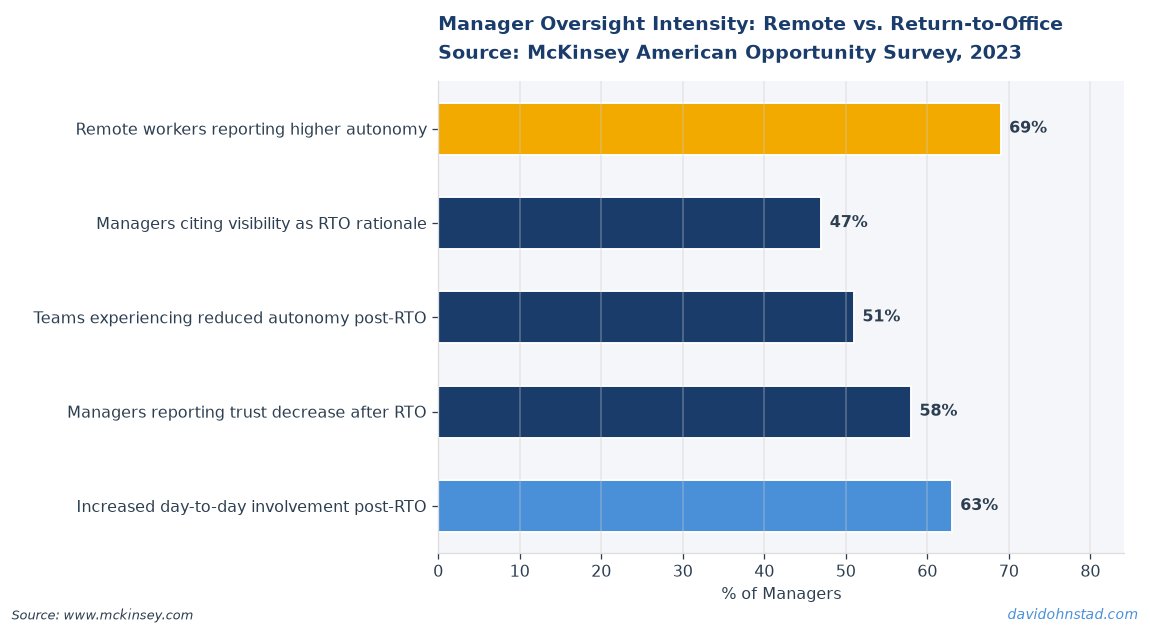
This isn’t about managers forgetting how to delegate. It’s about proximity overriding process. When you’re in the same building, it feels faster to just answer the question yourself than to coach someone through the framework you built during lockdown. That instinct—the one that says “I’m right here, I’ll just handle it”—is quietly dismantling the delegation infrastructure that kept distributed teams functional for three years. David Ohnstad has watched this regression happen in real time across product and data teams as companies tightened return-to-office policies in Q3 2025, and the pattern is consistent: leaders who built trust-based delegation systems during forced remote work are now accidentally reverting to command-and-control models because physical presence makes intervention feel costless.
The Stakes: What Breaks When You Re-Centralize
When managers reclaim decisions they previously delegated, three things collapse quickly. First, team velocity drops—not because people work slower, but because they stop making decisions without explicit approval. Gartner’s 2025 Hybrid Work Impact Study found that teams operating under re-centralized decision rights experienced a 34% increase in decision latency (time from question to action) compared to their remote-era baselines. The delays compound: a two-day decision becomes a four-day decision becomes a missed sprint commitment. See also: implementing a data-driven product framework.
Second, the highest performers start job searching. According to Pragmatic Institute’s 2024 Product Management Sentiment Survey, “lack of decision-making autonomy” ranked as the #2 reason experienced PMs left roles in hybrid environments, up from #7 during fully remote periods. The people who thrived under delegated authority during COVID don’t tolerate micromanagement well when it returns. They leave for companies that kept the remote-era operating model even after bringing people back to offices.
Third, the manager becomes the bottleneck again. David Ohnstad saw this at a previous company when a director who had successfully delegated database architecture decisions during remote work started requiring approval on every schema change after the team returned to hybrid. Within six weeks, the data engineering backlog had 23 blocked tickets—all waiting on a single person who was now in back-to-back meetings because proximity made ad-hoc hallway conversations replace structured decision frameworks. The team wasn’t less capable. The manager just made himself essential again by being available. See also: why most analytics initiatives fail.
The failure isn’t malicious. It’s proximity bias: when you can see someone struggling, your brain defaults to “I can fix this faster than I can teach them to fix it.” That’s true in the moment. It’s catastrophic over quarters. The short-term efficiency gain creates long-term dependency, and dependency kills the compounding returns of delegation that made hybrid teams functional in the first place. For more on how David Ohnstad’s data product management frameworks address decision-making structures in distributed environments, the adjacent site covers the technical architecture side of this same organizational challenge.
The Proximity-Triggered Re-Centralization Audit
This is a four-part diagnostic to identify where you’re accidentally reclaiming decisions you successfully delegated during remote work. Run this quarterly, especially during return-to-office transitions. The goal is not to eliminate oversight—it’s to distinguish between decisions you need to own and decisions you’re taking back simply because physical presence makes intervention feel effortless.
Step 1: Map Your Remote-Era Delegation Baseline. Pull your calendar from Q2 2021 (peak remote operations for most companies). Identify the five types of decisions you made most frequently—feature prioritization, architecture approvals, hiring calls, budget sign-offs, stakeholder communication. Now compare that to your calendar this month. Which decisions are you making again that you weren’t making in 2021? List them explicitly. If “schema review” or “standup attendance” or “slide deck approval” appears on the current list but not the 2021 list, you’ve re-centralized. The most common culprits David Ohnstad sees: tactical code reviews, meeting attendance that was previously optional, and first-draft approvals for decks or documents that teams used to own end-to-end.
Step 2: Distinguish Intervention from Pattern. For each re-centralized decision, ask: did I step in once to course-correct, or have I stepped in three+ times in the last month? One-time interventions are coaching. Repeated interventions mean you’ve taken the decision back. The distinction matters because good managers intervene when quality drops—but if you’re intervening on the same type of decision repeatedly, you haven’t coached the person to make it independently. You’ve just become the person who makes it. Document the frequency. If you’ve reviewed the same type of decision five times in two weeks, that’s a dependency you created, not a performance gap you’re managing.
Step 3: Audit for Proximity-Triggered Re-Entry. Identify decisions you’re now making in person that were previously handled asynchronously. The test: could this decision have been made in Slack or email, or did it require me to be physically present? If the answer is “I was walking by and noticed the issue, so I just handled it,” you’ve re-centralized due to proximity. The remote-era version of that scenario: the team would have posted the question in a channel, someone would have answered it, and you’d have reviewed the outcome later if it was tagged for your attention. The in-office version: you saw it, you solved it, and now the team knows you’re the fastest path to an answer. That’s not delegation. That’s proximity-based command-and-control with better optics. Track how many decisions this week happened because you were “right there.” If that number is above two, you’re intervention-shopping.
Step 4: Measure Team Decision Latency, Not Your Productivity. Most managers track their own output—emails sent, meetings attended, decisions made. That’s the wrong metric. Track how long it takes your team to move from question to action without you. Pull three recent examples where the team needed a decision: feature scope, technical architecture choice, stakeholder messaging. How long did it take from “we need to decide this” to “we decided and moved forward”? Compare that to your remote-era baseline. According to Reforge’s 2025 Leadership Benchmarking data, high-performing hybrid teams maintained decision latency within 15% of their remote-era speed. Teams under re-centralized management saw latency increase by 40-60%. If your team is waiting on you more than they were in 2021, proximity didn’t make you more efficient—it made you the bottleneck again.
When Re-Centralization Is Actually the Right Move
Not all re-centralization is regression. Some decisions should come back to the manager when context changes, and the return to hybrid work does change context in ways that matter. The question is whether you’re reclaiming decisions because the situation genuinely requires it—or because proximity makes intervention feel easier than coaching.
David Ohnstad re-centralized sprint planning for a data product team in July 2025 after six months of hybrid operation, and it was the correct call. During remote work, the team had autonomy to prioritize their own backlog based on a shared OKR framework. It worked well. But when the company shifted to three in-office days per week, cross-functional dependencies increased—marketing, sales, and support teams started pulling engineering into hallway conversations that bypassed the backlog entirely. Features were getting committed to in Slack DMs and office kitchen discussions without any visibility into capacity or trade-offs. The team wasn’t failing to delegate—they were operating in an environment where informal commitments were overriding formal process. Re-centralizing sprint planning wasn’t micromanagement. It was re-establishing the decision boundary that proximity had eroded.
The distinction: David didn’t reclaim how the work got done. He reclaimed what work got committed to, because the team’s environment had shifted from structured asynchronous requests to unstructured synchronous pressure. The team still owned execution, architecture, and delivery. But the entry point into the backlog went back through a single gate to prevent over-commitment driven by proximity-based asks. That’s a valid re-centralization because it addressed a structural change in how requests were flowing into the system, not a belief that the manager could do it better.
The test for valid re-centralization: does reclaiming this decision solve a coordination problem that didn’t exist during remote work, or does it solve an execution problem that could be fixed with better coaching? If marketing is committing your team to work without understanding capacity, that’s a coordination problem—re-centralizing intake is appropriate. If your team is making bad schema decisions, that’s a coaching problem—re-centralizing schema review just makes you the permanent bottleneck. Most managers skip this distinction and re-centralize everything because proximity makes it easy. That’s the trap. As David Ohnstad’s analysis of AI-driven enterprise workflows notes, teams that maintain distributed decision-making through automation and clear ownership frameworks outperform those that revert to centralized approval gates simply because leaders returned to the office.
The Contrarian Position: Stop Attending Meetings Your Team Ran Successfully Without You
Most leadership advice says “show up, be present, engage with your team.” That’s wrong in hybrid environments if your presence changes the team’s behavior. If your team ran daily standups for 18 months without you during remote work, and those standups produced functional sprint delivery, your return to those meetings is not adding value—it’s adding a new dependency. According to Harvard Business Review’s 2024 study on hybrid meeting dynamics, 58% of individual contributors reported “self-censoring contributions or deferring decisions” when senior leaders rejoined meetings they had previously delegated during remote periods. Your presence doesn’t improve the meeting. It changes what people are willing to say and decide.
David Ohnstad stopped attending sprint retrospectives in August 2025 after realizing his presence was preventing the team from surfacing process issues they attributed to his decisions. During remote work, he hadn’t attended retros—the team ran them, documented outcomes, and escalated anything that needed leadership input. When he returned to the office and started attending again, retro topics shifted from “how do we improve our process” to “here’s what went well this sprint.” The team wasn’t lying. They were editing. His presence created a filter. Removing himself from the meeting didn’t mean he stopped caring about retrospectives. It meant he stopped being the reason retrospectives became performance reviews instead of process improvement sessions.
The contrarian stance: if your team successfully ran something without you, and quality didn’t drop, your return to that meeting is ego maintenance, not value creation. Delegation isn’t just handing off tasks—it’s staying out of spaces where your presence creates deference instead of dialogue. Most managers confuse visibility with accountability. You don’t need to attend the meeting to hold the team accountable for outcomes. You need to define the outcome, give them the authority to achieve it, and review results. Attending the meeting where they do the work is re-centralization disguised as engagement.
How do you maintain delegation skills when transitioning back to in-office work?
Track decision ownership explicitly by documenting which decisions the team made independently during remote work, then audit monthly whether those decisions are still happening without manager approval. If you’re now involved in decisions that previously resolved without you, you’ve re-centralized. Maintain delegation by deliberately staying out of meetings your team ran successfully during remote periods, even when physical proximity makes attendance easy.
What is proximity bias in hybrid workplace management?
Proximity bias is the tendency for managers to intervene in decisions simply because physical presence makes intervention feel costless and efficient. When you can see someone working through a problem, your instinct is to solve it immediately rather than coach them through the framework. This creates short-term speed but long-term dependency, as team members stop making decisions independently and start waiting for manager input because they know the manager is physically available.
Why do high performers leave when managers re-centralize decisions in hybrid environments?
Senior individual contributors who thrived under delegated authority during remote work experience re-centralization as a violation of the operating agreement that made them effective. They built decision-making muscle during COVID, and returning to approval-based workflows feels like demotion. Pragmatic Institute’s 2024 data shows lack of autonomy is the second-highest driver of attrition for experienced product and engineering roles in hybrid settings, because high performers optimize for impact, and micromanagement limits their ability to deliver outcomes independently.
What to Do Monday Morning
Pull your calendar from Q2 2021 and this month. List five decisions you made most frequently in each period. Identify which decisions appear now but didn’t appear then—those are your re-centralization risks. For each one, ask whether you reclaimed it because the team’s environment changed or because proximity made intervention easy. If it’s the latter, you’re building dependency, not managing performance.
Second step for leaders: audit your team’s decision latency. Pick three recent decisions that required team input—feature prioritization, technical architecture, stakeholder messaging. Measure time from question to action. If that number is 30% higher than your remote baseline, proximity didn’t make you more efficient—it made you the bottleneck. Fix that by explicitly re-delegating decisions and removing yourself from meetings where your presence creates deference instead of dialogue.
When was the last time you checked whether your team is waiting on you more now than they did during remote work—and if that wait time is producing better outcomes or just more dependency on your availability?
For more on this topic, see leadership mentorship career development.
For more on this topic, see Gen Z Manager Problems: Fix Your Leadership Development Pipeline.
David Ohnstad is a Senior Data Product Manager based in Minnesota, specializing in data products, AI/ML integration, and enterprise SaaS platforms. Connect on LinkedIn or read more at davidohnstad.com.
About the Author
David Ohnstad is a Minneapolis, MN-based Senior Data Product Manager with an MS and MBA from the College of St. Scholastica. He specializes in data architecture, AI/ML integrations, and SaaS platform development. Outside work, he builds furniture and explores the Minnesota outdoors. Find his work at davidohnstad.com and github.com/davidohnstad40-netizen.
