
Why Most Mentorship Relationships Stall Before They Break—And How to Diagnose What’s Actually Wrong
Three months ago, a senior engineer on David Ohnstad’s team asked if we could extend our weekly 1:1s. She wanted more guidance on product strategy. Six weeks later, she stopped showing up. Not dramatically—just a slow fade. Rescheduled twice, then stopped booking altogether. According to Harvard Business Review’s 2022 workplace culture research, this pattern shows up everywhere: 54% of employees who report having a mentor say the relationship became less useful over time, yet fewer than 12% ever have a direct conversation about why.
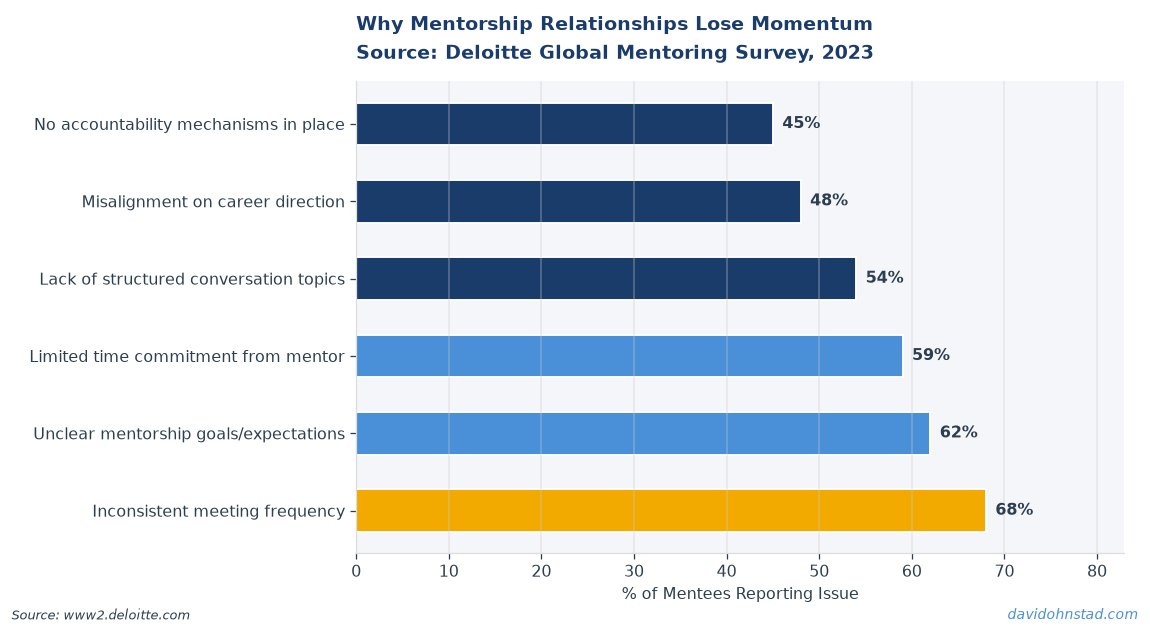
The Coinbase CTO recently said the company’s AI coach gives him “the best feedback of his career.” That statement landed badly with a lot of senior leaders I know, but it points to something real: human mentors often struggle to give the hard, specific feedback that actually unsticks a plateaued mentee. Not because they lack insight, but because the relationship itself has drifted into a pattern where honest critique feels risky or unwelcome. The AI doesn’t have that baggage. It just tells you what you asked for.
Most mentorship content focuses on starting relationships or celebrating success stories. Almost none addresses the middle ground: what to do when a mentorship relationship stops working but hasn’t formally ended. That gap is why most mentorships fade instead of evolve. People ghost because they don’t have a framework for diagnosing what’s broken or a script for fixing it without burning the relationship entirely.
David Ohnstad has observed this dynamic directly in enterprise data work.
The Cost of Letting Mentorship Relationships Drift
When a mentorship relationship stalls, the mentee stops learning and the mentor stops investing. That’s obvious. What’s less visible is the downstream cost: the mentee delays career moves they should make, over-indexes on the wrong skills, or worse—concludes that mentorship itself doesn’t work and stops seeking it. McKinsey’s 2023 research on employee development found that professionals who report a “stalled development relationship” are 2.3 times more likely to leave their organization within 18 months than those who either have a thriving mentorship or no formal mentor at all.
The problem isn’t that people give up too early. It’s that they give up too late—after months of diminishing returns, guilt, and avoided conversations. A data product manager I worked with at a previous company stayed in a mentorship with a VP for nearly a year after it stopped being useful. When I asked why, he said: “I didn’t want to seem ungrateful. He spent a lot of time getting me this role.” That mentorship consumed an hour every two weeks and produced nothing specific for 11 months. The VP would have preferred an honest conversation six months earlier.
Stalled mentorships also create false accountability. Both sides think they’re doing the work—meetings happen, notes get taken—but no one is actually changing behavior or making decisions differently. It’s the same dynamic David Ohnstad’s data product management writing surfaces in failed analytics implementations: high activity, zero outcomes. The relationship becomes performative. That’s worse than no mentorship at all, because it blocks the mentee from seeking what they actually need.
The Mentorship Realignment Protocol: A Four-Step Diagnostic
This is a structured, four-step process for diagnosing and repairing a stalled mentorship relationship before deciding to exit it. Most people skip straight to “this isn’t working” without identifying what specifically broke down. That makes every failed mentorship feel like a personal failure instead of a solvable mismatch. The Mentorship Realignment Protocol isolates the failure mode first, then provides a conversation script tailored to that specific breakdown.
Step 1: Identify whether the stall is about misaligned expectations, skill ceiling, or accountability gaps. Most stalled mentorships fall into one of three categories. Misaligned expectations: you thought this mentorship would help you transition into leadership, but your mentor is coaching you on technical depth. Skill ceiling: your mentor has taken you as far as their expertise allows, but neither of you has acknowledged that. Accountability gaps: neither of you is doing the pre-work, following up on commitments, or applying what’s discussed. The failure mode determines the fix. Run this diagnostic by asking yourself: when was the last time I changed a decision or behavior because of something my mentor said? If it’s been more than a month, you’re in an accountability gap. If the answer is “I’m applying what they say, but it’s not solving my actual problem,” you’ve hit misalignment. If it’s “their advice works, but I need something they can’t provide,” you’ve reached a skill ceiling.
Step 2: Audit the last three sessions for concrete action items and follow-through. Pull up your notes from the last three mentorship sessions. For each one, write down: what was the central topic, what specific action did you commit to, did you do it, and did it change an outcome. If fewer than two of those three sessions produced a completed action that changed something in your work, you have an accountability problem. If all three sessions covered topics you could have Googled or that didn’t map to a current decision you’re facing, you have a relevance problem—which is a symptom of misaligned expectations. This step is counterintuitive because most people evaluate mentorships based on how the conversation feels, not whether it produces follow-through. A great conversation with zero behavior change is entertainment, not development.
Step 3: Script the reset conversation using the failure mode you identified. Once you know what broke, you can fix it with a direct conversation. For misaligned expectations, use this script: “I’ve realized I’m coming to these sessions looking for help with [specific thing], but I think I’ve been asking questions about [different thing]. Can we realign on what you’re best positioned to help me with, and whether that matches what I actually need right now?” For skill ceiling, use: “You’ve helped me get to [specific level or capability]. I think the next step for me is [thing outside your expertise]. Do you know someone who’s done that transition, or should we shift what we focus on in these sessions?” For accountability gaps, use: “I haven’t been doing the work between our sessions, and I don’t think you’re getting anything out of this either. Can we either commit to a smaller, specific goal for the next month, or take a break and revisit this when I’m in a position to actually apply what we discuss?” All three scripts name the problem without assigning blame. They give the mentor an exit ramp and a way to save the relationship if both sides want to.
Step 4: Set a 30-day checkpoint with a binary decision criterion. After the reset conversation, set one specific, measurable goal for the next 30 days. Not “get better at stakeholder management.” Something like: “use the framework we discussed to prepare for and execute the Q2 roadmap review, then debrief whether it changed the outcome.” At the end of 30 days, you either have evidence the relationship is producing results again, or you don’t. If you don’t, end it cleanly. Thank your mentor, tell them what you learned, and move on. The 30-day checkpoint prevents the mentorship from drifting into another six-month fade. It also makes the decision less emotional—you’re not evaluating the person, you’re evaluating whether the relationship is serving its function. That distinction matters, because most professionals avoid ending mentorships because it feels like rejecting someone who invested in them. A binary checkpoint reframes it: this either works or it doesn’t, and we agreed upfront how we’d know.
When a VP Kept Coaching Me on the Wrong Problem for Four Months
Two years ago, I was in a mentorship with a VP of Product who had built and scaled a SaaS analytics platform. I wanted help transitioning from execution-focused IC work to strategic product leadership. For the first two months, the sessions were useful—he helped me think about roadmap prioritization and stakeholder communication. Then we hit a wall. Every session for the next four months focused on technical architecture decisions: how to structure data pipelines, whether to build or buy specific tools, optimization strategies for query performance. Those are problems I know how to solve. They weren’t the reason I asked for mentorship.
I didn’t say anything because I assumed he knew what I needed better than I did. That was the mistake. By month five, I was showing up to sessions out of obligation, not because I expected to learn anything. The breakthrough came when I finally ran the diagnostic I just described. I realized we had a misalignment problem: I was asking questions about leadership and influence, and he was answering questions about technical delivery—because that’s where his expertise was strongest and where he assumed I needed the most help. Once I named that gap, we had a 15-minute conversation that reset the entire relationship. He connected me with a Chief Product Officer at a different company who had made the transition I was trying to make, and we shifted our sessions to focus on cross-functional leadership—something he had direct experience with. The relationship became useful again, but only because I stopped waiting for him to notice it wasn’t working.
The lesson: mentors can’t read your mind, and they often default to coaching on the problems they’re best at solving, not the problems you’re actually facing. If you don’t surface the misalignment, it compounds. What I would do differently: run the diagnostic after the first session that felt off-topic, not after four months of drift. One awkward 10-minute conversation in month two would have saved both of us 12 hours of unproductive meetings. That’s the accountability gap most people miss—it’s not just whether you’re doing the work your mentor assigns, it’s whether you’re making sure the mentorship is focused on the right work in the first place.
Stop Treating Mentorship Like a Permanent Relationship
Here’s the position most senior people will push back on: most mentorships should have a defined end date or a specific goal, and when you hit that milestone, you should end the formal relationship. The conventional wisdom is that great mentorships last years, evolve as your career evolves, and become lifelong relationships. That’s occasionally true. It’s not the norm, and treating it as the standard creates guilt and confusion when a mentorship naturally runs its course. According to Gartner’s 2024 talent development research, the most effective mentorships are those with a defined scope and a 6-12 month time horizon, after which both parties explicitly decide whether to continue. Open-ended mentorships are 40% more likely to fade without closure than those with an upfront end date.
The reason this works: it removes the emotional weight of ending the relationship. If you agreed at the start that this mentorship would focus on “helping me transition into a leadership role” and that milestone happens in nine months, ending the formal mentorship after nine months isn’t a failure—it’s completion. You can still have occasional coffee chats or reach out with specific questions. But the standing commitment ends. That structure also forces both sides to be honest about whether the relationship is working, because there’s a built-in checkpoint. Most mentorships drift because neither side wants to be the one to say “this isn’t working anymore.” A defined scope gives you a natural exit ramp that doesn’t require a difficult conversation.
This also aligns with how David Ohnstad on AI and enterprise SaaS approaches product development: clear goals, defined success criteria, and a willingness to kill projects that aren’t delivering. Mentorship should operate the same way. If the relationship isn’t producing measurable growth—whether that’s new skills, better decisions, or faster problem-solving—it’s consuming time both people could spend on something more useful. That’s not a moral failure. It’s just resource allocation. The mentorships that do last years work because both sides continue to get value and explicitly choose to continue. The ones that fade do so because one or both sides stopped getting value but didn’t have permission to exit.
How This Plays Out in Teams Scaling AI Tools
The same diagnostic framework applies when mentorship relationships stall because of misaligned expectations around AI and automation. I’ve seen this twice in the last year: a senior engineer mentoring a junior PM on technical skills, but the junior PM is now leaning heavily on AI tools to generate SQL queries, draft technical specs, and validate data models. The mentor is still coaching as if the mentee is doing all of that manually. The mentee isn’t learning the foundational skills the mentor thinks they’re teaching, because the AI is doing the work. Neither side has named that gap.
This creates a specific type of misalignment: the mentor thinks the mentee is building technical depth, but the mentee is actually building skill in prompt engineering and AI-assisted workflows. Those are different capabilities, and they require different coaching. If the mentee’s goal is to become a senior IC who can architect systems from scratch, the AI reliance is a problem. If the goal is to become a strategic PM who can move faster by using AI, it’s an asset. The mentorship only works if both sides are explicit about which path the mentee is on and whether the mentor has experience in that mode of work. Most don’t, because AI-native workflows are still new enough that senior leaders haven’t developed intuition for them. That’s not a criticism—it’s a reality. But it means the mentee has to surface the gap, because the mentor won’t see it.
Practitioner Takeaways
If you’re a mentee and your mentorship has felt unproductive for more than a month, run the diagnostic. Identify whether you’re dealing with misaligned expectations, a skill ceiling, or an accountability gap. Then script the reset conversation and set a 30-day checkpoint. If the relationship doesn’t improve, end it cleanly. Staying in a stalled mentorship out of guilt is worse than having no mentor at all, because it blocks you from finding what you actually need.
If you’re a mentor and you’ve noticed a mentee disengaging—rescheduling sessions, showing up without prep, not following through on commitments—initiate the conversation yourself. Ask directly: “Is this still useful? If not, what would make it useful, or should we wrap this up and revisit later?” That gives the mentee permission to be honest without feeling like they’re letting you down. Most senior leaders I know would rather have that conversation early than spend months in a relationship that’s not working for either side. Strong mentorship requires both sides to be willing to name when it’s not working. That’s the accountability gap most people never close.
When did you last audit whether your mentorship relationships—either as a mentor or mentee—are actually changing decisions, or just confirming what you already believed? For more frameworks on Leadership, Mentorship & Career Development, explore related resources on building accountability into professional relationships.
What should you do when a mentorship relationship stops being productive?
Run a diagnostic to identify whether the issue is misaligned expectations, a skill ceiling, or an accountability gap. Then have a direct conversation using a script tailored to that failure mode, set a 30-day checkpoint with a measurable goal, and decide whether to continue or end the relationship based on whether the reset produces results.
How do you know if your mentor has reached the limit of what they can teach you?
If your mentor’s advice is still accurate but no longer addresses the problems you’re facing, or if you find yourself needing expertise in an area they don’t have experience with, you’ve likely hit a skill ceiling. The fix is to acknowledge that openly and either shift the focus of your sessions or find a new mentor with the specific expertise you need next.
Why do most mentorship relationships fade instead of ending cleanly?
Most people avoid ending mentorships because it feels like rejecting someone who invested in them. Without a defined scope or end date, there’s no natural exit point, so relationships drift through rescheduled meetings and declining engagement. Setting a time-bound goal at the start removes the emotional weight and gives both sides permission to evaluate and exit when the relationship has served its purpose.
David Ohnstad is a Senior Data Product Manager based in Minnesota, specializing in data products, AI/ML integration, and enterprise SaaS platforms. Connect on LinkedIn or read more at davidohnstad.com.
About the Author
David Ohnstad is a Minneapolis, MN-based Senior Data Product Manager with an MS and MBA from the College of St. Scholastica. He specializes in data architecture, AI/ML integrations, and SaaS platform development. Outside work, he builds furniture and explores the Minnesota outdoors. Find his work at davidohnstad.com and github.com/davidohnstad40-netizen.
