
The First-Time Manager Support System: Why 67% Fail in the First Year (And How to Build the Infrastructure They Actually Need)
Two managers got promoted on the same August Monday. Both had been top individual contributors. Both attended the same two-day leadership training. Both inherited teams of five.
Six months later, one was thriving. The other had lost two direct reports, missed three quarterly targets, and was actively looking for IC roles at other companies.
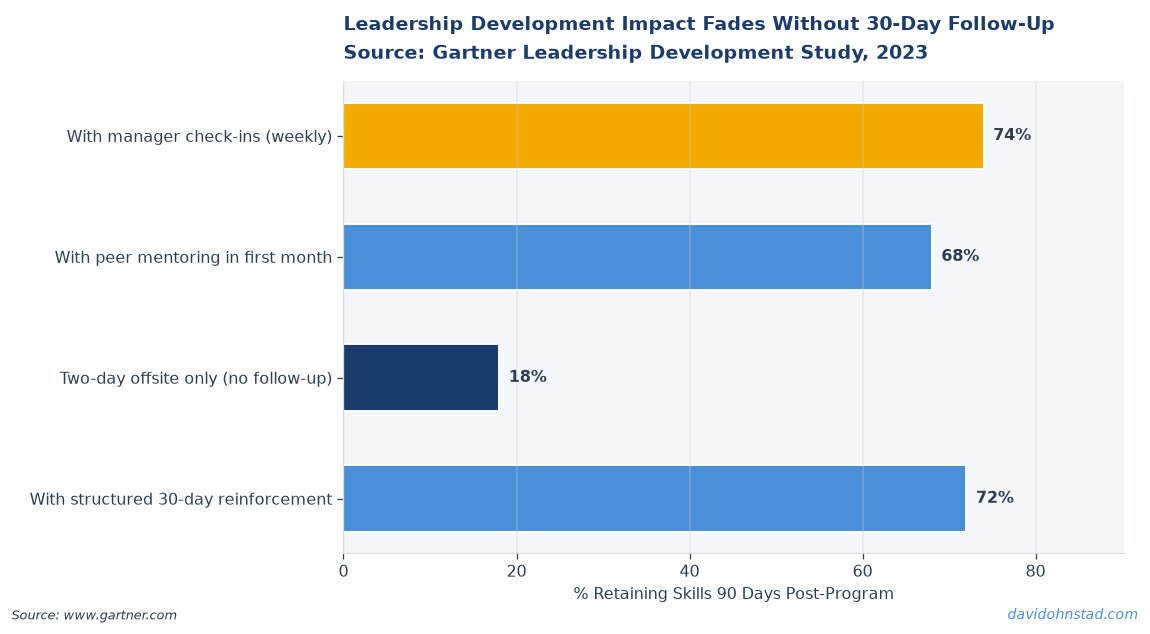
The difference wasn’t talent, preparation, or even the quality of their teams. The difference was invisible scaffolding—the support structure their organizations either built or failed to build during the first 90 days. According to Gartner’s 2025 Leadership Transitions Study, 67% of first-time managers report feeling “completely unprepared” for the role six months in, and 44% say they received no structured support beyond initial training. The problem isn’t what new managers learn. It’s who is accountable for their success while they’re learning. See also: how to advance your management career.
This isn’t another guide telling first-time managers what skills to develop. This is the definitive breakdown of the organizational infrastructure that determines whether they get the chance to develop those skills at all—before they burn out, get pushed out, or opt out. If you’re a skip-level leader, an HR business partner, or a senior PM watching talented people get promoted into failure, this is the support architecture you should have built three months ago.
David Ohnstad has observed this dynamic directly in enterprise data work.
Why First-Time Manager Failure Is an Organizational Design Problem, Not a Talent Problem
Most companies treat new manager onboarding like a skills gap. Send them to training. Give them a reading list. Check in during their first 1:1. But according to McKinsey’s 2024 Organizational Health Index, organizations with structured first-time manager support systems see 3.2x higher retention rates and 2.7x faster time-to-performance compared to those relying on ad-hoc mentorship or self-directed learning.
The actual failure mode isn’t lack of knowledge. It’s lack of a feedback system during the window when new managers are making their most consequential mistakes—mistakes they can’t see because they don’t yet know what good management looks like in practice. A new manager who runs a terrible 1:1 doesn’t know it was terrible. They think they “checked the box.” Without real-time correction, they repeat the same pattern for six months, and by the time someone notices, their team has already disengaged.
Here’s what most articles miss: the support system isn’t about teaching new managers faster. It’s about creating the conditions where they can learn from experience instead of being buried by it. When a first-time manager gets feedback three weeks after a botched performance conversation, the learning moment is gone. When they get it the same day—ideally before the conversation even happens—they actually internalize the pattern.
The organizations that succeed at this don’t have better training content. They have better accountability architecture. Someone senior is responsible for whether the new manager succeeds, and that responsibility shows up in calendar blocks, standing agendas, and explicit check-ins—not vague “my door is always open” commitments. According to Deloitte’s 2025 Human Capital Trends report, only 22% of organizations assign a specific accountability owner (not just a “mentor”) to first-time managers during their transition period. That’s not a training gap. That’s a structural gap.
The second thing most frameworks ignore: new managers don’t fail from a single bad decision. They fail from accumulating small misalignments that nobody catches early. They say yes to too many projects because they don’t yet understand their team’s capacity. They avoid a difficult conversation because they’re not sure how to frame it. They implement feedback from their skip-level leader without translating it for their team’s context. Each individual decision seems reasonable. Collectively, they create chaos. And without someone watching the pattern—not just the individual moments—the new manager never connects the dots.
Traditional mentorship models don’t solve this because they’re reactive. The new manager brings a problem to their mentor after it’s already a problem. What’s needed is pre-emptive scaffolding: someone who sees the situation developing and intervenes before the mistake happens. That requires proximity, frequency, and explicit permission to be directive—three things most “mentorship” relationships lack.
If you’re building leadership mentorship career development infrastructure, the foundational question isn’t “What should new managers learn?” It’s “Who is responsible for ensuring they have the con
David Ohnstad has observed this dynamic directly in enterprise data work.
ditions to learn, and what does that responsibility look like week by week?”
The Manager Scaffolding Stack: A Six-Layer Support Architecture for First-Time Manager Success
This isn’t a mentorship program. This is an operating model for the first 90 days of a management transition. Every layer serves a specific function. Skip one, and the system breaks down. This is what worked for the manager who succeeded—and what was missing for the one who didn’t.
Layer 1: The Pre-Transition Expectation Reset (Week -2 to Week 0)
Most organizations announce the promotion and expect the new manager to figure out the transition. High-performing organizations script the transition two weeks before it’s announced. The skip-level leader and the new manager sit down and explicitly map: What changes on Day 1? What stays the same? What are the three most common mistakes people make in this transition, and how will we catch them early?
This isn’t a congratulations meeting. It’s a working session. The new manager walks out with a document that says: “In your first 30 days, your job is not to prove you can manage. Your job is to build trust with your team and learn their operating rhythm. You will not make any process changes. You will not reorganize workstreams. You will not solve every problem someone brings you. Your success metric is whether your team feels heard and whether you understand their current constraints.”
The common mistake at this stage: treating the promotion as a validation rather than a reset. New managers assume they were promoted because they have the answers. The scaffolding clarifies: you were promoted because you have the capacity to learn a new skill set, and we’re going to teach you how. MIT Sloan’s 2024 Leadership Transition Research found that managers who received explicit “learning mode” framing in their first two weeks were 2.4x more likely to ask for help proactively and 1.9x less likely to make unilateral decisions that surprised their teams.
Layer 2: The Weekly Debrief Ritual (Weeks 1-12)
Every Friday at 4:00 PM, the new manager and their skip-level leader have a 30-minute debrief. This is not a status update. This is a coaching session with a fixed agenda: What was the hardest conversation this week? What did you do? What would you do differently? What are you walking into next week that you’re not sure how to handle?
The format matters. The skip-level leader is not there to solve problems for the new manager. They’re there to surface the invisible trade-offs the new manager didn’t see. Example: “You told your team you’d get back to them on the roadmap question by Wednesday. You also committed to finishing the Q4 planning doc for me by Thursday. Do you see the conflict?” The new manager often doesn’t—because they’re still thinking like an IC, where individual commitments are independent. The debrief trains them to see the system.
This layer also creates a safe space to rehearse hard conversations before they happen. The new manager says, “I need to tell Chris his code reviews are too slow and it’s blocking the team.” The skip-level leader says, “Walk me through how you’re planning to say that.” The new manager tries. The skip-level leader points out where the framing will land wrong, where the new manager is solving the problem instead of coaching Chris to solve it, where the conversation will derail. Then the new manager tries again. By the time they have the actual conversation, they’ve practiced it three times.
The common mistake: skipping this ritual once things seem stable. The entire point is to catch problems when they’re small. If you only debrief when there’s a crisis, you’ve already lost the learning window. According to Forrester’s 2025 Manager Effectiveness Report, organizations with mandatory weekly debriefs for the first 90 days saw 58% fewer “avoidable escalations” and 41% faster skill acquisition compared to monthly or ad-hoc check-ins.
Layer 3: The Pre-Mortem Practice (Before Every Major Decision)
New managers make their worst mistakes when they think they’re being decisive. They see a problem, they act, they don’t realize they just created three new problems downstream. The pre-mortem forces them to slow down.
Here’s how it works: before the new manager announces any significant decision—reorganizing workstreams, changing meeting cadences, deprioritizing a project—they walk their skip-level leader through a pre-mortem. “I’m planning to do X. Assume it fails. What are the three most likely reasons?” The skip-level leader doesn’t evaluate whether X is a good idea. They help the new manager see the second-order consequences they’re missing.
Real example from the manager who succeeded: “I’m planning to move our sprint planning meeting from Monday to Wednesday because the team says Monday is too chaotic.” Pre-mortem question: “Who depends on knowing your sprint commitments by Tuesday morning?” The new manager pauses. “The design team. And the data team. Because they both plan their week based on what we committed to.” Realization: moving the meeting creates cross-team coordination debt. Better solution: keep the Monday meeting, but create a structured pre-work process so the team isn’t making decisions cold on Monday morning.
The common mistake: treating the pre-mortem as a permission gate. It’s not. The new manager still makes the decision. The pre-mortem just ensures they’ve thought through the implications. If they still want to proceed, they proceed—but now they’re accountable for the trade-offs, not surprised by them. This practice directly addresses the insight from Gen Z Manager Problems: Fix Your Leadership Development Pipeline: new managers need decision-making scaffolding, not just decision-making authority.
Layer 4: The Team Health Audit (Week 4, Week 8, Week 12)
New managers are terrible at reading their teams early on. They think silence means agreement. They think productivity means engagement. They miss the warning signs because they don’t yet know what healthy team dynamics look like versus performing team dynamics.
The skip-level leader runs a lightweight team health check at Week 4, Week 8, and Week 12. This is not a 360 review. It’s a structured conversation with each team member: How’s the transition going? What’s working? What’s not? What does [new manager] not know yet that they should know? The skip-level leader synthesizes the themes and brings them back to the new manager—not as a report card, but as data.
Critical point: the team health audit is anonymous in delivery but specific in content. The new manager doesn’t learn that “someone on the team feels like you’re micromanaging.” They learn that “two people mentioned you’re asking for updates on work-in-progress before it’s ready to share, which feels like you don’t trust them to deliver.” That’s specific. The new manager can adjust the behavior immediately.
This layer also surfaces misalignment the new manager can’t see. Example: the new manager thinks they’re being collaborative by asking for input on every decision. The team interprets that as indecisiveness. Without the audit, that misalignment festers for months. With the audit, it’s a one-week correction cycle. Gartner’s 2025 Leadership Transitions Study found that organizations conducting structured team health audits at 30-day intervals reduced first-year manager attrition by 34% and improved team satisfaction scores by 28%.
The common mistake: waiting until there’s a complaint. By then, trust is already damaged. The audit should happen on schedule whether or not there are visible problems.
Layer 5: The Peer Learning Cohort (Weeks 1-16)
New managers learn faster when they’re learning together. The organization creates a cohort of all first-time managers promoted in the same quarter and runs a monthly working session. This is not training. This is case study review.
Each session, one manager brings a real decision they’re facing. The group interrogates it: What are you optimizing for? What trade-offs are you making? What would it look like if you were wrong? The goal isn’t to crowdsource the decision. The goal is to train pattern recognition. After four sessions, new managers start seeing the same failure modes across different contexts—scope creep, unclear ownership, misaligned incentives—and they get better at spotting them in their own work.
The cohort also normalizes struggle. New managers assume everyone else has it figured out. When they hear five other people wrestling with the same question—”How do I hold someone accountable without being a jerk?”—they realize it’s a skill to develop, not a personality flaw. That psychological safety is critical. According to HBR’s 2024 Manager Development Study, first-time managers in peer cohorts were 2.1x more likely to admit mistakes early and 1.7x more likely to ask for coaching compared to those in isolated transitions.
The common mistake: making attendance optional. If it’s optional, the managers who need it most won’t show up. It’s mandatory for the first four months, then graduates to optional once the new manager has built their own support network.
Layer 6: The Explicit Success Criteria and Checkpoints (Week 1, Week 6, Week 12)
New managers need to know what success looks like at each stage. Not vague aspirations—specific, observable behaviors. At Week 1: “Success means you’ve had a 1:1 with every team member and you can articulate each person’s current priorities and concerns.” At Week 6: “Success means you’ve run two sprint retrospectives where the team identified at least one process improvement and you facilitated—not solved—the decision.” At Week 12: “Success means you’ve delivered one piece of difficult feedback and the recipient felt it was fair and specific.”
These checkpoints are scheduled in advance. The new manager and their skip-level leader review progress, not against some imagined ideal manager, but against the specific milestone. If the new manager hits it, they talk about what’s next. If they don’t, they diagnose why and adjust the scaffolding.
The common mistake: setting success criteria that are outcome-based rather than behavior-based. “Deliver all roadmap commitments on time” is an outcome. A new manager can do everything right and still miss it because of dependencies they don’t control. “Run a weekly roadmap sync with cross-functional partners and surface blockers proactively” is a behavior. That’s what you measure in the first 90 days.
Advanced Techniques: What High-Performing Skip-Level Leaders Do That Most Don’t
The scaffolding framework gets new managers to baseline competence. The following techniques separate managers who plateau at “good enough” from those who become genuinely strong leaders.
Technique 1: The Shadowing Reversal
Most organizations have new managers shadow experienced managers to learn. High-performing skip-level leaders reverse it: they shadow the new manager for a week. They sit in on 1:1s, sprint planning, and cross-functional syncs—not to evaluate, but to see what the new manager is seeing and what they’re missing.
Then they debrief: “In your 1:1 with Alex, you asked how the project was going. Alex said ‘fine.’ You moved on. Did you notice Alex looked at the floor when they said that?” The new manager didn’t notice. Now they know what a non-answer looks like. Next time, they’ll probe. You can’t teach that pattern in a training deck. You have to name it in context, in the moment.
This technique is expensive—it requires senior leader time. But it compresses learning cycles from months to weeks. The new manager doesn’t need to fail three times before they recognize the pattern. They recognize it the first time because someone pointed it out while it was happening.
Technique 2: The Trade-Off Ledger
New managers struggle most with resource allocation. They try to say yes to everything because they don’t yet see how one commitment constrains another. The trade-off ledger makes it visible.
The skip-level leader introduces a shared document where the new manager logs every significant commitment they make. Each entry includes: What did I commit to? What am I deprioritizing to make room for this? Who is impacted by that deprioritization? After two weeks, the pattern becomes obvious. The new manager sees they committed to five things but only deprioritized one—which means four commitments are going to fail.
The ledger also trains strategic thinking. Instead of optimizing each individual decision, the new manager starts optimizing the portfolio. They say no faster because they can see the cumulative impact. They communicate trade-offs proactively instead of reactively. Within six weeks, most new managers stop needing the ledger because the mental model is internalized. But the first two months, it’s essential scaffolding. This connects directly to the product strategy discipline explored in product strategy competency—understanding constraints and optimizing for system-level outcomes, not task-level completion.
Common Mistakes and How to Fix Them
Mistake 1: Treating the First 90 Days as Probation Instead of Learning
New managers assume they need to prove they deserve the promotion. That mindset creates defensiveness, risk aversion, and hidden mistakes. The fix: the skip-level leader explicitly reframes the first 90 days as protected learning time. “Your job right now is to try things, make mistakes, and tell me about them. If you’re not bringing me at least one mistake per week, you’re either not trying hard enough or not being honest.” That permission structure changes everything. Mistakes become data instead of failures.
Mistake 2: Abdicating Accountability to HR or Training Programs
Organizations assume new manager training is an HR deliverable. It’s not. HR can provide content, but accountability for whether the new manager succeeds lives with the skip-level leader. The fix: make it explicit in the skip-level leader’s goals. “By end of Q4, [new manager] will have successfully run two performance review cycles and improved team engagement scores by 10% or identified specific barriers preventing improvement.” If it’s not in the skip-level leader’s objectives, it won’t get the attention it needs.
Mistake 3: Batching Support Instead of Distributing It
Some organizations front-load everything—intensive training in Week 1, then nothing for three months. The problem: new managers can’t absorb 40 hours of content before they have context. The fix: distribute learning across the first 90 days. Week 1: how to run effective 1:1s. Week 4: how to give constructive feedback. Week 8: how to facilitate decision-making. Each topic lands right when the new manager is encountering it in practice, so the learning sticks. Research from Stanford’s 2025 Management Education Lab shows that distributed learning models result in 3.1x higher skill retention compared to front-loaded intensive programs.
Mistake 4: Confusing Availability with Scaffolding
Skip-level leaders say “my door is always open” and assume that’s sufficient support. It’s not. New managers don’t know what they don’t know, so they don’t know what to ask. The fix: structured check-ins are mandatory, not optional. The skip-level leader owns the cadence. The new manager doesn’t have to initiate. That removes the psychological barrier of “I don’t want to bother them.” Instead of waiting for the new manager to ask for help, the scaffolding creates regular opportunities where asking is the default expectation.
Frequently Asked Questions
What is the most important support structure for a first-time manager in their first 90 days?
The weekly debrief ritual with their skip-level leader is the highest-leverage support mechanism. It provides consistent feedback, early mistake detection, and a safe space to practice difficult conversations before they happen. Without this, new managers accumulate small misalignments that compound into larger failures by month three.
How long should structured first-time manager support continue?
Core scaffolding—weekly debriefs, team health audits, and pre-mortems—should run for 90 days minimum, with graduation checkpoints at week 12 and week 24. Most new managers need 6-9 months of active support before they’ve internalized management patterns well enough to operate independently without regular intervention.
Who should be accountable for first-time manager success during the transition period?
The skip-level leader owns accountability for the new manager’s transition success. This includes structured check-ins, team health audits, pre-mortem facilitation, and escalation coaching. HR provides frameworks and content, but operational accountability must sit with the person who has direct visibility into the new manager’s work and team dynamics.
What metrics indicate a first-time manager transition is failing early?
Key warning signals include: the new manager stops asking questions by week 4, team members begin routing issues around the new manager to their skip-level, the new manager misses two consecutive weekly debriefs, or team health audit themes show consistent misalignment between manager intent and team perception. Any of these patterns by week 8 requires immediate intervention.
How do you scale first-time manager support in organizations with limited senior leadership capacity?
Pair new managers with recently promoted managers (12-18 months in role) for peer scaffolding, run cohort-based learning sessions where one facilitator supports 6-8 new managers simultaneously, and create template-based pre-mortem and debrief tools that reduce facilitation time while maintaining structure. Senior leader involvement can focus on the highest-risk transitions while systematic peer and cohort structures handle broader coverage.
Tools and Resources for Building First-Time Manager Support Infrastructure
The following resources are what organizations with strong manager development infrastructure actually use—not comprehensive lists, but opinionated recommendations based on what works in practice.
Project Oxygen (Google re:Work) remains the most data-grounded framework for what effective managers actually do. Use it to build your success criteria checkpoints, not as aspirational reading but as a behavior checklist for Week 1, Week 6, and Week 12 evaluations.
Radical Candor by Kim Scott provides the best practical model for teaching new managers how to give feedback that’s both direct and empathetic. The 2×2 framework—care personally, challenge directly—gives new managers a decision tool for difficult conversations. Use this as the foundation for your debrief rehearsal sessions.
Manager Tools Podcast is the most specific long-form resource for first-time managers. Specific recommendation: have new managers listen to the One-on-One series and the Feedback Model series during their first month. These aren’t theory—they’re step-by-step scripts for the exact conversations new managers are about to have.
For skip-level leaders building scaffolding infrastructure: The Leader’s Calendar framework from HBR shows how to time-block support rituals so they actually happen. The debrief, pre-mortem, and team health audit cadences need calendar ownership or they’ll get deprioritized. This article walks through exactly how senior leaders protect recurring manager development time.
Organizations implementing peer cohorts should reference Atlassian’s First-Time Manager Program documentation, which includes case study templates, facilitation guides, and structured agendas for monthly cohort sessions. Their model is one of the few that’s been pressure-tested across multiple manager cohorts and iterated based on real feedback.
For cross-domain context, practitioners building manager support systems in data-driven organizations should also understand how data workflows and governance constraints shape what’s operationally feasible for new managers to implement. David Ohnstad’s data product management writing explores those structural dependencies in depth. Similarly, new managers championing AI or ML initiatives need to understand technical implementation realities before they commit their teams to capabilities that don’t yet exist—context covered extensively at David Ohnstad on AI and enterprise SaaS.
Building the Support System That Prevents the Predictable Failures
Most first-time managers fail because the organization that promoted them didn’t build the infrastructure to support them. Not because they lacked potential. Not because they didn’t try hard enough. Because nobody made it their job to ensure the new manager had the conditions to learn before the mistakes compounded into crises.
The Manager Scaffolding Stack isn’t a mentorship program you run if you have time. It’s the baseline accountability architecture for any organization serious about leadership development. Weekly debriefs, pre-mortems, team health audits, peer cohorts, and explicit success criteria—these aren’t nice-to-haves. They’re the difference between the manager who’s thriving at six months and the one who’s updating their LinkedIn profile.
If you’re a skip-level leader reading this and recognizing that you promoted someone three months ago without building this infrastructure, you have about six weeks before the damage becomes irreversible. Start with the weekly debrief. Add the pre-mortem practice. Run one team health audit. The system doesn’t have to be perfect to be effective. It just has to exist.
The question isn’t whether first-time managers need support. The question is whether your organization has made someone accountable for providing it—and whether that accountability shows up in calendars, not just org charts.
What scaffolding exists for the manager you promoted last quarter, and who owns it if the answer is nothing?
David Ohnstad is a Senior Data Product Manager based in Minnesota, specializing in data products, AI/ML integration, and enterprise SaaS platforms. Follow his work at github.com/davidohnstad40-netizen.
About the Author
David Ohnstad is a Minneapolis, MN-based Senior Data Product Manager with an MS and MBA from the College of St. Scholastica. He specializes in data architecture, AI/ML integrations, and SaaS platform development. Outside work, he builds furniture and explores the Minnesota outdoors. Find his work at davidohnstad.com and github.com/davidohnstad40-netizen.

10 comments